

























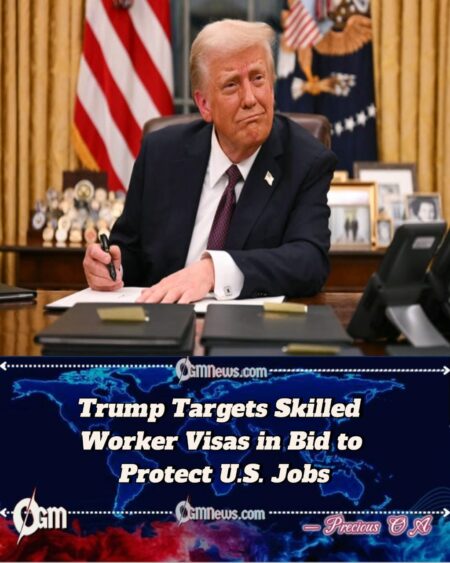
President Trump, currently serving his second term, is preparing to sign a proclamation that would impose a $100,000 application fee on H-1B visas, in what his administration describes as a decisive effort to protect American workers. The measure represents one of the most significant overhauls of the high-skilled visa system in decades, setting the stage for a heated debate between business leaders, labor advocates, and policymakers.
The H-1B program, a longstanding pathway for U.S. employers to hire foreign professionals in critical industries, particularly in science, technology, engineering, and mathematics (STEM), has often been at the center of controversy. Proponents view it as a lifeline for industries facing shortages of skilled labor, while critics argue it has been exploited to displace American workers and drive down wages.
Trump Administration’s Vision for Reform
Trump is framing the new policy as a correction to years of what he calls systemic abuse in the visa system. Administration officials argue that many outsourcing firms have flooded the application process, securing large numbers of visas and then contracting workers to third-party companies, often at lower wages than U.S. counterparts. By raising the cost of applications so sharply, the administration hopes to discourage speculative or bulk filings and limit visas to employers with genuine labor shortages.
Trump has repeatedly emphasized his “America First” agenda, which prioritizes domestic job creation across all sectors. In the case of H-1B visas, the White House believes that tightening access will open opportunities for American graduates, particularly in high-demand technical fields. Officials further note that the $100,000 fee could generate significant revenue, potentially funding workforce development programs and training initiatives.
Trump will sign the proclamation as early as today, underscoring his administration’s urgency in implementing measures designed to reshape the U.S. labor market.
Business Leaders Express Concern
Trump’s proposal has sparked alarm within the technology industry, where reliance on international talent is substantial. Companies in Silicon Valley and other tech hubs argue that the domestic supply of workers with advanced technical expertise is insufficient to meet demand. Industry leaders warn that the new fee could make it prohibitively expensive for smaller firms and start-ups to hire specialized workers from abroad.
Critics contend that such a steep fee will not only disadvantage emerging companies but also risk driving international talent to competitor nations such as Canada, Germany, and Australia, which have actively expanded visa access to attract skilled workers. For global corporations with multinational options, shifting research and development operations abroad may become a more attractive alternative to absorbing the added costs in the U.S.
Trump’s critics in the business community argue that while protecting jobs is important, a blanket fee of this size risks undermining U.S. competitiveness in technology, medicine, and other high-skill sectors. They suggest more targeted reforms would be more effective than sweeping cost increases.
Labor Groups and Domestic Workforce Advocates
Trump has also received support from certain labor organizations and workforce advocates who argue that the visa system, as currently designed, disadvantages American workers. They claim that large outsourcing firms often secure thousands of visas, then contract foreign workers to U.S. companies at lower wages, creating downward pressure on salaries for domestic employees.
By introducing a fee so substantial, the administration believes it can curb excessive filings by such firms, while encouraging employers to prioritize American candidates. Proponents of the change argue that companies will have stronger incentives to invest in local training and education programs, helping address skill shortages without heavy reliance on foreign workers.
Trump’s allies in Congress have echoed this sentiment, suggesting that protecting domestic workers remains central to broader economic recovery goals.
Political and Economic Implications
Trump’s move fits into a broader pattern of immigration policy reform aimed at reshaping U.S. labor markets. Previous measures from the administration have tightened eligibility standards, increased scrutiny of applications, and restricted pathways for work authorizations. The $100,000 fee, however, is unprecedented in scale and signals a much more aggressive step.
Analysts suggest the measure could test the administration’s relationship with the business community, which has generally supported the president’s tax and deregulation policies but has voiced unease over his immigration stance. The fee could also become a flashpoint in upcoming congressional debates, with lawmakers divided along both party and regional lines. States heavily dependent on technology and research industries may push back, while others with large domestic labor pools may support the measure.
Trump, however, appears undeterred, framing the policy as a fulfillment of his promise to prioritize American workers.
International Repercussions and Future Outlook
Trump’s decision may also carry global consequences. For decades, the U.S. has been a primary destination for skilled workers, attracting talent from India, China, and other nations that heavily rely on H-1B opportunities. Restricting access through steep fees may prompt skilled professionals to pursue opportunities elsewhere, altering the flow of global talent and potentially reducing the U.S.’s edge in innovation.
Immigration experts caution that once top talent begins shifting toward other nations, it may be difficult to reverse the trend. This could have long-term implications for U.S. leadership in areas such as artificial intelligence, biotechnology, and advanced engineering. Trump’s supporters argue that these risks are outweighed by the potential benefits of a stronger domestic labor force. They insist the move will create a more level playing field for American workers who have long faced competition from visa holders.
Trump is therefore poised to fundamentally reshape the H-1B visa landscape with his new proclamation, introducing a fee structure that could redefine how businesses and workers approach skilled immigration. Supporters view it as a necessary step to protect American jobs, while critics warn of serious economic and innovation setbacks. As the measure awaits the president’s signature, the United States finds itself at a crossroads in balancing economic competitiveness with workforce protection. What is clear is that the $100,000 H-1B fee will ignite one of the most consequential debates on immigration and labor policy in recent years.

Logging in is a breeze and the site stability is amazing even during peak hours....