


























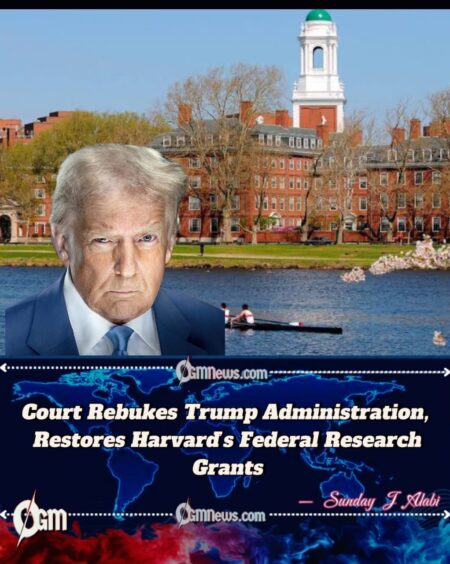
A federal judge delivered a significant blow to the Trump administration Wednesday, ruling that its decision to freeze nearly $2 billion in federal grants to Harvard University violated the institution’s First Amendment rights and federal law. The decision represents a major victory for the Ivy League university in its ongoing legal battle with the current administration over campus antisemitism policies.
Court Finds Trump Administration Used Antisemitism as “Smokescreen” for Ideological Attack
U.S. District Judge Allison Burroughs issued a scathing 84-page ruling that characterized the Trump administration’s actions as a “targeted, ideologically-motivated assault” on the nation’s premier universities. The judge found that while Harvard had indeed been “plagued” by antisemitism in recent years and should have done more to address the issue, there was “little connection between the research affected by the grant terminations and antisemitism.”
Burroughs wrote that the administration used antisemitism concerns as a “smokescreen” for actions that violated the Administrative Procedure Act, the First Amendment, and Title VI of the Civil Rights Act. The judge emphasized that the administration’s conduct jeopardized decades of research and disregarded constitutional protections.
The ruling specifically noted that none of the letters sent by the Trump administration to Harvard “identified any specific instance of antisemitism on Harvard’s campus” or specified how the university had failed to respond to such acts in violation of Title VI requirements. This procedural failure became a key element in the court’s decision to block the funding freeze.
Trump Administration Vows Appeal, Calls Judge “Activist”
The White House responded swiftly to the adverse ruling, with Assistant Press Secretary Liz Huston announcing the administration’s intention to appeal the decision. In a statement that criticized the judge personally, Huston characterized Burroughs as an “activist Obama-appointed judge” who was predetermined to rule in Harvard’s favor regardless of the evidence presented.
The administration maintained its position that Harvard had failed to protect Jewish students from harassment and discrimination on campus. Huston emphasized that the university “does not have a constitutional right to taxpayer dollars” and stated that Harvard would remain ineligible for future grants.
The White House expressed confidence in ultimately prevailing on appeal, framing the dispute as part of ongoing efforts to hold Harvard accountable for its handling of campus antisemitism. This response signals that the legal battle between the administration and the university is far from over.
Timeline of Escalating Conflict Between Administration and University
The current legal dispute began in April when the Trump administration sent Harvard leaders a letter containing specific demands regarding the university’s antisemitism policies. After Harvard rejected these terms, administration officials announced the freezing of more than $2.2 billion in grants and contracts to the institution.
Subsequently, Harvard received termination letters from nine separate federal agencies canceling various research grants. The administration’s punitive actions extended beyond funding cuts, with President Trump also threatening to revoke the school’s tax-exempt status.
Harvard responded by filing a lawsuit against the Trump administration in April, characterizing the funding freeze as part of a broader “pressure campaign” designed to force the university to submit to governmental control over its academic programs and campus speech policies. The university argued that the administration was attempting to dictate its response to anti-Israel speech on campus.
Judge Characterizes Actions as “Government-Initiated Onslaught”
In her comprehensive ruling, Judge Burroughs described the Trump administration’s campaign against Harvard as a “government-initiated onslaught” that prioritized promoting governmental orthodoxy over legitimate concerns about antisemitism. The judge found that the administration’s true motivation was retaliatory rather than protective of Jewish students.
Burroughs acknowledged that Harvard had been “wrong to tolerate hateful behavior for as long as it did” but determined that fighting antisemitism was not the administration’s genuine objective. The judge emphasized that even legitimate concerns about discrimination cannot justify violations of First Amendment protections.
The ruling highlighted that Harvard was currently taking steps to combat antisemitism and appeared willing to do more if necessary. Burroughs positioned the court’s intervention as necessary to protect academic freedom and ensure that important research would not be subjected to arbitrary terminations based on political motivations.
Broader Pattern of Administrative Actions Against Harvard
The funding freeze represents just one element of the Trump administration’s broader campaign against Harvard University. The administration has also targeted the institution’s ability to enroll international students, prompting another lawsuit that resulted in a separate court victory for Harvard in June.
Judge Burroughs had previously blocked the Trump administration from revoking Harvard’s ability to enroll foreign students, a decision that the Justice Department has appealed. These multiple legal fronts demonstrate the comprehensive nature of the administration’s pressure campaign against the university.
The conflict escalated further in August when the Trump administration signaled potential plans to seize control of Harvard’s patents stemming from federally funded research. This threat represents yet another avenue through which the administration has sought to pressure the institution into compliance with its demands.
Implications for Academic Freedom and Federal Research Funding
The court’s decision carries significant implications for the relationship between federal funding and academic freedom at American universities. Judge Burroughs’ ruling establishes important precedent regarding the limits of governmental authority to terminate research funding based on disagreements over campus policies unrelated to the research itself.
The decision emphasizes that federal agencies cannot arbitrarily cancel research grants without following proper procedural requirements and demonstrating legitimate connections between funding decisions and program violations. This protection extends particularly to situations where political motivations may be driving administrative actions.
For Harvard and other research institutions, the ruling provides crucial protection against what the court characterized as ideologically motivated funding decisions. However, the Trump administration’s stated intention to appeal ensures that these questions will continue to work their way through the federal court system, potentially reaching higher appellate levels where different conclusions might be reached.

[…] […]