

























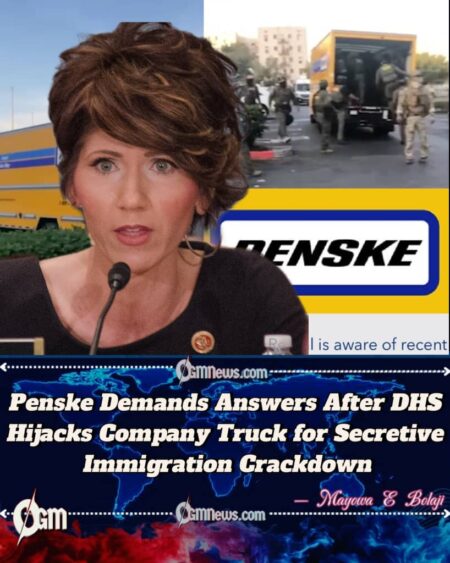
Penske’s has issued a sharply worded statement distancing itself from the Trump administration’s Department of Homeland Security (DHS) following the unauthorized use of one of its branded trucks during an immigration raid in Los Angeles. The transportation services company stressed it “strictly prohibits the transportation of people in the cargo area of its vehicles under any circumstances.”
Penske emphasized it was “not made aware that its trucks would be used in today’s operation and did not authorize this.” The company pledged to engage DHS directly to reinforce corporate policy and prevent future misuse. The firm’s swift response marked a rare and public rebuke of a federal agency by a major American corporation.
Penske Truck at Center of Controversial DHS Operation
Penske found itself at the center of national controversy after its vehicle was used in what Border Patrol dubbed “Operation Trojan Horse” — a sting operation conducted in the early hours at a Home Depot parking lot in Westlake, Los Angeles. Masked DHS agents reportedly hid in the back of a Penske box truck, emerging suddenly to detain immigrant workers.
Penske trucks, typically associated with routine moves and logistical operations, were used deceptively in this case to create a false sense of security for the day laborers. Eyewitnesses, including a man named Ceasar, described how the truck’s arrival gave no indication of danger — until it was too late.
Penske’s Name Dragged into Viral Immigration Crackdown
Penske trucks became the unexpected face of a viral firestorm after videos of the raid spread rapidly across social media. The footage showed frightened day laborers running for cover as agents in tactical gear burst from the truck and began apprehending workers in what appeared to be an aggressive ambush.
Penske trucks — typically a symbol of domestic mobility and enterprise — were instead portrayed in the footage as instruments of entrapment. The company’s brand was instantly associated with federal enforcement, prompting immediate reputational risk that the company acted quickly to mitigate.
Penske Reiterates Zero Tolerance for Unauthorized Use
Penske reiterated its zero-tolerance policy regarding the misuse of its rental vehicles, noting that the incident violates the fundamental trust between the company and its customers. It stressed that transporting people in cargo compartments is not only dangerous but strictly against company policy and safety standards.
Penske has also indicated it is evaluating its legal and contractual safeguards with federal agencies. Industry insiders suggest the company could move to enforce stricter clauses in its rental agreements or explore litigation if the government refuses to comply with corporate usage terms.
Penske’s Statement Spurs Broader Corporate Accountability Discussion
Penske has inadvertently ignited a larger discussion about corporate responsibility in politically charged enforcement actions. The company’s prompt public condemnation was hailed by immigrant rights groups as an act of ethical leadership, setting an example for how private enterprises should respond when dragged into controversial government operations.
Penske may now serve as a case study for crisis management and brand protection in the age of viral outrage and digital activism. Analysts note that its decision to denounce the government — rather than remain neutral — was a calculated but principled move.
Penske Pushes Back as Trump Administration Defends Tactics
Penske’s rebuke comes as the Trump administration continues to double down on its harsh immigration enforcement strategy. DHS has remained silent on the company’s statement, while Border Patrol Sector Chief Greg Bovino justified the raid as “a lawful effort to protect American jobs.”
Penske, however, has made clear it wants no association with these tactics. The company’s swift and unequivocal condemnation stands in stark contrast to the administration’s unapologetic tone, highlighting a growing divide between private enterprise and government policy under Trump’s second term.
Penske’s Future Involvement With Federal Agencies Under Review
Penske is reportedly reviewing its future involvement with federal agencies, especially those tied to immigration enforcement. Legal experts suggest the company may push for new clauses in its contracts or avoid certain partnerships altogether if such misuse is repeated or left unaddressed.
Penske could also face pressure from shareholders and customers to strengthen safeguards, as the public grows increasingly sensitive to corporate complicity in civil rights violations. The company’s leadership is said to be working closely with legal and public relations teams to ensure its policies reflect both ethical standards and public expectations.
Penske Faces No Backlash—Yet Earns Praise for Its Swift Response
Penske has so far avoided major backlash, with most public commentary praising the company’s decisive stance. Industry commentators commended Penske for not adopting a neutral or evasive position, which might have further harmed its reputation among increasingly values-driven consumers.
Penske’s proactive response, combined with its firm corporate policies, has placed it on the side of transparency and accountability at a time when public trust in both government and big business is fragile. The company may emerge from the crisis not only unscathed but strengthened in its commitment to ethical operations.
Penske’s Message: We Will Not Be Used as Tools of Oppression
Penske has made its final position unmistakably clear: the company will not allow its brand or equipment to be weaponized for clandestine or abusive government actions. By publicly confronting DHS and distancing itself from “Operation Trojan Horse,” Penske has drawn a red line against the misuse of corporate assets for authoritarian-style enforcement.
Penske’s stance sends a powerful message — to customers, to federal agencies, and to corporate America at large: the private sector has a role to play in defending democratic values and ensuring that business is not used as a silent accomplice in state overreach.


[…] […]