




























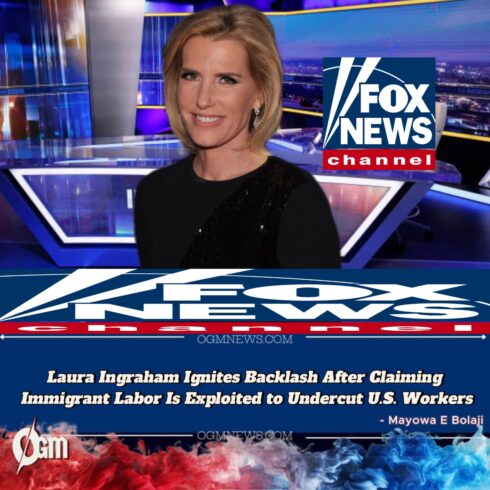
Laura Ingraham, conservative commentator and Fox News host has sparked a national conversation after forcefully rejecting what she calls “one of the most insulting lies” in U.S. labor politics: that Americans are unwilling to work in so-called “undesirable” jobs. Her personal testimony, shared during a primetime broadcast, pushed back against pro-mass immigration arguments that claim low-wage labor sectors would collapse without foreign workers.
Citing her own family’s working-class roots in the 1970s, Ingraham painted a vivid picture of an America where dignity in labor transcended job titles. “We delivered newspapers, waited tables, cut grass, picked fruit—whatever it took,” she said, adding, “To say Americans won’t do these jobs is an elite fantasy that insults generations of workers.”
A Family That Worked: Ingraham’s Personal Story Strikes a Nerve
Ingraham’s remarks were not simply political rhetoric; they were deeply personal. She recalled how her mother worked as a waitress for over 25 years, raising children on grit and tips. Her brothers, she said, did everything from picking tobacco and blueberries to working fast food and caring for neighbors’ kids.
“It wasn’t glamorous. But it was honest,” Ingraham said. Her story quickly resonated across social media, especially among middle- and working-class Americans who saw their own histories reflected in hers. Commentators noted the power of personal narrative in highlighting often-overlooked truths about the American workforce.
Debunking the ‘Jobs Americans Won’t Do’ Myth
Ingraham’s comments revived long-simmering debates about labor, immigration, and cultural perception. For decades, politicians and economists have justified lax border policies and large guest worker programs by claiming that Americans refuse to work in agriculture, hospitality, construction, or caregiving industries.
However, labor advocates argue this is a false binary. “Americans will do these jobs,” said labor analyst Sarah Fremont. “They just won’t accept being underpaid, exploited, or deprived of protections—conditions too common in sectors flooded by illegal or low-wage immigrant labor.”
Criticism of Political Elites and Corporate Interests
Ingraham also took aim at Washington elites and corporate donors who, she says, benefit from the devaluation of American labor. “They outsource jobs and import cheap labor, then lecture hard-working families about ‘compassion,’” she charged. “But the compassion always seems to benefit the employers, never the workers.”
Economists note that corporate interests often resist wage hikes and workplace reforms by pointing to immigrant labor as a pressure release valve. “It’s a race to the bottom,” said Professor Harold Kline of Georgetown University. “This isn’t about jobs Americans won’t do—it’s about jobs Americans can’t afford to take at the current terms.”
White House Responds Cautiously as Pressure Mounts
When asked about Ingraham’s comments, White House Press Secretary Jenna McKnight gave a measured response. “The president supports American labor and believes every citizen deserves a fair wage and opportunity,” she said. While not directly addressing Ingraham’s critique, her comments underscored the sensitivity of immigration policy during President Trump’s second term.
Sources within the administration say internal discussions are ongoing about tightening visa programs and increasing wage requirements for foreign labor. A senior advisor anonymously stated, “President Trump wants Americans first—not as a slogan, but as a standard.”
Democrats and Activists Push Back: “Oversimplifying a Complex Issue”
Progressive lawmakers and immigration activists quickly pushed back against Ingraham. Rep. Joaquin Castro (D-TX) called her remarks “tone-deaf,” arguing that immigrants “fill critical labor gaps and contribute billions to the economy.” Others claimed Ingraham’s anecdotes ignore structural inequalities that make certain jobs unattractive.
Immigration advocate Maria Tovarez said, “This is not just about wages—it’s about access, mobility, and protection. Many Americans don’t even hear about these job openings because labor recruiters target migrant communities specifically.”
Social Media Reactions: Praise, Pushback, and Personal Stories
The internet lit up following Ingraham’s segment, with thousands of Americans sharing their own stories under hashtags like #WeWorkedToo and #RealJobsRealPeople. From former janitors to retired farmhands, the message was clear: “We did those jobs, and we still would—just pay us fairly.”
However, critics accused Ingraham of glorifying hardship or romanticizing poverty. One viral post read: “Picking blueberries as a kid is not a public policy. It’s survival. We deserve better.” The polarized response underlined the cultural divide surrounding labor, dignity, and opportunity.
The Future of American Labor in a Changing Economy
As the U.S. economy undergoes technological transformation, demographic shifts, and post-pandemic adjustments, the question of who does what work—and under what conditions—remains central. Analysts warn that unless wage growth and labor protections improve, both citizens and immigrants may continue to be trapped in a cycle of underemployment and dependency.
Ingraham’s intervention may not offer a policy roadmap, but it has undoubtedly reignited a national conversation. “Respect the work and respect the worker,” she concluded. “That’s how you rebuild the middle class—and the country.”
A Cultural Reckoning with Work, Worth, and Who We Value
Ingraham’s emotional plea may have been rooted in memory, but it landed in a nation still grappling with questions about equity, identity, and the dignity of labor. Whether the political class will absorb or deflect her challenge remains to be seen—but the millions of Americans who saw themselves in her words may prove a force too powerful to ignore.

[…] […]