





























Mark Carney, Canada’s Prime Minister, confirmed on Sunday that his government has officially suspended plans to implement a digital services tax targeting American tech firms. The announcement marks a dramatic shift in Canada’s economic diplomacy and signals a reopening of high-level trade negotiations with the United States.
Carney described the move as “strategic and forward-looking,” emphasizing that Canada must protect its broader economic interests even if it means pausing policies with strong public support. “This is about more than taxation,” Carney stated. “This is about ensuring Canada remains a reliable, stable trade partner and avoids unnecessary retaliation from our largest ally.”
Mark Carney Acknowledges Pressure from President Trump
Mark Carney acknowledged that sustained pressure from the Trump administration influenced his decision to pull back. According to the Prime Minister, several private messages and formal warnings from the White House emphasized that the proposed tax would “trigger swift and damaging retaliation.”
Carney revealed that President Trump had personally raised the issue during a bilateral phone call, warning that tariffs on Canadian exports were “not off the table.” Carney, known for his economic acumen, concluded that prolonging the standoff would risk far greater harm to Canada’s economy than the tax’s anticipated revenue.
Mark Carney Defends Policy Reversal as Economic Safeguard
Carney defended his government’s reversal by stressing the economic logic behind the decision. He said Canada could not afford to jeopardize billions in cross-border trade for the sake of a $1 billion-per-year digital levy. “Economic stability must come first,” he insisted.
Carney argued that a retaliatory spiral, particularly involving the automotive, agriculture, and aluminum sectors, would damage supply chains and cost Canadian jobs. “We have always said we would act in the national interest,” Carney stated. “And today, that means preventing a trade war.”
Mark Carney Sets New Tone for Trade Talks
Mark Carney announced that trade talks with the United States will resume in Washington next week, focusing on long-standing economic irritants and 21st-century challenges like digital commerce and carbon border adjustments. He characterized the renewed talks as a “reset opportunity.”
Carney emphasized that Canada is returning to the negotiating table with “good faith and clear priorities.” He promised a push for fair rules governing cross-border data flows and digital taxation through multilateral bodies like the OECD, rather than unilateral national measures.
Mark Carney Faces Political Blowback at Home
Carney is now contending with fierce political backlash from domestic critics who see the suspension of the tax as a capitulation. Opposition leader Pierre Poilievre accused him of “kneeling before Washington” and abandoning a chance to assert Canadian digital sovereignty.
Carney responded to the criticism by calling it “shortsighted populism,” arguing that leadership sometimes requires “uncomfortable but necessary decisions.” He insisted the policy was “paused, not scrapped” and would be revisited in a global context once trade tensions have cooled.
OGMNews.COM
Canadian PM, Mark Carney Surrenders to Silicon Valley: Digital Tax Pulled After U.S. Threats
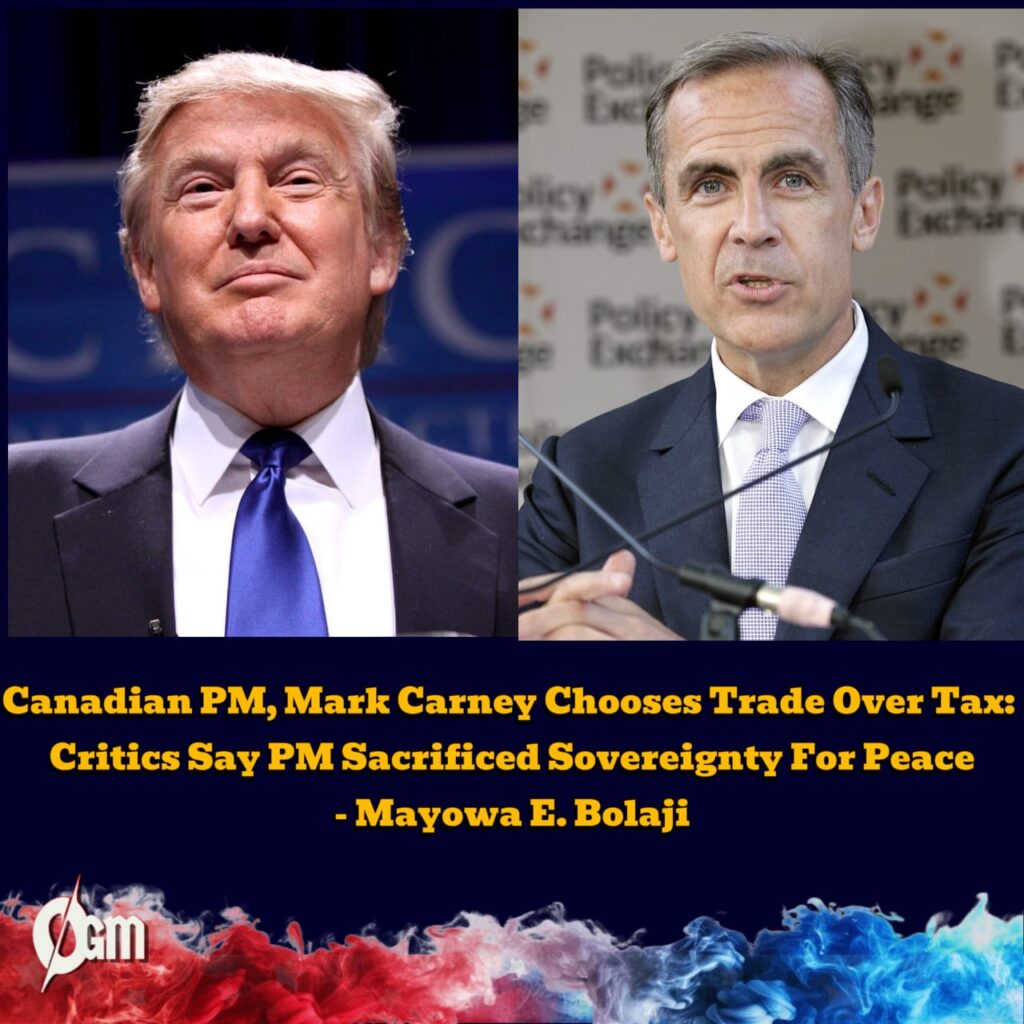
Mark Carney acknowledged that lobbying from major American tech companies played a role in shaping his government’s decision. Industry executives had warned of reduced investment in Canada and possible job cuts if the tax moved forward.
Carney said the involvement of companies like Google and Amazon only underscored the complexity of taxing multinational digital firms. “These are not just economic actors—they are geopolitical ones,” he said. “We must confront them as a coalition of nations, not alone.”
Mark Carney Weighs Fiscal Impact of Retreat
Mark Carney admitted that the decision to halt the digital tax would create a shortfall in projected federal revenue but argued that it was a small price to pay to preserve trade harmony. “Fiscal resilience means understanding when to pull back,” he said.
insisted that alternative revenue sources and spending discipline would make up for the lost $1 billion annually. He also hinted that Canada may explore digital regulation and licensing fees as a softer path toward holding tech companies financially accountable.
Mark Carney Looks to OECD for Long-Term Solution
Carney affirmed his commitment to a global digital tax regime under the OECD framework, saying unilateral actions risk fragmentation and conflict. “Canada will lead where we can and collaborate where we must,” he declared.
Carney closed his remarks by framing the suspension not as a retreat, but as a pivot toward consensus-based policy-making. “The tax will return, but it will return through the right door—with allies, not enemies.”
Mark Carney’s Political Calculus Amid Election Speculation
Carney is widely rumored to be preparing for a potential snap election later this year. Analysts believe this latest move reflects a desire to appear both globally minded and economically cautious to centrist voters.
Carney brushed aside election speculation, saying, “This decision was not political—it was patriotic. When the stakes are this high, leadership demands discipline.” Whether Canadians buy that message remains to be seen.

Ae888covenuscasino, okay, I'm curious. Gonna check out this site and try to find some amazing...