




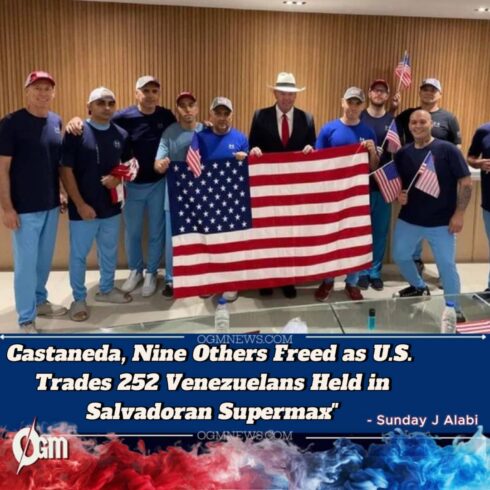
Ten American citizens held in Venezuela were released on Friday, July 18, 2025, in a complex prisoner exchange involving the United States, Venezuela, and El Salvador. Secretary of State Marco Rubio announced the development in a press briefing, hailing the operation as a “major diplomatic and humanitarian breakthrough.”
The Americans were exchanged for 252 Venezuelan nationals who had previously been deported from the U.S. and detained in a Salvadoran supermax prison known as the Terrorism Confinement Center (CECOT). These detainees were alleged to be members of the violent transnational gang, Tren de Aragua. The exchange also included the release of dozens of Venezuelan political prisoners, according to senior U.S. officials.
The deal, first proposed by El Salvador in April, came together in the final hours, with sources describing it as a “down-to-the-wire” arrangement. Venezuelan officials reportedly delayed the departure of the flight as a show of force before eventually greenlighting the operation.
Navy SEAL Among Freed Americans
One of the most high-profile detainees released was Wilbert Joseph Castaneda, a former U.S. Navy SEAL, who had been held in Venezuela since 2024. Castaneda was detained during what his family described as “personal travel,” which the U.S. government had strongly advised against due to the risks of wrongful imprisonment.
“We have prayed for this day for almost a year,” Castaneda’s family said in a public statement. “My brother is an innocent man who was used as a political pawn by the Maduro regime.” They further noted that Castaneda had suffered multiple traumatic brain injuries during his 18-year service in the military, impairing his judgment and likely influencing his decision to travel to Venezuela.
All 10 Americans were photographed shortly after their release with U.S. diplomat John McNamara. The U.S. Embassy in Venezuela confirmed their safe passage and posted a photo of the group on its official X (formerly Twitter) account.
Trump-Era Deportations Triggered the Crisis
The roots of this prisoner swap trace back to the Trump administration’s decision in March 2025 to deport more than 200 Venezuelan nationals to El Salvador under the Alien Enemies Act, a wartime law from the 18th century. The migrants were deemed a national security threat due to suspected affiliations with Tren de Aragua, despite reports that many had no criminal records.
The Salvadoran government imprisoned the deportees at CECOT, prompting international human rights concerns. A 60 Minutes investigation in April revealed that many of the detainees lacked any criminal convictions, and some of their families denied gang affiliations altogether.
In a post confirming the swap, the Venezuelan government described the 252 returnees as “kidnapped” individuals who had been “subjected to forced disappearance” in a “concentration camp,” referring to CECOT.
Rubio, Trump, and Bukele Take Credit
Secretary of State Marco Rubio praised President Donald Trump’s leadership in securing the release, saying, “Every wrongfully detained American in Venezuela is now free and back in our homeland.” He emphasized that Venezuela previously held more U.S. citizens wrongfully than any other country in the world.
Salvadoran President Nayib Bukele, a staunch Trump ally, said the initiative for the swap originated from his administration. “We handed over all the Venezuelan nationals detained in our country… in exchange for a considerable number of Venezuelan political prisoners and all the American citizens it was holding as hostages,” Bukele posted on X.
Rubio also credited Bukele’s role in facilitating the deal and reiterated that the swap had no connection to discussions around lifting U.S. sanctions on Venezuela, calling it purely “humanitarian in nature.”
Sanctions and Geopolitics Still in Play
The prisoner swap unfolded amid a turbulent geopolitical climate. Venezuela continues to face crippling U.S. sanctions, especially targeting its oil sector. Just a day before the swap, the U.S. government imposed new sanctions on six affiliates of Tren de Aragua, further tightening the noose on Venezuela’s criminal networks.
Despite the urgency of the humanitarian deal, senior officials insisted that sanctions were not part of the negotiation. Analysts suggest, however, that the timing of the swap—just 24 hours after the sanctions announcement—reveals the broader pressure the Maduro government is facing.
While the release of American and political detainees is being hailed as a diplomatic win for Washington, critics remain skeptical about the long-term implications of engaging in swaps involving individuals with alleged criminal ties. Still, for the families of the 10 Americans, Friday marked the end of a harrowing chapter and a long-awaited homecoming.