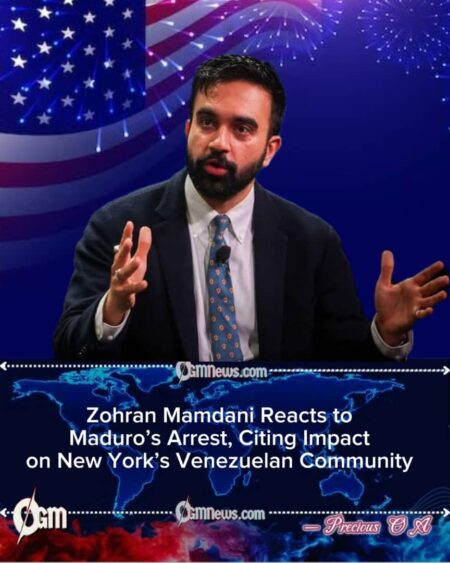
Zohran Mamdani responded publicly after Venezuelan President Nicolás Maduro was reportedly toppled and arrested, calling the development a major geopolitical event with local consequences for New York City’s large Venezuelan and broader Latin American communities. In a statement released through City Hall, the mayor emphasized that international political upheavals often have direct ripple effects on immigrant populations living in the United States.
City officials noted that New York is home to tens of thousands of Venezuelan nationals, asylum seekers, and dual citizens who maintain close family and economic ties to their country of origin. Mamdani said his administration would closely monitor the situation and coordinate with federal and state agencies to ensure that residents affected by the news have access to accurate information and community resources.
Local advocacy groups reported an immediate surge in inquiries from Venezuelan families seeking clarity about travel rules, remittances, and the legal status of relatives still living abroad. Community leaders urged calm while encouraging the city to prepare culturally sensitive outreach programs.
City Hall’s Immediate Response
Zohran Mamdani said New York City would expand multilingual information services and collaborate with nonprofit legal organizations to support immigrants navigating uncertainty created by political shifts overseas. Officials confirmed that community centers in Queens, the Bronx, and Brooklyn would host informational sessions in Spanish and Portuguese.
Administration representatives stressed that the city is not taking a political stance on Venezuelan leadership changes but is instead focused on the well-being of residents. Municipal agencies are reviewing whether emergency housing, food access, and immigration legal services may see increased demand.
One City Hall aide noted that similar community outreach frameworks were used during crises in Haiti, Afghanistan, and Ukraine, providing a model for rapid response during international disruptions.
Reactions Across Immigrant Communities
Zohran Mamdani acknowledged that immigrant communities often experience emotional and financial stress when political instability affects their countries of origin. He stated that city agencies would ensure mental-health counseling and family support programs are made available through public clinics and nonprofit partnerships.
Neighborhood leaders reported that Venezuelan-owned businesses expressed concern about supply chains, import costs, and the availability of goods commonly shipped from South America. Some store owners are reportedly seeking new suppliers to hedge against potential trade disruptions.
Faith-based organizations also announced plans to hold prayer gatherings and community meetings to help families process the uncertainty surrounding the developments in Caracas.
Economic Implications for New York
Zohran Mamdani said the city’s economic development office would analyze whether the Venezuelan political crisis could influence remittance flows, trade activity, and investment trends within immigrant neighborhoods. Officials stressed that small businesses could feel the impact first.
Financial analysts explained that many Venezuelan families rely on money transfers between New York and Latin America, and disruptions could affect housing stability, tuition payments, and healthcare access. City leaders are discussing partnerships with credit unions and community banks to provide financial guidance.
Meanwhile, nonprofit organizations focused on immigrant entrepreneurship are preparing workshops on diversifying supply chains and managing currency volatility.
Coordination With State and Federal Partners
Zohran Mamdani confirmed that City Hall is coordinating with New York State agencies and federal immigration authorities to stay informed on any policy changes that may arise from Venezuela’s political transition. The mayor said the city would advocate for humanitarian considerations in federal decision-making.
Officials added that while foreign policy remains under federal jurisdiction, municipalities can play a vital role in ensuring that residents understand evolving travel, asylum, and documentation policies. Information hotlines are expected to expand staffing over the coming weeks.
State legislators representing districts with large Venezuelan populations said they are working alongside the city to ensure resources are adequately funded.
Community Outlook and Next Steps
Public health officials emphasized the importance of maintaining access to counseling, housing stability programs, and food assistance as families cope with stress related to international uncertainty.
Local immigrant advocacy coalitions are preparing public forums to allow residents to ask questions directly to legal and social service experts.
Zohran Mamdani concluded that New York City’s priority remains the safety, dignity, and stability of all residents regardless of global political changes.
Zohran Mamdani said his administration would continue to provide transparent updates as more verified information becomes available from international authorities.