








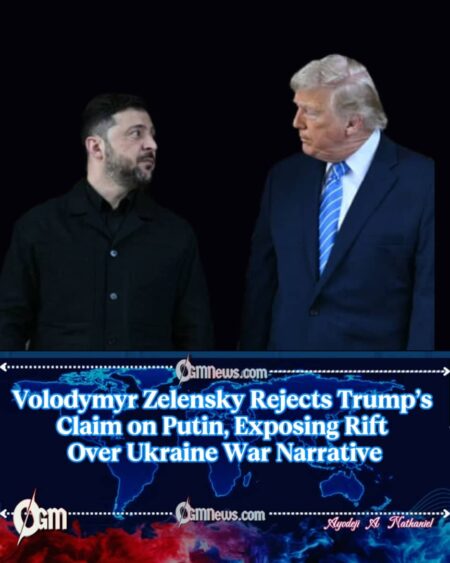
Volodymyr Zelensky has publicly rejected remarks by Donald Trump, the current U.S. president serving a second term, disputing Trump’s assertion that Vladimir Putin wants Ukraine to “thrive.” Zelensky said Ukraine’s experience since Russia’s full-scale invasion directly contradicts any suggestion that Moscow seeks the country’s prosperity or long-term stability.
The public response marks one of the clearest rejections yet of Trump’s characterization of Russia’s intentions, sharpening differences in how the conflict is framed by Kyiv and Washington.
Zelensky’s Assessment of Russia’s Actions
According to Volodymyr Zelensky, Russia’s military conduct provides the most accurate measure of its intentions. He pointed to sustained missile attacks, occupation of Ukrainian territory, and civilian casualties as evidence that Moscow’s objectives are incompatible with Ukraine’s survival as a sovereign state.
Ukrainian officials say these realities leave little room for alternative interpretations. From Kyiv’s perspective, any claim of Russian goodwill ignores both the human cost of the war and the systematic damage inflicted on Ukraine’s infrastructure and economy.
Trump’s Remarks and the U.S. Political Context
President Trump’s comments suggesting that Putin wants Ukraine to succeed have generated controversy across diplomatic and political circles. Critics argue that such language downplays Russia’s responsibility for the war and risks undermining international consensus.
Supporters of Trump counter that his rhetoric reflects a negotiating posture rather than an endorsement of Russian aims. Volodymyr Zelensky, however, has emphasized that Ukraine’s assessment is grounded in lived experience, not theoretical diplomacy.
Western and NATO Perspectives
Across Europe and within NATO, leaders have consistently described Russia’s campaign as coercive and expansionist. Official statements from allied governments emphasize Ukraine’s right to self-defense and reject narratives portraying Moscow as acting in Ukraine’s interest.
Volodymyr Zelensky has aligned his remarks with this broader Western consensus, noting that unity among allies has been central to sustaining military aid, sanctions, and diplomatic pressure on Russia.
Moscow’s Narrative Versus International Findings
The Kremlin has repeatedly claimed that its actions are defensive or protective in nature. These assertions have been widely challenged by international observers, human rights organizations, and investigative bodies documenting the impact of Russian operations.
Ukrainian officials argue that the contrast between Moscow’s statements and its conduct is stark. Volodymyr Zelensky has said that judgments about Russia’s intentions should be based on verifiable actions rather than official rhetoric.
Diplomatic Implications of the Dispute
Public disagreements over the war’s narrative carry diplomatic consequences, influencing public opinion and alliance cohesion. Ukrainian officials worry that mixed messaging from major partners could weaken deterrence or embolden Moscow.
At the same time, Volodymyr Zelensky has maintained that clarity is essential, even when it exposes differences among allies. He argues that confronting disputed narratives directly helps prevent miscalculation and preserves strategic focus.
Competing Narratives in a Prolonged Conflict
The exchange highlights enduring divisions over how Russia’s intentions are interpreted at the highest levels of global politics. While Trump’s supporters frame his comments as tactical diplomacy, Ukraine and most Western leaders see them as inconsistent with the realities of war.
As the conflict continues, the episode underscores how leadership messaging shapes international responses—and why Ukraine remains determined to anchor the global narrative in its experience on the battlefield.