










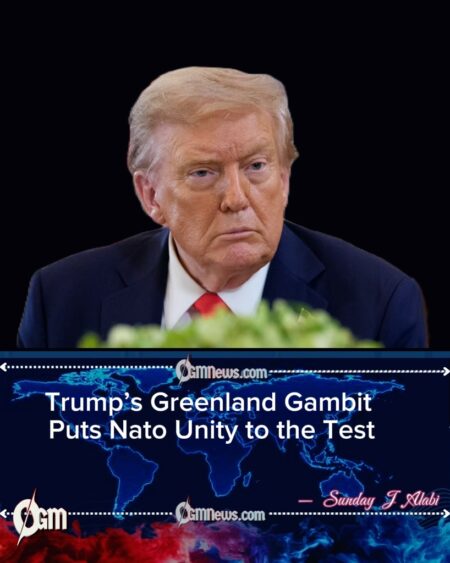
The current U.S. president, Donald Trump, serving a second term, has intensified international uncertainty after declining to clarify how far he would go to secure Greenland, a territory of Denmark. His remarks, delivered during a White House press briefing, came alongside fresh warnings to Nato allies that the transatlantic alliance is only as strong as the United States allows it to be, reinforcing concerns across Europe about Washington’s strategic direction.
Trump’s comments, marked by deliberate ambiguity, have revived debates about U.S. foreign policy priorities, alliance management, and the future stability of Nato. As global leaders prepared to converge at the World Economic Summit in Davos, the president’s statements placed renewed focus on Greenland’s strategic importance and the potential consequences for U.S.–European relations.
A Deliberate Ambiguity on Greenland
At a press briefing in Washington, President Trump responded tersely when asked how far he would go to acquire Greenland, saying only: “You’ll find out.” The remark, brief but pointed, immediately drew attention for what it suggested about the administration’s willingness to keep all options on the table regarding the Arctic territory.
Trump declined to provide assurances that he would rule out the use of force, a stance that has unsettled Nato partners and Danish officials alike. Greenland, while geographically distant from continental Europe, is viewed as strategically vital due to its location, natural resources, and growing importance in Arctic security calculations.
The president Trump framed his interest in Greenland as a matter of global and national security, arguing that control of the territory would enhance not only U.S. safety but also broader international stability. His refusal to specify limits, however, has amplified diplomatic unease.
Nato Under Pressure from Trump Administration
Trump used the briefing to reiterate long-standing grievances about Nato, asserting that the alliance owes its current strength almost entirely to U.S. leadership. He repeatedly claimed that Nato was “weak” before his involvement and suggested that America’s role gives it decisive influence over the alliance’s future direction.
“Whether you like it or not, it’s only as good as we are,” Trump said, underscoring his view that without the United States, Nato would lack real power. Such remarks reinforced fears among European allies that Washington may be willing to leverage its dominance to extract concessions on issues such as Greenland.
When pressed on whether the potential breakup of Nato would be an acceptable price for acquiring Greenland, Trump dismissed the premise, saying he believed any eventual outcome would benefit the alliance. Nonetheless, the comments highlighted growing strains within a partnership that has underpinned Western security for decades.
Security Justifications and Strategic Calculations
The president Trump justified his Greenland ambitions by citing security concerns, arguing that the territory is essential for U.S. national defence and global stability. He suggested that future arrangements could satisfy both U.S. interests and Nato’s collective goals, though without detailing how such a balance would be achieved.
Analysts note that Greenland’s Arctic position has become increasingly important amid rising geopolitical competition in the region, particularly involving Russia and China. Trump’s rhetoric reflects a broader shift toward viewing Arctic territories as central to future power dynamics.
However, critics argue that framing the issue in confrontational terms risks destabilising existing alliances and undermining trust at a time when coordinated responses to global threats remain crucial.
Davos Diplomacy and Trade Tensions
Trump’s remarks came hours before his departure for the World Economic Summit in Davos, where he was scheduled to meet several world leaders. Earlier in the day, he revealed that he had spoken with Nato secretary general Mark Rutte about Greenland, suggesting behind-the-scenes diplomacy was ongoing.
In parallel, the president dismissed European Union discussions about retaliating against U.S. tariffs through anti-coercion measures. In an interview with NewsNation, he said any EU action would be swiftly matched by Washington, though he expressed optimism that compromises could be reached during meetings in Davos.
The dispute has already strained transatlantic trade relations, with EU leaders warning that U.S. pressure tactics over Greenland could trigger broader economic retaliation.
Nobel Prize Claims and Presidential Grievances
During the extended briefing, Trump also revisited personal grievances, including his belief that he deserved the Nobel Peace Prize. He claimed to have settled eight wars and argued that his failure to receive the award reflected political bias rather than merit.
Trump suggested that Norway, which hosts the Nobel committee, exerted undue influence over the prize, despite the committee’s formal independence. He linked these frustrations to his broader worldview, portraying himself as a peacemaker who had been unfairly denied recognition.
In a previously disclosed letter to Norwegian Prime Minister Jonas Gahr Støre, Trump appeared to connect his disappointment over the Nobel Prize with a harder stance on peace-related considerations, a linkage that has drawn criticism from diplomatic observers.
Limited Options, Growing Consequences
Experts widely agree that the administration’s options for acquiring Greenland are limited. These include attempting to purchase the territory from Denmark, pushing for a referendum on Danish governance, or, in the most extreme scenario, the use of military force.
Trump’s recent threat to impose tariffs on European Nato members opposing his Greenland bid has already provoked outrage across the EU. The escalating dispute has deepened uncertainty within Nato and forced Brussels to consider retaliatory trade measures.
Complicating matters further, the U.S. Supreme Court is currently reviewing the legality of Trump’s use of tariffs as a foreign policy tool. Asked what he would do if the court ruled against him, the president said he would turn to “something else,” signalling that pressure on allies could continue through alternative means.


