










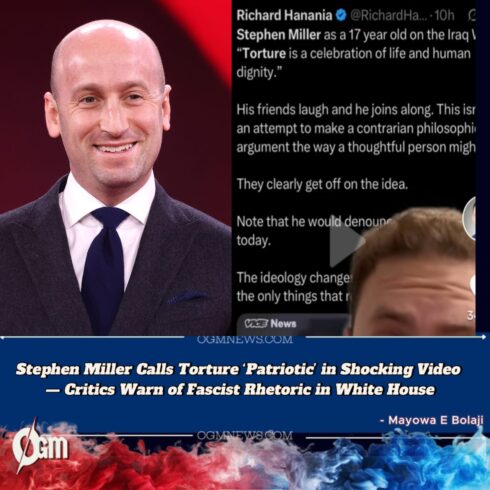
Political Advisor Stephen Miller is heard saying in a newly surfaced video that has stunned the American public and policymakers alike “Torture is not cruelty; it’s clarity,”. The statement, delivered in a 2018 off-camera policy discussion, has opened a Pandora’s box of ethical, legal, and political debates. Stephen Miller, a top policy strategist in President Trump’s second-term administration, is no stranger to controversy — but this time, critics say, he may have gone too far.
The footage, authenticated by multiple former administration officials and investigative outlets, appears to capture Stephen Miller advocating torture as not only necessary but “a celebration of life.” The comment has triggered bipartisan backlash and renewed scrutiny into the moral direction of U.S. national security policy under Trump’s ongoing leadership.
“We Need to Stop Apologizing for Power,” Stephen Miller Begins in the Video
Stephen Miller opens the leaked clip with a stark declaration: “We need to stop apologizing for power. Torture is not a failure — it’s a celebration of life, of survival.” He speaks to a group of policy advisors, gesturing forcefully as he describes torture as an “ancient rite of sovereignty” and a tool that “separates strong nations from weak ones.”
The setting appears to be a closed-door roundtable during his time as senior advisor on national security matters. Miller’s tone is firm, and the audience’s silence is telling. While no one interrupts or visibly reacts in opposition, internal sources now confirm that some aides present were “deeply disturbed” but felt constrained by the political culture of the era.
“Torture Is Misunderstood — It’s Not About Pain, But Purpose,” Stephen Miller Claims
In a longer section of the video, Miller elaborates: “Torture is misunderstood. It’s not about inflicting pain — it’s about clarity, commitment, and extracting truth. It honors life by preserving it through force.” His language is philosophical, even poetic, but the substance is chilling to many observers.
Experts on interrogation practices were quick to rebuke Stephen Miller’s interpretation. Former CIA analyst Glenn Carle responded: “That’s propaganda dressed as philosophy. Torture has never been a reliable method of intelligence gathering and is illegal under U.S. and international law.” Several human rights groups now argue that Miller’s ideological framing could influence covert programs still active today.
“History Will Vindicate Us,” Miller Argues — But Critics Say Otherwise
Stephen Miller doubles down in the leaked footage, stating: “History will vindicate us. Rome used it. Israel used it. America needs to stop pretending we’re above the harsh truths of civilization.” He invokes global powers and ancient empires to rationalize torture as a geopolitical necessity.
However, historians and legal scholars reject this notion outright. “Rome collapsed, and Israel outlawed torture,” said Professor Lydia Marshall of Columbia University. “What Stephen Miller is offering isn’t realism — it’s myth-making designed to justify authoritarian excess.” Lawmakers are now calling for an urgent review of any national security protocols Miller may have helped shape during both Trump terms.
“We Don’t Need Consensus — We Need Results,” Miller Declares
Stephen Miller’s language escalates further in the second half of the video. “We don’t need consensus — we need results,” he states, emphasizing the “strategic value” of fear in foreign and domestic policy. He even suggests that public discomfort with torture is “proof that it works.”
This framing has ignited fury across the aisle. Democratic Senator Alex Padilla called it “deeply fascistic,” while Republican Senator Mike Lee stated, “This goes beyond party. No American official should speak of torture with reverence.” Multiple lawmakers are pushing for a special hearing on ethical boundaries in intelligence policy under the current administration.
“You Can’t Win a War with Soft Gloves,” Miller Adds — Military Pushes Back
“You can’t win a war with soft gloves,” Stephen Miller remarks later in the video, criticizing “decades of moral overreach” by previous administrations. He accuses post-9/11 leaders of “crippling American security” by adopting what he calls “interrogation anxiety.”
The U.S. military community has reacted harshly. Pentagon officials and retired generals have expressed disgust, warning that Miller’s narrative endangers soldiers and allies abroad. General Mark A. Milley, speaking anonymously, was quoted as saying, “No battlefield victory is worth becoming what we fight against.”
“This Is the Real Patriotism,” Miller Claims — America Disagrees
In one of the most incendiary moments, Miller concludes: “This is the real patriotism — defending your people, even if the world calls it torture.” The line, delivered with cinematic cadence, has been looped across media platforms, drawing rebuke even from former White House allies.
Civil liberties organizations are not holding back. The ACLU called the footage “the clearest signal yet that the U.S. must urgently reaffirm its legal commitments under international law.” Online, hashtags like #TortureIsNotPatriotism and #MillerMustGo dominate political discourse, as pressure mounts for Miller’s resignation.
“We Will Not Apologize,” Miller Warns — But Will Accountability Follow?
Miller ends his address with a warning: “We will not apologize for doing what’s necessary. We will not yield to critics who never had to make hard choices.” He portrays himself as part of a misunderstood warrior class — an image that many say mirrors the ideological extremes of post-9/11 governance.
Whether this controversy leads to actual accountability remains unclear. House Oversight Chair Jamie Raskin is reportedly considering subpoenas, and legal experts have filed formal complaints demanding review of any U.S. practices linked to Miller’s ideology. If proven that such comments reflect policy rather than rhetoric, both domestic and international legal consequences could follow.
The Echoes of Tyranny or a Misunderstood Doctrine?
Stephen Miller’s leaked video has exposed what some fear is the ideological undercurrent of Trump-era power — one that blurs the line between national security and moral erosion. While Miller argues for strength, his words are now being seen by many as a call for state-sanctioned brutality.
The broader question remains: how much of Miller’s philosophy shaped — or still shapes — U.S. policy? And at what point does loyalty to ideology become a liability to democracy itself?


