










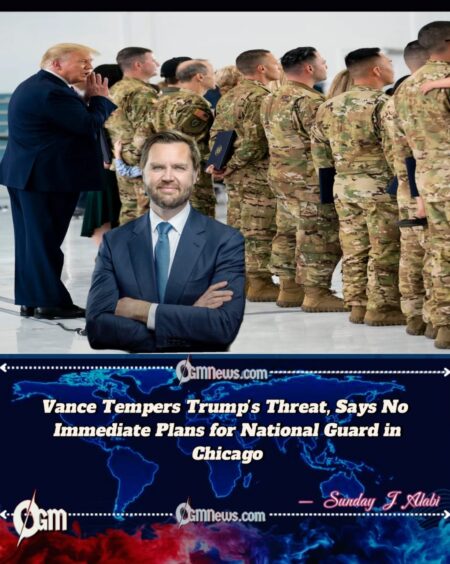
Vice President JD Vance said Wednesday that the Trump administration has “no immediate plans” to send National Guard forces to Chicago, despite President Trump suggesting a day earlier that troops could be deployed to the nation’s third-largest city to curb violent crime. The clarification comes amid mounting tensions between the White House and Illinois leaders over the federal government’s role in local law enforcement.
Trump Signals Tougher Action on Cities
President Trump told reporters Tuesday that his administration is prepared to act, declaring, “we’re going in,” though he stopped short of offering a timeline. The president’s remarks followed earlier deployments of National Guard forces to Washington, D.C., and Los Angeles, actions he defended as necessary to restore order and protect federal personnel.
The president Trump has also signaled that Chicago is not alone on his radar. He suggested Baltimore could face a similar intervention and confirmed Wednesday that New Orleans is also under consideration for future deployments.
Vance Seeks Cooperation with Illinois Leaders
When pressed by reporters, Vice President Vance deferred to the president’s authority but emphasized there was no immediate plan to send troops. “The president Trump has said he has the legal authority to protect American citizens, whether that’s in Chicago or in Washington, D.C.,” Vance noted. He added that the Trump administration hopes to work with Illinois Governor JB Pritzker to address concerns about violent crime without escalating federal involvement.
Vance’s comments echoed President Trump’s request that Pritzker formally invite federal forces into Chicago. Such a request would give the White House political cover to argue that its actions were in partnership with state leaders rather than an imposition from Washington.
Pritzker Pushes Back, Threatens Legal Action
Governor JB Pritzker has forcefully rejected the idea of military involvement, calling the president’s statements “unhinged.” He vowed to resist any attempt to deploy Guard forces without state consent and signaled he would take the matter to court if necessary.
Pritzker pointed to city crime data showing violent crime in Chicago trending downward. He argued that federal troops would not only be unnecessary but could also inflame tensions and undermine community policing efforts already underway.
Federal Immigration Enforcement Plans in Motion
Beyond the debate over Guard deployments, federal officials are preparing a separate push in Chicago. According to Department of Homeland Security sources, the Trump administration is planning an expansion of immigration enforcement operations in the city, which could begin as early as this week.
The move reflects a broader strategy by the Trump administration to target major urban centers for high-profile federal interventions. Critics argue the approach is more about political theater than public safety, while supporters contend it demonstrates the president’s determination to tackle crime and illegal immigration head-on.
Legal and Constitutional Questions Loom
If President Trump follows through with a deployment to Chicago, it would likely spark a new round of legal challenges. California Governor Gavin Newsom has already sued the administration over the Los Angeles deployment, claiming the federal government unlawfully took control of state Guard forces.
While an appellate court allowed the troops to remain in Los Angeles, a district judge ruled this week that the deployment violated the 19th-century Posse Comitatus Act, which restricts the use of the military for domestic law enforcement. Chicago could soon become the next battleground in what is shaping up to be a constitutional test of presidential power.
What Comes Next for Chicago?
For now, the Trump administration insists no immediate Guard deployment is planned. But with the president publicly floating the idea and Vice President Vance leaving the door open, the possibility remains alive. Local leaders are bracing for a potential clash over federal authority in the coming weeks.
Whether the dispute escalates into another high-profile legal fight may depend on the White House’s willingness to negotiate with Illinois officials—or its determination to press forward unilaterally. For residents of Chicago, the uncertainty leaves open a pressing question: will the city become the next stage in the administration’s battle over law and order?


