




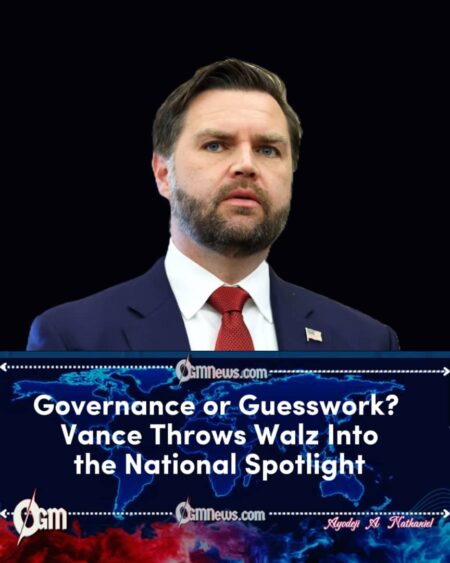
Vice President JD Vance has ignited a wide-ranging national conversation after forcefully criticizing Minnesota Governor Tim Walz, questioning both his leadership credentials and the integrity of his administration. While the remarks were directed at a single governor, they have resonated far beyond Minnesota, reopening broader debates about accountability, oversight, and standards of governance across U.S. state governments.
The comments come at a time when public confidence in institutions is closely tied to perceptions of transparency and fiscal responsibility. As a result, the vice president’s intervention has been interpreted not only as a political attack, but also as part of a larger argument about how state leaders are evaluated and held accountable.
Vice President JD Vance and the Political Context of the Remarks
VP JD Vance delivered his criticism against the backdrop of intensifying partisan competition and renewed scrutiny of state-level governance. By rejecting portrayals of Governor Walz as a defender of freedom and competence, the vice president positioned his remarks within a broader national debate over leadership standards rather than a narrow policy dispute.
Analysts note that such interventions from senior federal officials often signal an effort to frame upcoming political contests around governance and credibility. In this case, the remarks quickly gained national attention, ensuring that Minnesota’s administrative record became part of a wider political narrative.
Vice President JD Vance on Governance, Fraud, and Oversight
In focusing on alleged fraud and administrative failure, VP JD Vance touched on a sensitive issue that has implications well beyond a single state. Across the country, concerns over the misuse of public funds and weak oversight mechanisms have fueled calls for stricter audits and greater transparency.
While JD Vance did not cite specific cases in his remarks, policy experts observe that accusations of this nature tend to revive scrutiny of existing investigations and past compliance failures. They also reinforce public demand for clearer accountability structures within state governments.
Minnesota’s Administrative Record in a National Lens
Governor Walz’s administration has previously faced both praise and criticism for its handling of crises, social programs, and economic management. Supporters argue that complex challenges inevitably strain bureaucratic systems, while critics contend that these same challenges expose weaknesses in oversight and internal controls.
The current controversy has elevated these debates to a national stage, prompting comparisons with other states that have faced similar issues. In this sense, the focus has shifted from individual leadership style to systemic questions about how state governments manage risk and enforce compliance.
Vice President JD Vance and the Role of Federal Voices in State Debates
The involvement of Vice President JD Vance underscores how federal officials increasingly shape discussions about state governance. When national leaders weigh in, local administrative issues often become symbols of broader ideological and policy disputes.
This dynamic can sharpen public attention, but it also raises concerns about politicization. Observers warn that sustained federal criticism, if not matched by evidence-driven follow-up, risks blurring the line between legitimate oversight and partisan messaging.
Public Trust, Accountability, and Institutional Confidence
Beyond party politics, the episode highlights a deeper challenge facing American democracy: maintaining public trust in government institutions. Allegations of fraud, whether proven or not, can have lasting effects on confidence in leadership and public administration.
Experts emphasize that the long-term impact will depend on transparency and due process. Clear investigations, timely reporting, and measurable reforms are seen as essential if public debate is to translate into improved governance rather than deeper cynicism.
Broader Implications for National Political Discourse
The controversy illustrates how individual political statements can catalyze broader discussions about standards of leadership and accountability nationwide. As voters increasingly judge officials on competence and integrity, such debates are likely to remain central to U.S. politics.
Whether this episode leads to concrete policy changes or remains primarily rhetorical, it reflects a political environment in which governance records are scrutinized as closely as ideological positions.