








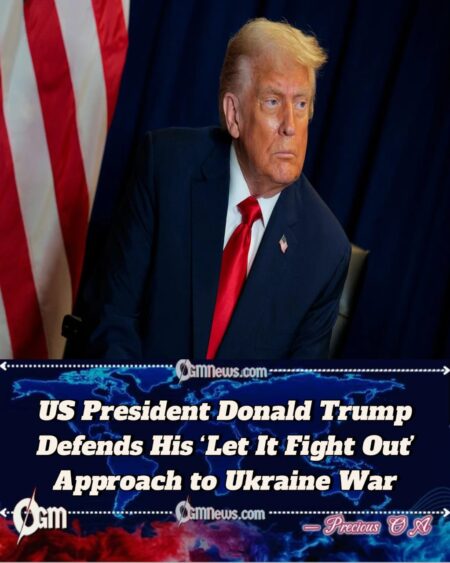
U.S. President Donald Trump has once again stirred global attention with his latest remarks on the Ukraine conflict, suggesting that sometimes wars must be allowed to “fight out” before peace can be achieved. Speaking during a televised interview on Monday, President Trump defended his strategic approach to global conflicts, emphasizing that he has successfully “settled eight wars” in his political and business career. His comments come at a critical moment when the international community continues to pressure for renewed peace negotiations between Ukraine and Russia, a war that has taken a heavy human and economic toll across Europe and beyond.
Donald Trump’s tone reflected both confidence and defiance as he discussed the ongoing war, adopting his trademark bluntness that has long defined his communication style. “Sometimes you have to let it fight out. And they’re fighting. And they’re fighting it out,” he said, referring to the prolonged and bloody struggle between the two nations. “It’s been tough for both. Sometimes you have to let it, you know, just get fought out. I’ve settled eight wars.” The president’s statement immediately ignited debate across diplomatic circles, with analysts divided over whether his words signal a calculated strategy of patience or a hands-off approach that risks prolonging the suffering of millions.
Donald Trump’s supporters argue that his stance reflects a pragmatic worldview grounded in the realities of conflict resolution rather than emotional reaction. They point out that he has consistently prioritized American interests while advocating for stronger borders, restrained foreign intervention, and financial accountability in U.S. aid policies. “The president understands that not every conflict needs U.S. troops or endless funding,” said a senior White House aide. “His record of settling disputes through negotiation rather than escalation speaks for itself.” Supporters believe that Trump’s approach is one of strategic endurance—allowing hostile powers to exhaust themselves before stepping in as a broker of peace.
Critics, however, contend that the remarks display an unsettling detachment from human suffering on the ground, arguing that such rhetoric minimizes the humanitarian catastrophe in Ukraine. Many have accused him of downplaying the massive civilian casualties, infrastructure destruction, and refugee crises that continue to unfold daily. The president’s comments have therefore reignited old arguments about the balance between realpolitik and moral responsibility in U.S. foreign policy. Analysts from Washington to Brussels have voiced concern that Trump’s words could encourage aggressors or signal an American retreat from its long-standing leadership role on global peace initiatives.
Reactions from Washington and Abroad
Donald Trump’s comments quickly drew responses from lawmakers across the political spectrum, with reactions ranging from measured caution to sharp criticism. Several members of Congress expressed concern that his words could be misconstrued as a signal of diminishing U.S. commitment to Ukraine’s defense. Democratic leaders, in particular, called for clarification, warning that such statements could embolden Russia at a time when Kyiv remains heavily reliant on Western support. The remarks were discussed in closed-door meetings at the Capitol, where intelligence officials briefed lawmakers on possible diplomatic consequences.
Donald Trump’s allies within the Republican Party offered mixed reactions. Some conservative lawmakers praised him for what they described as “refreshing honesty,” arguing that the president is voicing what many policymakers quietly believe—that military entanglements must have limits. Others, however, urged a more cautious diplomatic tone, emphasizing that words matter on the world stage. “The president’s instincts are right—wars cannot be solved by throwing money forever,” said Senator Rand Paul. “But we must ensure that our words don’t weaken our alliances or send the wrong message to aggressors.” This debate has opened yet another fault line within the Republican Party over how America should navigate its role in a shifting global order.
The White House, meanwhile, moved swiftly to clarify the president’s remarks. Officials emphasized that the administration’s broader commitment to supporting Ukraine remains firm, even as Trump advocates for a more strategic and limited approach. According to aides, the president’s comments were meant to highlight the futility of endless escalation rather than signal withdrawal or indifference. “He was simply underscoring that wars of attrition eventually reach a breaking point,” said one spokesperson. “The president believes in timing, leverage, and endurance—not reckless involvement.”
Donald Trump’s reference to having “settled eight wars” has raised curiosity about which conflicts he was referring to. Aides later clarified that he meant disputes ranging from trade confrontations, diplomatic standoffs during his first term, to indirect military tensions he claims to have defused through negotiation. Supporters cite the de-escalation of tensions with North Korea, the Abraham Accords in the Middle East, and reduced hostilities in Afghanistan as examples of his so-called “settlements.” Yet, critics maintain that these claims exaggerate his achievements and distort the complexities of international relations.
A Philosophy Rooted in Tough Diplomacy
Donald Trump’s comments highlight a broader worldview that has defined his presidency—a belief that power, patience, and pressure are more effective than perpetual intervention. “Letting them fight it out” reflects, in his view, not indifference but a calculated restraint meant to force both sides toward exhaustion and eventual compromise. Supporters of this philosophy argue that his approach prevents the U.S. from being drawn into endless foreign entanglements while keeping global rivals aware of America’s readiness to act if necessary. They see it as a deliberate reassertion of “America First” diplomacy, one where U.S. resources are protected even as the nation remains an influential force abroad.
Donald Trump’s critics, however, warn that such reasoning risks normalizing violence as a form of negotiation. Human rights advocates have pointed out that “letting it fight out” can translate to extended civilian suffering, displacement, and destruction of vital infrastructure. They argue that while his approach may yield tactical leverage, it undercuts moral leadership and international law, potentially weakening America’s image as a global stabilizing force. Political analysts note that this approach aligns more closely with transactional diplomacy than with the cooperative alliances built after World War II, marking a decisive shift in how the U.S. exerts influence on the global stage.
Donald Trump’s inner circle continues to defend his stance as part of a larger vision of disciplined diplomacy. “He’s not afraid of confrontation, but he also knows when to stand back,” said a senior adviser. “It’s about strength through calculation, not through chaos.” His aides insist that the president’s remarks were not dismissive of the conflict’s gravity but instead reflected his confidence in controlled negotiation as a means of achieving lasting peace. They also note that Trump’s approach to global conflict mirrors his negotiation style in business—allowing tension to reach a natural peak before intervening with decisive action.
Observers note that the international response to Trump’s philosophy has been mixed, with some nations interpreting it as a call for self-reliance while others see it as a retreat from global leadership. European allies, already grappling with the financial and security strains of supporting Ukraine, have expressed both concern and cautious optimism about his stance. Some diplomats argue that his blunt honesty forces uncomfortable but necessary conversations about long-term strategy. Whether his “let it fight out” stance ultimately brings resolution or prolongs instability, it has once again cemented his reputation as a leader unafraid of controversy—one who continues to redefine America’s approach to diplomacy in an increasingly unpredictable and fractured world.