










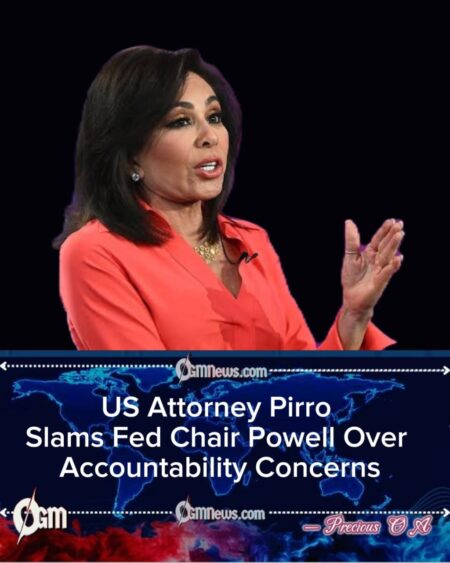
US Attorney Pirro opened a new front in Washington’s simmering debate over financial oversight after publicly criticizing Federal Reserve Chair Jerome Powell, accusing him of hiding behind institutional independence while an inquiry connected to his conduct continues to draw attention. Speaking in remarks that quickly spread across political media, Pirro said that independence does not place any public official beyond the reach of legal accountability.
The comments immediately reignited long-running arguments over how much transparency the Federal Reserve owes the public, Congress, and oversight bodies. While the Fed has traditionally operated with a high level of institutional autonomy, critics argue that its leadership must still be fully responsive when questions are raised about official statements, internal communications, and compliance with congressional requests.
Supporters of Powell, meanwhile, say that Fed independence is a cornerstone of economic stability and that political pressure on central bank leadership risks undermining investor confidence. They stress that any review of the chair’s conduct should follow established procedures and remain free from partisan escalation.
What Triggered the New Round of Criticism
The renewed attention follows reports that certain congressional committees have been reviewing aspects of testimony, communications, and policy-related disclosures made by the Federal Reserve’s leadership. While no final determinations have been publicly released, the very existence of the inquiry has created a political opening for critics to challenge the Fed’s internal culture.
US Attorney Pirro argued that even the perception of evasiveness can damage public trust in financial institutions that wield enormous influence over interest rates, lending conditions, and inflation control. In her public comments, she emphasized that federal agencies must be prepared to answer difficult questions directly rather than rely on institutional authority to deflect scrutiny.
Observers note that disputes over transparency at the Fed are not new. Over the past two decades, lawmakers from both parties have periodically questioned how much information the central bank should disclose about internal deliberations, emergency lending facilities, and communications with major financial institutions.
Federal Reserve Independence Under the Microscope
Federal Reserve independence has long been defended as essential for shielding monetary policy from short-term political pressure. Economists argue that the ability to make unpopular decisions—such as raising interest rates to control inflation—depends on insulating policymakers from electoral cycles.
However, critics counter that independence does not equal immunity. They say that while monetary decisions may need protection from politics, questions about truthfulness in testimony, compliance with disclosure rules, and ethical obligations fall into a different category altogether.
US Attorney Pirro specifically framed her argument around accountability, stating that independence should never be interpreted as a barrier to lawful investigation. Her remarks have been widely shared by political commentators who argue that a renewed emphasis on oversight is necessary given the Fed’s expanding role in crisis response and financial regulation.
Lawmakers React Across Party Lines
Reactions on Capitol Hill have been mixed. Some lawmakers welcomed the spotlight on transparency, saying that clearer communication from the Federal Reserve would strengthen public confidence during a period of persistent economic uncertainty.
Others urged caution, warning that turning technical oversight matters into headline-driven political conflicts could erode trust in institutions that markets rely on for stability. They stressed that any inquiry should proceed methodically and without inflammatory rhetoric.
US Attorney Pirro has since doubled down on her position in subsequent media appearances, reiterating that her focus is not on monetary policy decisions themselves but on ensuring that senior officials meet the same legal standards as any other public servant.
Attorney Pirro: Market and Public Confidence Considerations
Financial analysts are closely watching the political response, mindful that investor confidence is highly sensitive to perceived instability within the Federal Reserve. While markets have not yet shown major volatility directly tied to the controversy, commentators note that sustained political pressure could gradually influence sentiment.
Transparency advocates argue that clear, prompt explanations from the Fed could defuse tension and prevent speculation from filling information gaps. They point out that in the modern information environment, silence or ambiguity often invites misinformation and exaggerated narratives.
US Attorney Pirro has framed her stance as an attempt to prevent that very outcome, asserting that open engagement with oversight bodies ultimately strengthens, rather than weakens, institutional credibility.
What Happens Next
At present, congressional reviews and internal assessments related to the Fed’s leadership remain ongoing, with no publicly released findings that formally accuse or exonerate any individual. The situation is expected to continue unfolding over the coming months as committees complete their work.
Policy experts anticipate that the debate will also feed into broader discussions about whether statutory reforms are needed to clarify reporting standards and disclosure expectations for central bank officials.
US Attorney Pirro has indicated that she will continue pressing for what she describes as consistent legal accountability, while supporters of Powell maintain that established review mechanisms should be allowed to run their course without political escalation.
For now, the episode stands as another reminder of how central banking, law, and politics remain deeply intertwined—and how questions of transparency can quickly become flashpoints in Washington’s broader accountability debates.


