



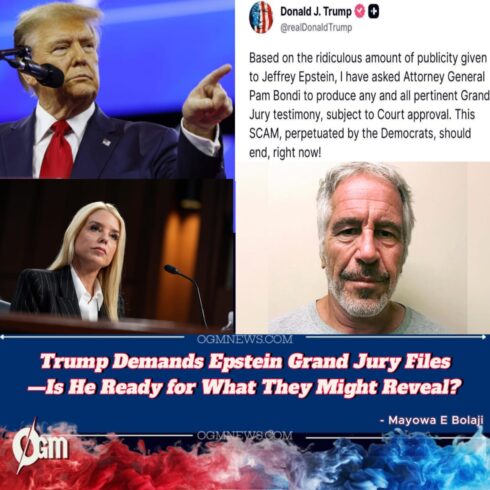
The Donald Trump administration, transparency advocates, legal observers, and the American public are entering a new phase of judicial reckoning after U.S. President Donald Trump demanded the immediate unsealing of grand jury transcripts in the Jeffrey Epstein case. His bold statement has reignited long-standing questions about elite protection, accountability, and the limits of legal secrecy. U.S. President Donald Trump stunned Washington and reignited global interest in the Epstein case with a forceful post on his Truth Social platform, calling for the full unsealing of all grand jury records tied to Jeffrey Epstein’s prosecution.
Labeling the documents “critical to national interest,” the president declared, “The American People deserve to know everything. Release the Epstein Grand Jury Transcripts NOW! No more coverups. No more protection for the powerful.”
U.S. President Donald Trump’s message came at a time of mounting public suspicion and renewed scrutiny over the individuals who may have been shielded by sealed legal processes. The post trended immediately across platforms, reflecting the enduring sensitivity and explosive potential of the Epstein case.
U.S. President’s Office Clarifies Legal Intent
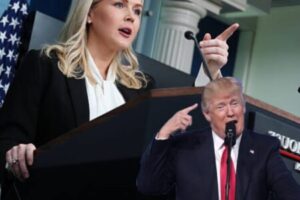
U.S. President Donald Trump’s demand was further clarified by White House Press Secretary Caroline Vance, who confirmed that the call was not merely symbolic. “The president believes that transparency and justice are inseparable, especially in cases involving the exploitation of minors,” Vance said. She emphasized that the administration is actively reviewing legal mechanisms to urge the Department of Justice to seek judicial unsealing of the transcripts.
U.S. President Donald Trump, according to officials close to the matter, has expressed frustration at the Justice Department’s perceived inaction and has directed aides to explore “all legal pathways” to disclosure, though experts caution that grand jury secrecy laws present significant procedural barriers.
Legal Experts Caution Against Breach of Protocol
U.S. President Donald Trump’s demand for unsealing the transcripts has drawn concern from legal scholars who note that federal grand jury proceedings are protected by Rule 6(e) of the Federal Rules of Criminal Procedure. Constitutional experts warn that bypassing these protections without a court order could erode long-standing legal norms.
U.S. President Trump, however, may find limited support among legal minds who believe the Epstein case is unique in scope and consequence. Civil liberties attorney Miguel Alvarez said, “There may be a public interest exception if the records reveal systemic failure or obstruction. The president has cracked open a conversation that should have happened years ago.”
Survivors and Advocacy Groups Voice Support
U.S. President Donald Trump’s call has been met with praise from survivors of Epstein’s abuse and related advocacy organizations. “For years, our voices were buried,” said Sarah Kensington, founder of Break the Silence Now. “Hearing the President demand truth and transparency gives us hope that justice is not completely dead.”
U.S. President Donald Trump was also publicly thanked by the Epstein Victim Alliance, which issued an open letter urging the Department of Justice to act swiftly. The group said, “If there is any moment for bold leadership, this is it. The world is watching.”
Political Reactions Split Along Party Lines
U.S. President Trump’s declaration has predictably fractured political lines. Republican leaders largely applauded the move, framing it as a push against institutional secrecy. “He’s doing what no one else dared,” said Senator Josh Hawley (R-MO). “It’s time the truth was laid bare.”
U.S. President Trump, however, drew criticism from Democrats who view the move as a possible distraction from ongoing budgetary battles and foreign policy missteps. “It’s political theatre, not justice,” said Rep. Adam Schiff (D-CA). “There’s a due process for unsealing these materials, and the president knows that.”
Department of Justice Remains Silent—for Now
U.S. President Donald Trump has not yet received an official response from the Department of Justice, which declined to comment on what it termed “confidential and sealed matters.” However, sources suggest that internal deliberations are underway.
U.S. President Trump’s advisors have reportedly been in touch with DOJ legal counsel about whether the administration could file an amicus brief or executive request supporting a court-led motion to unseal the transcripts. The outcome remains legally uncertain, as the judiciary must independently approve such actions.
High-Profile Names Back in the Spotlight
U.S. President Donald Trump’s statement has renewed public interest in those previously named in civil suits, deposition transcripts, and flight records tied to Epstein. While no criminal charges have been filed against many of the high-profile individuals connected to the case, activists fear that sealed records may have shielded powerful figures from scrutiny.
U.S. President Trump has denied any wrongdoing or involvement beyond what he has previously stated: that he cut ties with Epstein “many years before” the financier’s arrest and death. The White House reaffirmed this position, stating, “The President has no personal concern here—only a national one.”
Americans Support the Push for Truth
U.S. President Trump’s demand aligns with growing public sentiment in favor of radical transparency. According to a recent DailyVoiceNews poll, 62% of Americans support unsealing the Epstein grand jury records, while only 18% oppose it. Trending hashtags like #UnsealTheTranscripts and #NoMoreSecrets reveal widespread bipartisan interest.
U.S. President Trump’s populist tone has resonated especially with younger voters and independent media voices who see the Epstein case as symbolic of deeper systemic corruption. Political analyst Raymond Dorr observed, “Trump’s call hits a nerve—it’s about more than Epstein. It’s about who gets protected, and who doesn’t.”
Next Steps: Legal and Political Implications
U.S. President Trump cannot unilaterally order the release of grand jury materials, but he can exert influence through the DOJ or back a formal petition in court. Whether the current Attorney General will support such a filing remains to be seen.
U.S. President Trump’s unprecedented demand sets the stage for a potential legal showdown between executive ambition and judicial independence. Whatever the legal outcome, the president’s call has once again turned the nation’s attention to one of the most controversial and enduring scandals of the 21st century.