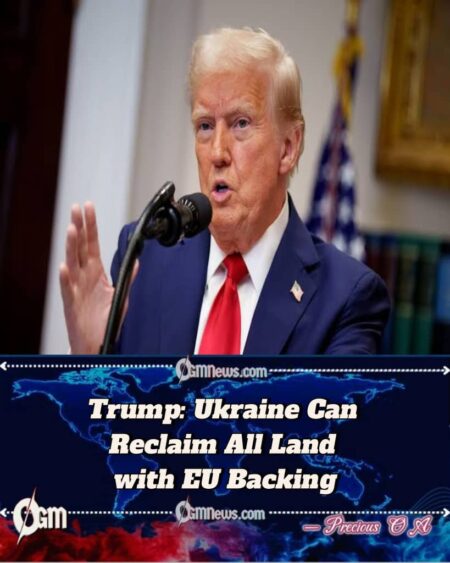
Trump stated that Ukraine, with firm backing from the European Union, stands in a position to fight and ultimately win back all of its original territory. His words emphasized that Russia and its leadership are in “big economic trouble,” pointing to the toll of international sanctions and prolonged conflict. The president also made a point to wish both countries well, adding a diplomatic tone to his otherwise assertive remarks.
Trump’s statement carried weight not only because of the optimism it expressed but also because of its timing. The war in Ukraine remains at the center of global attention, and questions about the country’s ability to reclaim lost territory persist. For Ukraine, his remarks reinforce the sense of determination and external backing that has sustained its efforts for over two years of conflict.
Trump drew particular attention to the European Union’s role, describing it as decisive for Ukraine’s resilience. While the United States and NATO are crucial players, his comments placed Europe at the heart of the struggle, highlighting how financial aid, weapons deliveries, and humanitarian relief have enabled Ukraine to continue resisting Russian advances.
Russia’s Economic Struggles and Global Impact
The president underlined that Russia’s economy is under severe strain, with sanctions and global isolation reducing its options. His words pointed directly to declining energy exports, restricted access to international banking, and the long-term impact of businesses exiting the Russian market. These challenges, he suggested, limit Moscow’s ability to sustain the costly war effort.
Trump’s reference to Russia’s “big economic trouble” echoed assessments by international economists who note that while Moscow has adapted in some areas, vulnerabilities remain. A shrinking workforce, dependence on China, and disrupted trade channels all combine to make Russia’s position increasingly precarious. The president’s words, therefore, were less about exaggeration and more about drawing attention to existing weaknesses.
Energy markets, food supplies, and trade patterns have also been affected by the conflict. Europe has endured higher energy bills, while developing nations have seen shortages of grain and fertilizer. These ripple effects illustrate how the war has reshaped global economic realities beyond the battlefield. In Africa, for instance, supply disruptions have contributed to higher food prices, showing that the consequences of the war are felt far beyond Europe’s borders.
Diplomatic Undertones and Future Possibilities
Trump, while confident in Ukraine’s prospects, also showed a degree of restraint. His statement, “I wish both countries well,” softened the otherwise bold prediction that Kyiv could reclaim its entire territory. This balance between assertiveness and compassion signaled awareness of the war’s human toll, including millions displaced and countless lives lost.
Some analysts argue that his remarks may also be designed to leave open channels for dialogue. As a political figure with influence over U.S. foreign policy, his choice of words carries weight in shaping perceptions both at home and abroad. The reference to both countries’ well-being suggests that despite firm support for Ukraine, there is recognition of the eventual necessity of negotiations to achieve peace.
Trump’s careful phrasing left room for interpretation. For some, it was a strong message of support for Ukraine’s military resilience. For others, it suggested that the president sees the need for diplomacy, however distant that possibility may seem. This duality reflects the complexity of balancing military confidence with humanitarian concern.
Trump’s mention of wishing both sides well may also have been designed for international audiences who view the war with growing concern. Many countries in the Global South, while sympathetic to Ukraine’s plight, remain wary of choosing sides too openly. By including a note of goodwill, the president may have sought to appeal to these nations and present himself as a leader mindful of global opinion.
The Role of Europe and Broader Implications
Trump returned repeatedly to the importance of Europe’s contribution. His recognition of the EU’s decisive role highlighted how the conflict has become not just a test of Ukraine’s survival, but also a test of European unity. By describing Europe’s support as central, he reinforced the idea that the continent’s collective action could shape the outcome of the war.
The European Union’s role has expanded beyond military support to include efforts aimed at stabilizing Ukraine’s economy and preparing it for eventual reconstruction. Billions of euros have already been pledged, and discussions on Ukraine’s potential future within the EU remain ongoing. This dual role of wartime support and long-term planning could prove decisive in determining how the conflict reshapes Europe’s geopolitical landscape.
Trump’s remarks serve as a reminder that Ukraine’s struggle is more than a regional conflict; it is a defining moment for international alliances. If Ukraine succeeds in reclaiming its territory, the result would weaken Russia’s influence and strengthen Western partnerships. In this sense, his prediction is tied to broader questions about the balance of power in the twenty-first century.
Trump’s outlook also adds weight to debates within Europe itself. Some European leaders continue to face domestic pressure over the high cost of supporting Ukraine, particularly with energy prices and inflation affecting households. His words may embolden those who argue that sacrifices are necessary to achieve a lasting and decisive outcome in the conflict.