The United States has issued pointed warnings in its diplomatic engagement with Mexico, referencing developments in Venezuela as an example of the consequences Washington says can follow when governments fail to align with its security expectations. The remarks, linked to ongoing disputes over organized crime, migration, and regional stability, have intensified debate across the Americas about sovereignty, cooperation, and the limits of U.S. influence.
The message has been associated with policy positions advanced by Donald J. Trump, currently serving a second term as U.S. president, whose administration has emphasized aggressive counter-narcotics measures and a more assertive posture toward governments it views as insufficiently responsive to transnational crime threats..
Washington’s Security Demands and Strategic Framing
U.S. officials have argued that cartel activity, fentanyl trafficking, and cross-border criminal networks constitute a shared security crisis requiring deeper operational cooperation from regional partners. The administration has pressed for expanded intelligence sharing, tighter enforcement coordination, and stronger action against organized crime infrastructure.
In making its case, Washington has pointed to past confrontations with Caracas as evidence of its willingness to escalate pressure when it believes democratic norms or security objectives are at risk. Analysts say invoking Venezuela serves both as a policy reference point and as a signal of resolve to other governments in the hemisphere.
This framing reflects a broader shift toward linking law-enforcement cooperation with geopolitical alignment, blurring the traditional boundary between criminal justice collaboration and foreign policy leverage.
Mexico’s Response: Sovereignty and Evidence-Based Cooperation
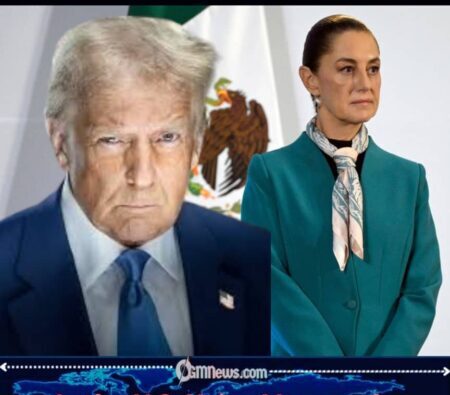
Mexican leaders have pushed back against what they perceive as coercive rhetoric, stressing that bilateral security cooperation must respect national sovereignty. President Claudia Sheinbaum has publicly rejected allegations tying Mexican institutions to Venezuelan criminal networks without verifiable evidence, urging the United States to rely on joint investigations rather than political assertions.
Officials in Mexico City maintain that they are committed to combating cartels but favor domestically driven strategies focused on social programs, financial tracking, and targeted enforcement rather than externally directed operations.
Diplomatic observers note that this divergence reflects longstanding Mexican foreign-policy doctrine emphasizing non-intervention, a principle rooted in 20th-century efforts to avoid external influence in domestic affairs.
Venezuela as a Reference Point in Regional Diplomacy
At the center of the comparison is the government of Nicolás Maduro, which has faced years of U.S. sanctions, political isolation, and accusations related to corruption and narcotics trafficking. Washington’s confrontational approach toward Caracas has included economic penalties and support for opposition movements, policies that remain controversial internationally.
By citing Venezuela, U.S. officials appear to be underscoring what they describe as the risks of allowing criminal networks and governance failures to converge. Critics, however, argue that using one nation’s crisis as a diplomatic example risks oversimplifying complex regional dynamics.
Scholars of inter-American relations warn that analogies between countries with vastly different political systems and institutional capacities can heighten tensions rather than foster practical cooperation.
Regional and International Reactions
Governments across Latin America and beyond have reacted cautiously, emphasizing dialogue and multilateral engagement over unilateral pressure. Several leaders have warned that escalating rhetoric could undermine collective security initiatives by eroding trust among partners.
European and international policy analysts have similarly stressed adherence to international law and cooperative frameworks, particularly in addressing organized crime, migration flows, and humanitarian challenges.
The episode illustrates how security concerns in the Western Hemisphere increasingly intersect with geopolitical competition, economic policy, and domestic political narratives.
The Broader Challenge of Transnational Crime
Underlying the diplomatic friction is the shared reality of powerful criminal organizations operating across borders. Cartels’ involvement in drug trafficking, human smuggling, and illicit finance has imposed significant economic and social costs throughout the region.
U.S. policymakers argue that only coordinated, high-intensity enforcement can disrupt these networks effectively. Mexican authorities counter that durable solutions require addressing inequality, corruption, and local governance vulnerabilities that enable organized crime to flourish.
Experts widely agree that neither enforcement-only nor development-only strategies are sufficient on their own, highlighting the need for hybrid approaches that combine policing, judicial reform, and economic investment.
A Delicate Balance Between Partnership and Pressure
The evolving dispute underscores the complexity of modern U.S.–Mexico relations, where deep economic integration coexists with periodic political strain. Trade, migration management, and shared border infrastructure require constant collaboration, even as disagreements emerge over tactics and tone.
For the Trump administration, demonstrating firmness on security aligns with domestic priorities centered on border control and anti-narcotics enforcement. For Mexico, maintaining autonomy in policymaking remains essential to its diplomatic identity and internal legitimacy.
As negotiations continue, analysts expect both sides to seek pragmatic compromises while avoiding steps that could destabilize one of the world’s most consequential bilateral relationships.