










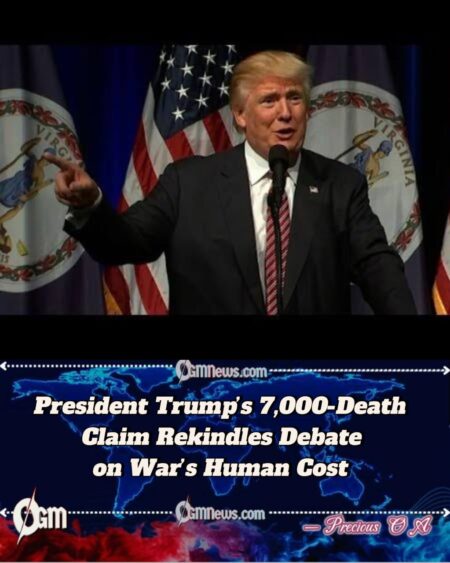
U.S. President Donald Trump stated during a recent appearance that “7,000 people died last week, by the way — in Russia, between Russia and Ukraine.” The remark, made while discussing the ongoing war between the two countries, immediately drew widespread attention for its striking nature and lack of immediate verification. The statement has since prompted renewed scrutiny of casualty figures in the conflict, which continues to exact a devastating toll on both sides.
While speaking at a policy event, President Donald Trump used the claim to underscore his argument that the United States and the international community must act more decisively to end the war. He described the conflict as a “human tragedy that should never have happened,” emphasizing the heavy price ordinary people have paid. His words quickly circulated across major global media platforms, with analysts and officials weighing in on the accuracy and implications of the figure.
The statement comes amid broader debates over transparency and accuracy surrounding the Russia-Ukraine war. Independent monitors and Western intelligence agencies have struggled to verify consistent casualty numbers, as both Moscow and Kyiv often withhold or alter figures for strategic reasons. The latest claim adds another layer to the uncertainty about the real human cost of the ongoing conflict.
Calls for Verification and Context
President Donald Trump’s comments have sparked a flurry of reactions from experts, who caution against taking the figure at face value without corroboration. Military analysts point out that, while casualties on both sides have indeed been substantial, there is no publicly available data confirming that as many as 7,000 people died within a single week. Instead, most verified reports suggest fluctuating death tolls depending on the intensity and geography of fighting.
President Trump’s statement, however, appears intended to highlight the futility of the prolonged conflict and the need for immediate peace talks. Some observers interpret his words as a deliberate attempt to draw attention to the growing human tragedy, while others argue that unverified claims could undermine confidence in factual reporting and diplomatic dialogue. “Public figures must be careful when citing such high figures,” one European defense expert told Reuters. “Even if the intention is to promote peace, numbers without verification can easily mislead or inflame tensions.”
President Trump’s office has not provided clarification or supporting data for the remark. Officials familiar with the situation suggest that the figure might have originated from unverified battlefield reports circulating on social media or informal intelligence summaries. Despite the uncertainty, the comment has succeeded in refocusing public discussion on the urgency of de-escalating the conflict.
President Donald Trump’s claim also drew responses from international observers, some of whom believe he may have been referring to cumulative deaths over several weeks rather than a single one. This interpretation aligns with Western estimates that both sides are sustaining heavy losses amid renewed offensives. However, the phrasing gave the impression of an alarming weekly toll, intensifying public debate about the scale of the devastation.
Wider Implications for the War Narrative
President Donald Trump’s reference to the 7,000 deaths also brings attention to how information is used in shaping public perception of war. Analysts note that in modern conflicts, the battle over narrative can be as consequential as the physical fighting. Governments, military units, and media outlets all compete to frame events in ways that influence international opinion and domestic morale.
President Donald Trump’s statement also underscores the ongoing humanitarian crisis across Eastern Europe. Millions have been displaced, thousands injured, and countless families torn apart since Russia’s invasion of Ukraine began. Aid agencies warn that the situation could deteriorate further as winter approaches, with damaged infrastructure, power shortages, and limited access to healthcare worsening civilian suffering. By calling attention to the staggering loss of life, he may have reignited a conversation about the human rather than political cost of the war.
President Donald Trump’s remarks have also reignited attention on humanitarian efforts. Organizations such as the Red Cross and Médecins Sans Frontières continue to document severe shortages of food, medical supplies, and shelter. Relief workers stress that while political leaders debate numbers, those affected are facing hunger, trauma, and displacement every day. His comment, though controversial, has indirectly renewed focus on global aid coordination.
President Trump’s words have not gone unnoticed in diplomatic circles. Both Moscow and Kyiv are reportedly monitoring the international response closely, aware that any statement from a U.S. president can influence negotiations and alliances. Some European diplomats believe the remark was a strategic move, signaling subtle pressure on NATO allies to increase their involvement in pursuing a peaceful resolution.
Focus on Human Cost Over Political Strategy
President Donald Trump’s emphasis on the number of deaths may reflect a shift in tone, highlighting empathy for victims rather than geopolitical rivalry. During his remarks, he expressed sorrow for those who “never should have lost their lives in this senseless conflict,” describing the situation as “a reminder of why strong leadership and diplomacy matter.” His words appeared to blend moral appeal with political messaging, calling for decisive international engagement.
President Donald Trump’s approach, according to several commentators, signals an effort to recast America’s global image from a distant observer to an active peacemaker. Analysts believe this rhetoric is aimed at positioning the United States as a stabilizing power capable of facilitating dialogue between the warring sides. However, critics contend that such rhetoric must be matched with tangible action if lasting peace is to be achieved.
President Donald Trump’s statement, whether grounded in precise data or not, has already shaped global discourse. The claim of 7,000 deaths in a single week has forced renewed reflection on the staggering scale of suffering. For many, it serves as a grim reminder that beyond strategy and politics, the human toll of war remains immense — and continues to demand the world’s attention.


