








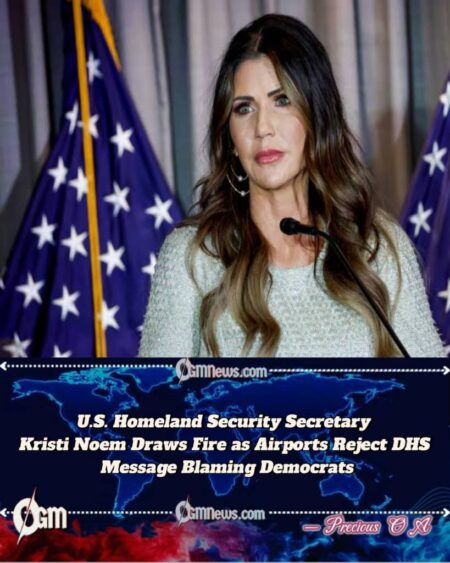
Kristi Noem, the U.S. Homeland Security Secretary, has found herself at the center of a growing controversy after multiple major airports refused to broadcast a video message from her department that critics have described as political propaganda. The video, reportedly commissioned by the Department of Homeland Security (DHS) at the height of the ongoing government shutdown, sought to frame Democratic lawmakers as the reason behind the federal impasse now crippling essential services.
Kristi Noem’s video was initially distributed to airport authorities nationwide with a request that it be displayed across airport terminals, lounges, and public waiting areas. The message portrayed the administration’s stance on border security and blamed Democrats for what it called “the reckless obstruction that led to this crisis.” The request came directly from the DHS communications office, citing the need for “public awareness” about the consequences of stalled funding.
Kristi Noem’s initiative, however, met stiff resistance. Officials from airports in New York, Atlanta, Denver, Los Angeles, and Chicago rejected the request, stating that they would not participate in any form of political messaging. Many emphasized that airport screens are meant for travel-related information, advertisements, and neutral public service announcements, not partisan materials.
Kristi Noem, who has long been regarded as one of the administration’s most outspoken defenders of President Trump’s policies, has maintained that the video was not meant to be divisive. In a statement released through her office, she insisted that “the American people deserve transparency about why their government is at a standstill.” She added that the refusal of airports to cooperate was “deeply disappointing and unpatriotic at a time when the nation needs unity.”
Growing Backlash and Ethical Concerns
Kristi Noem’s critics, including members of both major political parties, have accused her of politicizing a department meant to protect national security. Several congressional Democrats described the move as “propaganda financed by taxpayers,” while some moderate Republicans quietly expressed discomfort with the video’s tone and timing. Civil liberties groups also raised alarms, suggesting that the effort blurred the line between public communication and political campaigning.
Kristi Noem’s leadership of the DHS has already been marked by controversy. Her hardline stances on immigration, domestic extremism, and border enforcement have drawn both praise and condemnation. This latest episode, however, underscores the growing tension between the federal government and independent institutions trying to maintain neutrality during a politically charged shutdown.
Kristi Noem defended her actions during a press briefing, arguing that “it is not propaganda to tell the truth.” She reiterated that the video aimed to “set the record straight” about who bears responsibility for the shutdown, which has now entered its fifth week. Despite her defense, transportation officials noted that they were uncomfortable being drawn into a partisan conflict over federal operations.
Kristi Noem’s office reportedly contacted airport media vendors again after the initial refusals, urging reconsideration. However, many companies stood by their decisions, citing policies that prohibit political or governmental advertisements without bipartisan authorization. Some airports even issued public statements affirming their commitment to “neutrality and public trust.”
Federal Frustration and Public Reaction
Kristi Noem’s escalating confrontation with airport authorities has highlighted the growing frustration within the Trump administration. As the shutdown continues to affect border control, aviation security, and customs operations, Homeland Security has faced mounting pressure to justify its communication strategies.
Kristi Noem, speaking in an interview with Fox News, stated that “every American has the right to understand the truth about why this shutdown persists.” She argued that Democrats had “chosen politics over safety,” warning that delayed security operations could have “real-world consequences.” Her remarks were echoed by several administration allies who accused airport officials of censorship.
Kristi Noem’s opponents, however, view her campaign as part of a broader pattern of politicizing federal institutions. The American Civil Liberties Union (ACLU) released a statement condemning the DHS video, calling it “a disturbing misuse of government communication channels.” Meanwhile, social media platforms have seen the hashtag #AirportsForDemocracy trend as citizens and activists praise the airports for “standing up for neutrality.”
Kristi Noem’s supporters have rallied behind her, praising her for her “honesty and courage.” Several conservative commentators defended her decision to use federal communication platforms to “counteract misinformation” from the media and opposition lawmakers. Still, many observers believe the controversy could deepen the divide between the administration and key public sectors.
Kristi Noem’s future at the Department of Homeland Security may depend on how this episode unfolds. Analysts suggest that her close alignment with President Trump—now serving his second term—makes her both influential and vulnerable within Washington’s volatile political landscape. Her insistence on promoting the administration’s narrative has solidified her status as a loyalist, but critics say it risks eroding public trust in federal agencies meant to remain apolitical.
Kristi Noem’s office has not announced whether she plans to release the video through other platforms. Insiders suggest that discussions are ongoing about airing the message online or through state-level communication channels. For now, the controversy underscores a deepening national divide over the boundaries of government messaging during political standoffs.