










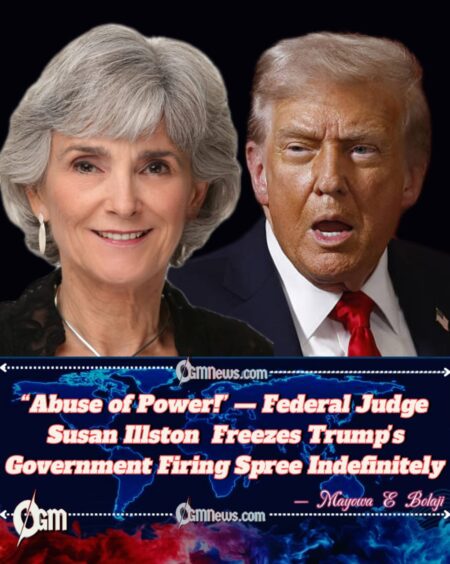
U.S. District Judge Susan Illston of the Northern District of California issued an injunction that indefinitely blocks the Trump administration’s sweeping plan to dismiss hundreds of federal employees. This order comes after labor unions challenged the legality of the mass layoffs and emergency reduction-in-force notices, arguing that they circumvent statutory protections for civil service employees. Judge Susan Illston’s decision brings a reprieve to thousands of workers who were facing abrupt termination.
The court’s opinion underscores that the executive branch cannot unilaterally override laws designed to protect federal workers without due process or congressional authorization. Judge Susan Illston, an appointee of President Bill Clinton, wrote that the dismissals appear “politically motivated” and that such sweeping terminations threaten to dismantle merit-based employment safeguards.
Trump’s legal team is expected to appeal immediately, but for now, the injunction halts all planned firings. Federal agencies, unions, and legal watchers alike are bracing for what could become a protracted judicial battle over the bounds of presidential power in reorganizing government staffing.
Constitutional Authority and Civil Service Protections at Stake
Judge Susan Illston’s ruling pivots on constitutional limits and statutory mandates that shield career federal employees from arbitrary removal. Her decision restates that even a president cannot invalidate civil service protections at will, especially when dismissals proceed without bipartisan oversight or legislative backing.
The opinion also delves into the doctrine of separation of powers, cautioning that allowing a president to dismantle the federal workforce unchecked would upset the balance of authority among the branches of government. The court warned that permitting such dismissals based on political motives would set a dangerous precedent.
Civil liberties groups and federal employee unions have lauded the decision, characterizing it as a defense of democratic accountability and institutional integrity. They argue that unchecked executive firings could transform the civil service into a political instrument rather than a stable, nonpartisan bureaucracy.
Ripple Effects Across Washington and the Agencies
Politically, Judge Susan Illston’s injunction disrupts the centerpiece of the Trump administration’s plan to reshape government operations by slashing headcounts and consolidating control. The decision forces the administration to maintain existing staffing levels—at least until the courts decide the merits of the case.
From an economic perspective, the ruling reassures many federal workers who faced uncertainty and restores some stability to agencies dependent on institutional continuity. Contractors and service providers linked to federal programs that were threatened by cuts now have breathing room, at least temporarily.
The injunction also intensifies debate in Congress over the proper reach of executive authority. Senators and representatives are expected to revisit legislative safeguards to prevent future attempts by the executive branch to downsize or reorganize the federal workforce unilaterally. As the Trump team readies an appeal, the judiciary’s role in policing executive ambition is now firmly in the spotlight.


