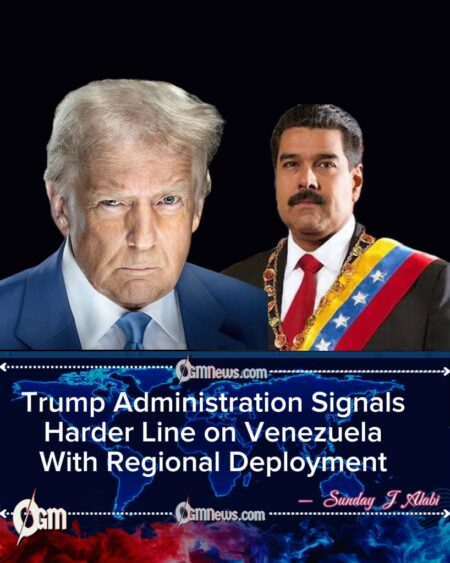
The United States has significantly expanded its military presence in the Caribbean, deploying troops, special operations aircraft, and naval assets as relations between Washington and Caracas deteriorate further. The latest buildup comes amid escalating pressure from President Donald Trump, the current U.S. president serving a second term, on Venezuelan leader Nicolás Maduro, raising international concern over the risk of a wider confrontation in the region.
U.S. officials describe the deployment as part of ongoing security operations, while Venezuela has condemned the moves as aggressive and destabilizing. The developments underscore a deepening standoff shaped by military signaling, economic sanctions, and a long-running dispute over Venezuela’s political legitimacy.
Expanding U.S. Military Footprint in the Caribbean
According to reports, the United States has deployed a substantial array of military assets to the Caribbean in recent days. These include at least ten CV-22 Osprey tilt-rotor aircraft, C-17 cargo planes, and accompanying troops and equipment that arrived earlier in the week. The aircraft reportedly originated from bases known to host U.S. special operations units, though officials have not confirmed the exact composition of the forces involved.
President Trump publicly characterized the deployment as unprecedented, describing it as “a massive armada, the biggest we’ve ever had.” He suggested that the military buildup could extend beyond air and sea operations, adding that similar programs would soon begin on land, without offering further operational details.
Official Responses and Operational Secrecy
U.S. Southern Command has sought to downplay the significance of the movements, emphasizing that rotations of personnel and equipment are routine. A spokesperson noted that, due to operational security concerns, the military does not disclose details about specific assets, troop numbers, or movement routes.
The Pentagon declined to provide additional comment, and the White House has not elaborated on the president’s remarks. This limited disclosure has fueled speculation about the scale and intent of the deployment, particularly given the already sizeable U.S. presence in waters near Venezuela.
Ongoing Operations and Regional Impact
The latest reinforcements come on top of an existing deployment of at least 11 ships and roughly 15,000 U.S. troops in the vicinity of Venezuela. U.S. operations in the region have included an aggressive drone campaign targeting Venezuelan boats, an effort that officials say is linked to enforcement of sanctions but which has reportedly resulted in dozens of fatalities.
Regional analysts warn that such operations risk miscalculation, especially in congested maritime zones. Neighboring countries have expressed quiet concern that heightened military activity could destabilize trade routes and regional security arrangements.
Sanctions Enforcement and Seizure of Oil Tankers
Alongside military pressure, the Trump administration has intensified economic measures against Caracas by targeting Venezuelan oil exports. U.S. forces, with support from the Navy and Coast Guard, have seized several oil tankers accused of helping Venezuela evade international sanctions. Officials argue that these vessels form part of a network that provides a critical economic lifeline to the Maduro government.
At an emergency meeting of the United Nations Security Council convened at Venezuela’s request, U.S. Ambassador Mike Waltz stated that sanctioned oil shipments fund what he described as an illegitimate regime and its criminal activities. Venezuela’s National Assembly has responded by passing legislation criminalizing such seizures, denouncing them as violations of international law.
Legal Pressure on Maduro and Escalating Rhetoric
President Trump and Defense Secretary Pete Hegseth have framed the pressure campaign as a response to alleged corruption and narcotics trafficking by senior Venezuelan officials. The Trump administration recently designated the so-called Cartel de los Soles—a term used to describe alleged drug-linked military elites—as a foreign terrorist organization.
Maduro has faced U.S. criminal charges since 2020, including accusations of narco-terrorism and weapons offenses. Successive U.S. administrations have increased the reward for information leading to his capture, with the figure now standing at $50 million following a recent increase under Trump’s second term.
Venezuela’s Political Crisis and International Recognition Dispute
Maduro, who has led Venezuela since 2013, remains a deeply polarizing figure internationally. His 2018 and 2024 election victories have been disputed by opposition parties and foreign governments, citing a lack of transparency and credible vote tallies. Opposition leaders Juan Guaidó and Edmundo González have both claimed electoral legitimacy at different times and were recognized by the United States and several allies.
Both men later fled Venezuela after arrest warrants were issued against them. The Trump administration has maintained its position that Maduro’s hold on power lacks democratic legitimacy, a stance that continues to shape U.S. policy as military, diplomatic, and economic pressure converges.