








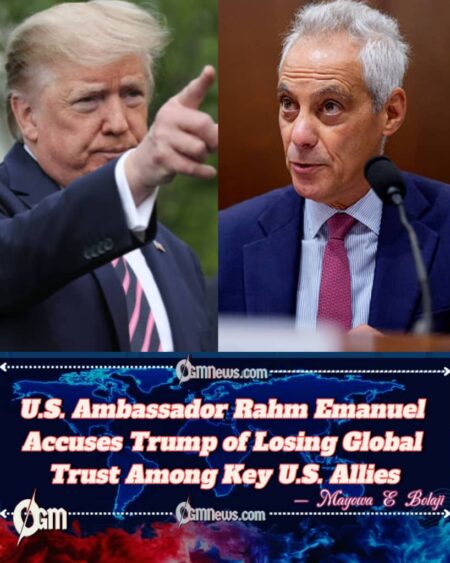
U.S. Ambassador Rahm Emanuel has sharply criticized Donald Trump’s trade strategy with China, accusing the administration of losing critical leverage and jeopardizing America’s agricultural backbone. Emanuel stated that China has “basically found leverage” and is “applying pressure” on vulnerable sectors like soybean farming — a key economic pillar in the Midwest. He warned that many farmers have already lost access to vital Chinese markets, resulting in significant financial losses and the growing risk of widespread bankruptcies in rural communities.
U.S. Ambassador Rahm Emanuel explained that Beijing’s retaliatory tariffs and targeted trade maneuvers have cornered American farmers who once relied on China as a top export destination. He emphasized that the ripple effects of Trump’s trade escalation are being felt in small towns and agricultural centers where livelihoods depend on stable export demand. According to Emanuel, “Our farmers have lost that market, are out a huge amount of money, and could see a lot of bankruptcies.”
U.S. Ambassador Rahm Emanuel lamented that the White House seemed to have realized the full impact of its actions too late. “All of a sudden, the president woke up and realized that he’s behind,” Emanuel remarked, describing the situation as one where the U.S. is “behind the eight-ball” in trade negotiations. He contended that by alienating allies and destabilizing long-standing trade channels, Donald Trump’s policies have weakened America’s economic positioning on the global stage.
U.S. Ambassador Rahm Emanuel Highlights Loss of Allied Trust in U.S. Global Strategy
U.S. Ambassador Rahm Emanuel underscored that the most damaging outcome of Trump’s trade confrontation with China may not only be economic but diplomatic. He noted that U.S. allies who once cooperated on coordinated export controls — including Japan, South Korea, Taiwan, and the Netherlands — are now hesitant to align with Washington. Emanuel explained that this hesitation stems from a growing distrust of America’s strategic consistency under Trump’s leadership.
U.S. Ambassador Rahm Emanuel pointed out that when Washington previously imposed export controls on China, those measures succeeded because partner nations stood “shoulder-to-shoulder” with the U.S. The combined force of multilateral cooperation was crucial in maintaining leverage against Beijing’s industrial and technological rise. However, Emanuel asserted that “today, they’re not ready to do that because they don’t trust the U.S.” This erosion of confidence, he said, marks a significant departure from past global cooperation efforts.
U.S. Ambassador Rahm Emanuel argued that this diplomatic rift represents a broader crisis in American credibility. Longtime partners who once viewed the U.S. as a steady global leader are now adopting a more cautious approach, unsure of Washington’s reliability or predictability. Emanuel warned that without restoring mutual trust and strategic discipline, the United States risks losing both economic advantage and moral authority in future international negotiations.
U.S. Ambassador Rahm Emanuel Warns of Economic Fallout and Geopolitical Decline
U.S. Ambassador Rahm Emanuel further cautioned that Donald Trump’s tariff-driven policy has triggered a dangerous feedback loop — where domestic economic instability fuels global uncertainty. He predicted that continued market volatility could accelerate the collapse of rural economies, increase food prices, and deepen political resentment across farming communities already disillusioned with Washington. Emanuel emphasized that without swift corrective action, the United States may face a prolonged agricultural and trade crisis.
U.S. Ambassador Rahm Emanuel explained that America’s weakened alliances and inconsistent foreign policy have emboldened China to exploit divisions within the West. He said Beijing’s trade leverage is not only financial but geopolitical, as it strategically invests in infrastructure, energy, and technology across developing nations — while the U.S. remains bogged down by self-inflicted trade disputes. According to Emanuel, this imbalance reflects “a dangerous moment where America’s competitors are seizing opportunities that once belonged to us.”
U.S. Ambassador Rahm Emanuel concluded that rebuilding America’s credibility and restoring its trade power requires consistency, cooperation, and long-term vision. He urged U.S. policymakers to repair strained alliances, realign economic objectives, and abandon reactive trade measures that isolate rather than empower the nation. Emanuel’s remarks, laden with frustration and urgency, echo a growing sentiment among diplomats that Trump’s confrontational approach has weakened not only America’s farmers but also its stature in the world.