








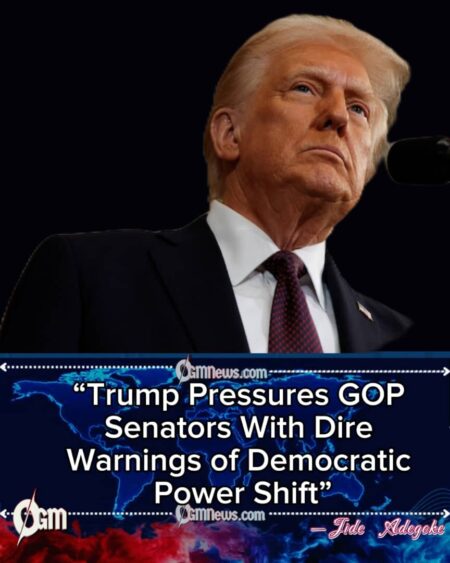
U.S. President Donald Trump, now serving his second term, has privately warned Republican senators that eliminating the Senate filibuster would empower Democrats to reshape the nation’s political landscape. But the message that followed—“If you do what I say, they’ll most likely never attain power”—has stirred debate within Washington, with critics characterizing the approach as less strategic party guidance and more an exercise in fear-driven control. The remarks have intensified scrutiny of how presidential influence is being wielded inside the Republican Party.
A President’s Message Behind Closed Doors
Reports from multiple Senate offices indicate that the president’s private conversations have become increasingly pointed. His warnings paint a scenario in which a future Democratic majority abolishes the filibuster and quickly moves to grant statehood to Washington, D.C., and Puerto Rico—an action that could add four Democratic senators.
Trump also cautioned that Democrats would “pack the Supreme Court with up to nine new justices,” a reference to long-standing progressive proposals to expand the judiciary. While these ideas are not currently on the legislative table, the president’s remarks underscore how central the filibuster remains in debates over institutional power.
Several Republican aides describe the tone of these briefings as intense, noting that the president frames his warnings not merely as hypothetical concerns but as imminent threats. The implication, they say, is clear: fidelity to his agenda is the only safeguard against sweeping Democratic control.
Fear-Based Rhetoric or Strategic Messaging?
The president’s critics argue that the language used in these meetings resembles coercion rather than political instruction. By suggesting that Democrats will “never attain power” if senators “do what I say,” Trump is accused of positioning himself as the singular bulwark against opposition rule.
Political communication analysts note that such messaging blurs the line between strong leadership and emotional manipulation. Instead of outlining policy arguments or long-term party strategy, the statements leverage fear of Democratic dominance to maintain intra-party obedience.
Supporters, however, view the warnings as a candid assessment of political realities. They contend that Democrats have openly discussed structural reforms, and Trump’s remarks simply reflect a desire to keep Republicans unified against potential institutional changes.
The Filibuster at the Center of the Debate
The Senate filibuster—requiring 60 votes to advance most legislation—has become a lightning rod in debates over governance and partisanship. Progressives argue the rule obstructs action on voting rights, climate legislation, and judicial reform. Moderates and conservatives defend it as a safeguard against rapid swings in national policy.
Trump’s insistence on preserving Republican resistance to any filibuster changes highlights the degree to which the rule has become a symbol of political survival. GOP senators wary of provoking the White House face increasing pressure to demonstrate loyalty in legislative battles.
Meanwhile, Democrats maintain that any major reforms would require unified control of Congress, something far from guaranteed. Nevertheless, the prospect remains potent enough for Trump to use as a mobilizing—and in some eyes, intimidating—tool.
Internal Tensions in a Party Under Tight Control
The president’s remarks have reignited concerns about the balance of power between the White House and Congress. Some Republican lawmakers privately express discomfort with the implication that defiance could help usher in long-term Democratic rule, saying it reduces complex legislative issues to a simple loyalty test.
Senior GOP strategists warn that such an environment may discourage independent policymaking, fostering instead a climate where political decisions are shaped by presidential pressure rather than party consensus or constituent needs.
These tensions reflect broader debates within the Republican Party about its identity in the Trump era. While the president maintains strong influence over its direction, fractures continue to emerge between those who embrace his style of leadership and those who fear it may undermine institutional norms.
A Broader Reflection on Political Culture
The controversy surrounding Trump’s statements highlights an evolving political culture where alarmist forecasts increasingly guide strategy. The use of escalating stakes—future court-packing, permanent shifts in Senate representation, irreversible partisan dominance—has become a common rhetorical tool in American politics.
What distinguishes this moment, observers say, is the degree to which such warnings are tied to personal loyalty rather than party ideology. As the president prepares for his third year of a second term, the dynamic raises questions about how intra-party authority should function within a democratic system.
For now, Trump’s message remains clear: Republican senators must align with him—or risk a Democratic future he portrays as transformative and perilous.