










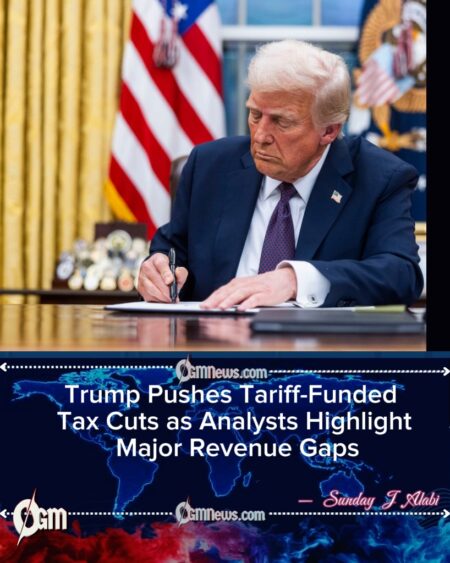
President Trump, the current U.S. president serving a second term, has floated a sweeping idea with potentially historic implications: using tariff revenue to dramatically reduce or even eliminate federal individual income taxes. Speaking during a December 2 Cabinet meeting, he argued that growing tariff collections—bolstered by his administration’s aggressive duties on imported goods—could one day generate enough revenue to render income taxes obsolete.
But economic experts across the political spectrum caution that the numbers tell a different story. While tariffs have surged under Trump-era policies, specialists say they still fall far short of the revenue needed to replace the nation’s single largest funding source. Analysts warn that such a shift could disproportionately affect working-class households while offering greater gains to higher-income earners.
Tariffs Versus Income Taxes: Understanding the Revenue Gap
Although tariff collections have increased sharply, they remain modest in comparison to income taxes. Treasury data shows that tariffs brought in $195 billion in fiscal year 2025—just 7% of the $2.67 trillion generated by individual income taxes. Personal income taxes consistently anchor federal revenue, providing roughly $2.7 trillion every year.
Tax Foundation economist Erica York notes that even under optimistic assumptions, tariff revenue cannot match the scale of income-tax collections. She estimates that current tariff policies would bring in $2.1 trillion over ten years, while federal income taxes would generate more than $32 trillion during the same period.
“Imports are simply not a large enough tax base,” York explained. “It is mechanically impossible to fully replace income tax revenues with tariffs.”
Economic Implications for Households and Consumers
Experts also stress that tariffs function differently from income taxes, with distinct impacts on American households. Tariffs work similarly to sales taxes: companies pay duties on imported items, often passing the added cost on to consumers through higher prices.
By contrast, the income tax system is progressive, with rates rising as income increases. Lower-income households pay the smallest share, while the top earners shoulder the majority. According to the Tax Foundation, the highest-earning 10% of Americans contribute about 72% of all federal income-tax revenue.
Replacing a progressive system with a relatively flat—and slightly regressive—tariff structure would shift more of the tax burden toward low- and middle-income families. “Swapping a highly progressive income tax for a slightly regressive tariff scheme would harm the very households the president claims to be helping,” York said.
Who Would Benefit? Experts Say Mostly High Earners
While proponents of lower taxes might welcome Trump’s vision, analysts argue that broad-based income-tax reductions would overwhelmingly benefit wealthier Americans. Scott Lincicome of the Cato Institute points out that because many low-income families already pay little or no income tax, a tax cut tied to tariff revenue would do little to meaningfully ease their financial strain.
“If they did a flat 3% reduction in income tax, the only people who would really benefit are the top 10%,” Lincicome said, noting that the current structure already concentrates income-tax payments among higher earners.
This divide raises questions about the distributional fairness of relying on tariffs rather than income taxes, especially at a time when many households are grappling with increased costs of living.
The Trump Administration $2,000 ‘Tariff Dividend’ Idea and Its Fiscal Hurdles
The president Trump has also floated another proposal: issuing a $2,000 “tariff dividend” check to American households. Although the idea has political appeal, economists warn that it is far from financially viable.
Lincicome estimates that sending one-time payments of that size would cost between $300 billion and $600 billion—far more than current annual tariff collections. Even if tariff revenue grows, it remains unlikely to reach the scale needed to fund such payments without dramatically reshaping U.S. trade and tax policy.
Congress would also need to approve any checks or alterations to the tax system, a challenging task in a deeply divided legislature. Some Republican lawmakers have already dismissed the idea, with Senator Ron Johnson stating the country “can’t afford” such payments.
Legal and Policy Challenges: Trump Tariffs Under Supreme Court Review
Trump’s tariff strategy faces not only economic scrutiny but legal challenges as well. The Supreme Court is currently evaluating the constitutionality of the administration’s tariffs. The outcome could affect future revenue collection and the viability of using tariffs as a major funding tool.
White House spokesman Kush Desai maintains that foreign exporters—not U.S. consumers—will ultimately bear the cost of the tariffs, which he says will generate “trillions” in federal revenue in the years ahead. But economists dispute that claim, pointing to numerous studies showing that American businesses and consumers typically absorb a substantial portion of tariff costs.
A Vision with Political Appeal but Limited Practical Pathways
President Trump’s proposals tap into widespread frustration over household expenses and long-standing desires for tax relief. His administration’s growing tariff collections have fueled a narrative that these funds could reshape federal taxation.
Yet experts argue that the math—and the structure of the U.S. economy—still presents formidable barriers. Tariffs generate only a fraction of what income taxes provide, burden everyday consumers through higher prices, and cannot feasibly replace the current progressive tax system without significant economic trade-offs.
As Congress, economists, and the courts continue to weigh in, Trump’s tariff-driven tax vision remains more aspirational than actionable.


