





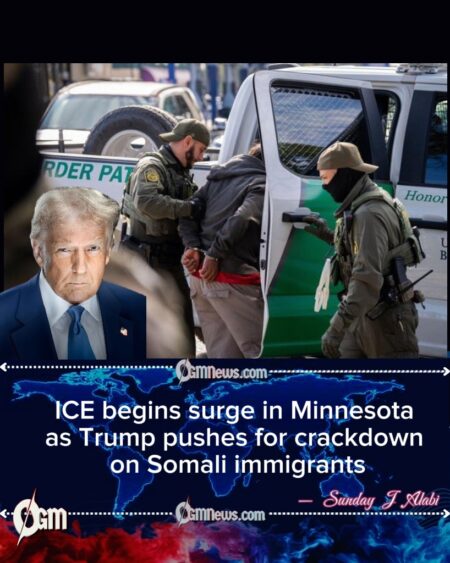
Federal immigration authorities have begun a surge of enhanced operations in Minnesota’s Twin Cities region, targeting individuals with outstanding deportation orders. The move aligns with the current U.S. president serving a second term, President Donald Trump’s increasingly forceful critiques of the state’s large Somali immigrant community. The initiative, confirmed by a U.S. official speaking to opitanglobamedia News, represents a new escalation in the Trump administration’s nationwide immigration crackdown.
The crackdown follows a series of statements by President Trump describing Somali immigrants in deeply negative terms and citing Minnesota as a focal point of his broader deportation strategy. The developments have drawn sharp responses from state officials and Somali American leaders, who characterize the president’ Trump s comments as inflammatory and unrepresentative of immigrant communities’ contributions to the state.
Federal Enforcement Surge Targets Twin Cities Region
Immigration and Customs Enforcement (ICE) began stepped-up enforcement operations this week across Minneapolis and St. Paul. According to a federal official, the surge focuses primarily on individuals with finalized deportation orders, though the precise scale and timeline remain undisclosed.
ICE operations in the region are not unprecedented, but the timing and tone from the White House have drawn renewed attention. State lawmakers and community advocates are concerned that the lack of clarity surrounding the operation could heighten fear among immigrant residents, including those who are U.S. citizens or lawful permanent residents.
As of now, ICE has not released public details about the number of personnel involved, the expected duration of the deployment, or the anticipated number of arrests. Civil rights groups say they are preparing for an increase in legal support requests amid the uncertainty.
President Trump Remarks Spark Outcry
During a Cabinet meeting on Tuesday, President Trump referred to Somali immigrants as “garbage” and claimed they “contribute nothing,” asserting that Somalia is “no good for a reason.” He further stated that he does not want Somali nationals entering the United States, reinforcing the administration’s position on restrictive immigration policy.
These remarks follow a pattern of heated rhetoric directed at Minnesota’s Somali population. The president Trump frequently cites Somalia in justifying his administration’s mass-deportation campaign and expanded travel restrictions. Democratic officials have condemned the comments as divisive and damaging to Minnesota’s social fabric.
Minnesota Governor Tim Walz sharply criticized the president’s statements, calling them “vile, racist lies and slander towards our fellow Minnesotans.” Somali American residents say the remarks fuel hostility and misrepresent a community that has long been part of the state’s cultural and economic life.
Immigration Policies Under Review and Restriction
The Trump administration has recently halted immigration cases—including naturalization ceremonies—for individuals from Somalia and 18 other nations listed under the federal travel ban. Additionally, officials have ordered a government-wide reexamination of green cards issued to immigrants from those countries.
Last month, the president Trump also moved to terminate Temporary Protected Status (TPS) for Somali immigrants, alleging without evidence that “Somali gangs are terrorizing the people.” TPS for Somalia is currently slated to expire in March 2026, though the Department of Homeland Security has not yet issued a formal termination notice.
Federal data indicates that just over 700 Somali immigrants nationwide are TPS recipients, with approximately 430 residing in Minnesota. Although the population affected by the program is relatively small, immigration lawyers say the decision symbolizes a broader shift toward restrictive policy and heightened administrative scrutiny.
Community Reaction: Defiance, Concern, and Calls for Unity
Members of Minnesota’s Somali community have responded firmly to the president’s characterizations. “I am not garbage,” said Hamse Warfa, a Somali-born entrepreneur and leader of a national education nonprofit. He affirmed his pride in his American citizenship, emphasizing that Somali Americans contribute meaningfully to Minnesota’s social and economic sectors.
Somali American leaders warn that negative rhetoric from the White House risks spreading misinformation and reinforcing stereotypes. Community organizations say they have been fielding increased inquiries related to immigration status, legal protections, and civil rights.
Advocates note that community resilience remains strong, with many residents pointing to Minnesota’s long history of refugee support and integration. Local nonprofits, mosques, and civic groups have reiterated their commitment to assisting individuals navigating immigration challenges.
Minnesota’s Somali Population: A Deeply Rooted Community
Minnesota is home to one of the nation’s largest Somali populations, totaling roughly 76,000 residents—over 1% of the state’s population—according to 2024 Census Bureau data. Many arrived after fleeing Somalia’s civil war in the early 1990s, with migration continuing over the decades due to ongoing instability and economic hardship in the East African nation.
Half of Somali Minnesotans entered the U.S. prior to 2010, and one in five arrived before 2000. Over the years, the community has established robust networks of cultural organizations, educational programs, and businesses.
Importantly, the majority of Somali Minnesotans are either U.S.-born or naturalized citizens. Census figures show that 52% were born in the United States and 42% are naturalized citizens, leaving only about 4,000 residents without citizenship. This demographic reality has been cited by community leaders to counter narratives suggesting that immigration enforcement operations broadly threaten Minnesota’s Somali population.
A State Grappling With Fraud Scandals and Political Repercussions
President Trump has repeatedly highlighted a series of high-profile fraud cases involving state assistance programs. Dozens of defendants—many of Somali descent—have faced charges related to misuse of food aid, housing funds, and autism services. The president has blamed Minnesota’s Democratic leadership, particularly Governor Walz, for what he describes as insufficient oversight.
State officials dispute the characterization, noting that prosecutors and auditors have actively pursued the cases and that the actions of the accused should not be used to stereotype an entire community. Lawmakers warn that linking fraud cases to immigration policy risks politicizing criminal investigations in ways that could undermine public trust.
While the legal cases continue to unfold, policy experts stress the importance of distinguishing between individual wrongdoing and the broader Somali American population, which has made significant civic and economic contributions to Minnesota.