










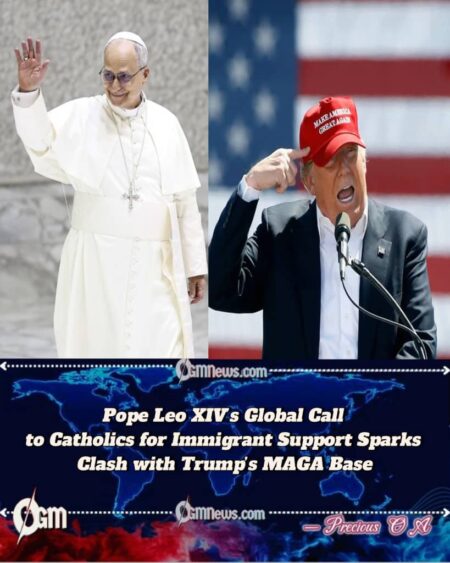
Pope Leo XIV called on Catholics worldwide during his Sunday Mass to “extend compassion and tangible support” to immigrants and refugees. He stressed that care for the displaced is at “the very heart of Christ’s teachings” and that Catholics must go beyond words to take “direct, visible action” to alleviate the suffering of those forced from their homes. This appeal has been described by Vatican observers as one of the strongest calls yet from the Church on immigration.
Pope Leo XIV framed his message as a moral imperative, stating that policies which “demonize rather than humanize” people in need run counter to both Christian ethics and universal human rights. Parishes and dioceses around the world were urged to open their doors, share resources, and offer legal assistance to migrants in need. Catholic bishops in Europe, Africa, and the Americas have begun drawing up guidelines to implement the Pope’s vision.
Pope Leo XIV emphasized that his appeal was not limited to national borders or political systems but rather directed at the global conscience of the Catholic faithful. He spoke of “a test of moral leadership for governments and believers alike,” warning against allowing fear to replace fraternity. His words echoed the Church’s long-standing teachings but were delivered with a sense of urgency that signaled a new phase of Vatican engagement on immigration issues.
Clash with President Trump’s Immigration Policies
Pope Leo XIV had, only days before this address, directly criticized the immigration measures enacted by President Donald Trump, who is currently serving his second term as the U.S. president. In a separate statement released by the Vatican, the Pope called such policies “cruel and inconsistent with the universal values of compassion and mercy.” This was seen by analysts as one of the most pointed rebukes of Trump’s immigration agenda from a major religious leader.
Pope Leo XIV highlighted specific measures, such as stricter asylum limits and expanded deportation programs, as examples of “institutional indifference to human suffering.” He warned that policies which treat migrants “as a problem rather than people” erode not only moral authority but also the credibility of nations that claim to champion human rights. While the pontiff’s remarks did not name Trump in every instance, the context was clear to his audience worldwide.
President Trump responded to reporters after a cabinet meeting, defending his immigration policies as “necessary to protect American borders and American families.” He stated that while he respected the Pope’s perspective, “my job is to defend the United States.” His supporters within the MAGA movement took to social media to frame the Pope’s remarks as political interference, suggesting the Vatican was “overstepping its spiritual role” by criticizing a sovereign nation’s security policies.
Global Reactions and Broader Implications
Pope Leo XIV has received praise from immigrant-rights organizations and humanitarian agencies for what they see as a crucial moral counterweight to restrictive immigration policies worldwide. Maria Gonzalez, director of a prominent global refugee charity, described the Pope’s appeal as “the leadership the world needs right now.” She noted that faith leaders hold extraordinary power to shape public conscience and political will.
Pope Leo XIV’s comments have also sparked debate within the Catholic Church itself, particularly in the United States, where many believers identify both as Catholic and as supporters of President Trump. Conservative Catholic commentators argued that the Pope’s stance risks alienating large portions of the faithful by prioritizing political issues over spiritual matters. Progressive Catholics, on the other hand, hailed the speech as a reaffirmation of the Church’s social justice mission.
Pope Leo XIV’s repeated insistence that Catholics choose “fraternity over fear” could reshape the way parishes and dioceses engage with migrant communities. If implemented widely, his directives may lead to new partnerships between the Church and humanitarian groups, creating networks of support that extend beyond national boundaries. Whether this will soften opposition from nationalist movements or harden resistance remains to be seen, but it marks a pivotal moment in the intersection of faith and politics.


