










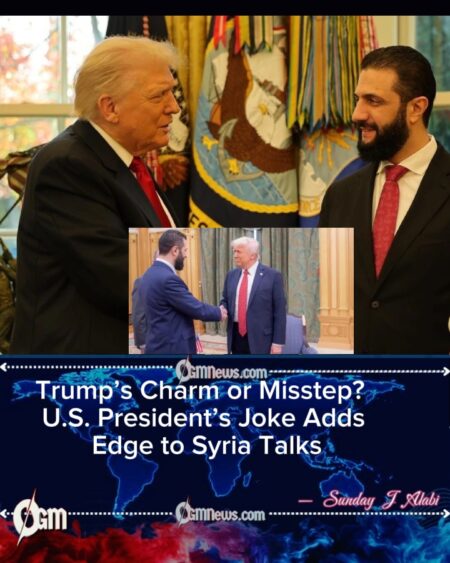
In a moment meant to symbolize renewed diplomatic engagement, U.S. President Donald Trump — now serving his second term — hosted Syrian President Ahmed al-Sharaa at the White House this week. The visit marked the first time a Syrian head of state has entered the iconic residence since Syria’s independence in 1946.
However, the historic tone quickly shifted when President Trump made a lighthearted but controversial remark about Sharaa’s wife. The U.S. leader presented his guest with a bottle of his signature fragrance, Trump Cologne, before jokingly asking, “How many wives do you have?” The Syrian leader, who smiled politely, replied that he had one. Trump responded with a grin, “With you guys, I never know!” — a comment that drew laughter but also stirred discomfort among observers.
The Exchange Between Trump and SharaaThat Sparked Debate
According to video footage from the meeting, Trump began the interaction by spraying the $249-a-bottle cologne on Sharaa’s beard, calling it “the best fragrance.” He then offered a second bottle for Sharaa’s wife, Latifa al-Droubi, whom the Syrian president has described as his “greatest support through a decade of struggle.”
When Sharaa returned the question by asking Trump how many wives he had, the president chuckled and replied, “Uh, right now one.” The exchange, while seemingly humorous, has prompted discussions about diplomatic decorum and cultural sensitivity — particularly given the complex history between the U.S. and the Muslim world.
From Rebel Commander to President
Ahmed al-Sharaa’s presence in the White House underscores an extraordinary personal and political transformation. Once a member of al-Qaeda during the Iraq conflict, Sharaa was captured by U.S. forces and held for five years before his release in 2011. Following years of opposition to former Syrian president Bashar al-Assad, Sharaa led an 11-day assault on Damascus in November 2024, resulting in Assad’s flight to Russia and the collapse of his government.
Officially sworn in as president on January 29, Sharaa has since sought to present himself as a reformer intent on rebuilding Syria’s shattered institutions and restoring international legitimacy. His administration’s stated priorities include economic reconstruction, counterterrorism cooperation, and reintegration into the global community.
Washington’s Calculated Diplomacy
President Trump has been cautiously optimistic about the new Syrian leadership. During Monday’s press briefing, he praised Sharaa as “a strong leader” and pledged to “do everything we can to make Syria successful.” At the same time, Trump acknowledged Sharaa’s past with a characteristically direct comment: “We’ve all had rough pasts.”
The meeting — conducted behind closed doors and without the ceremonial fanfare typically afforded to visiting heads of state — reflects Washington’s measured approach. Sharaa was ushered into the White House through a side entrance, avoiding the West Wing’s main door, where media coverage is usually more prominent.
Sanctions and Syria’s Bid for Economic Relief
Central to the discussions was Syria’s appeal for the full repeal of the Caesar Act — U.S. legislation imposing severe sanctions on Damascus over past human rights abuses. Although the Trump administration previously issued temporary waivers, the Syrian side is pushing for permanent relief.
In a statement released prior to the visit, Syria’s Ministry of Information emphasized that President Sharaa would “highlight the need to lift economic sanctions, particularly the Caesar Act, to enable economic recovery and attract foreign investment.” The statement also reaffirmed Syria’s commitment to “fighting terrorism and promoting regional stability.”
The Broader Strategic Picture
The White House visit signals a potential recalibration of U.S. policy toward Syria and the broader Middle East. Analysts suggest that Washington is exploring pragmatic cooperation with Sharaa’s government, particularly in counterterrorism and regional security. The meeting also coincides with ongoing U.S. efforts to consolidate its influence in the Middle East amid shifting alliances and global power competition.
While the lighthearted moment between Trump and Sharaa captured headlines, the underlying policy discussions point to a more consequential development — the possible re-entry of Syria into the U.S.-led coalition against the Islamic State and the gradual normalization of diplomatic relations between the two nations.
A Diplomatic Milestone Shadowed by Levity
Though critics called Trump’s comment “undiplomatic,” supporters dismissed it as characteristic banter from a president known for his unfiltered style. For Sharaa, the visit nonetheless represents a major step toward legitimacy and the restoration of Syria’s ties with Washington.
As one senior diplomat observed, “It was a meeting both symbolic and awkward — a reminder that even when history is being made, the personality of the moment can still shape the tone.”


