










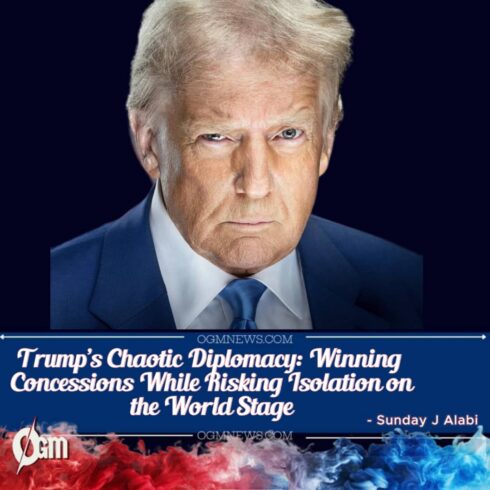
How Trump’s ‘Madman Theory’ Is Redefining Global Politics—and It’s Working
When asked last month whether he planned to join Israel in launching military strikes against Iran, U.S. President Donald Trump gave a characteristically opaque response: “I may do it. I may not do it. Nobody knows what I’m going to do.” This calculated ambiguity—soon followed by an unexpected bombing of Iranian nuclear sites despite reports of a negotiation pause—captures the essence of Trump’s foreign policy approach: radical unpredictability.
This is not randomness for its own sake. Trump’s unpredictability has morphed into an explicit doctrine reminiscent of Richard Nixon’s so-called “Madman Theory,” where projecting volatility is used as a tool of coercion in international relations. Trump’s leadership style, deeply personal and centralized, now drives America’s global engagements, altering alliances, unsettling adversaries, and reshaping the balance of power.
Observers note that Trump’s personality is no longer a background feature but the centerpiece of U.S. diplomacy. As Professor Peter Trubowitz of the London School of Economics puts it: “Policy decisions are now dependent on Trump’s temperament, preferences, and moods.” His unpredictability, once seen as a liability, has become a calculated asset.
Trump Alienating Allies, Emboldening Adversaries
Trump’s second term has been marked by a striking pattern: disparaging America’s traditional allies while embracing autocrats. Early in his presidency, he mocked Canada by suggesting it become the “51st state,” floated the idea of annexing Greenland, and even questioned NATO’s foundational Article 5, which mandates mutual defense.
Such remarks—once unthinkable—have had tangible consequences. A series of leaked communications from Trump’s administration revealed a disdain for European allies, whom officials described as “freeloaders” and “pathetic.” Even in public forums, such as the Munich Security Conference, Trump’s administration made clear that the U.S. no longer wishes to serve as Europe’s security guarantor.
This apparent withdrawal has pushed European nations into an uncomfortable recalibration. The UK, for instance, recently hiked its defense spending to 5% of GDP—more than double previous commitments—mirroring similar moves across NATO. While Trump’s strategy appears to be extracting immediate concessions, it has simultaneously eroded decades of transatlantic trust.
The Predictability of Unpredictability: A Double-Edged Sword
Trump’s strategy is not entirely unprecedented. In 1968, President Nixon employed a similar tactic, suggesting to adversaries that he might act irrationally unless they negotiated in earnest. Trump, however, has elevated this idea into a governing principle, using unpredictability as a lever not just in conflict zones but also in dealings with allies.
At the recent NATO summit, leaders seemed eager to flatter Trump, with NATO Secretary General Mark Rutte sending effusive messages thanking him for his “decisive action” on Iran. Trump, characteristically, leaked the message, reportedly finding amusement in the groveling.
Yet the danger is that this tactic may backfire. If allies and adversaries alike begin to recognize that Trump’s unpredictability stems from deeply ingrained, observable patterns—such as a craving for adulation or short-term victories—they may find ways to anticipate and counteract his moves. The “Madman Theory” works only if the perceived madness is convincing and opaque.
Facing Unyielding Foes: Iran, Russia, and the Limits of Chaos
While Trump’s unpredictability has unsettled allies, its impact on America’s adversaries has been less clear-cut. Ukrainian President Volodymyr Zelensky, after tense Oval Office meetings, eventually made concessions favorable to the U.S., including granting lucrative mineral rights. However, Russia’s Vladimir Putin has remained unmoved, continuing his aggressive posture in Ukraine despite repeated overtures and threats.
Iran presents the greatest test of the Madman Theory’s limits. Trump’s surprise decision to bomb Iranian nuclear facilities was intended as a shock to force Tehran back to the negotiating table. Yet experts warn it may have the opposite effect, accelerating Iran’s pursuit of nuclear weapons out of fear of regime change. William Hague, former UK Foreign Secretary, and Professor Michael Desch of Notre Dame both argue that rather than deterring Iran, Trump’s actions are likely to deepen its resolve to acquire the “ultimate deterrent.”
Historical lessons from Iraq, Libya, and North Korea suggest that states under threat from unpredictable U.S. policies are more likely to seek nuclear capabilities, not less. Iran’s leadership may view the current U.S. approach as further justification for hardening its stance.
The Growing Isolation of the United States
The long-term consequences of Trump’s unpredictability are becoming increasingly apparent. While allies have made short-term concessions—most notably sharp increases in defense spending—there is growing skepticism about America’s reliability as a partner. German Chancellor Friedrich Merz recently declared that Europe must become operationally independent from the United States, a striking admission after 80 years of security dependency.
Professor Julie Norman of University College London warns that unpredictability, while momentarily advantageous, may render the U.S. an unreliable negotiator in the eyes of the world. “If partners no longer trust that the U.S. will honor its commitments, the international system risks fragmenting,” she cautions.
To achieve true independence, European nations would need to dramatically expand their own defense industries, intelligence capabilities, and military manpower—an undertaking that could take years. Yet the process has begun, catalyzed in large part by Trump’s foreign policy revolution.
The Future of the ‘Madman Doctrine’: Strategic Brilliance or Fatal Flaw?
As Trump continues to wield unpredictability as a tool of statecraft, the question remains: is this a masterstroke of negotiation or a strategy destined to collapse under its own contradictions?
While the short-term results—military spending increases, new bilateral deals, and recalibrated alliances—suggest some success, the broader picture is more precarious. America risks alienating not only adversaries but also its oldest allies. And while unpredictability may force concessions from the weak, it appears less effective against determined adversaries like Russia and Iran.
Perhaps most importantly, the more Trump relies on his chaotic image, the more predictable it becomes. As world leaders adapt to this new reality, the efficacy of the Madman Theory could wane, leaving the United States isolated in a world it no longer fully controls.
In the end, what began as a strategy of strength could ultimately sow the seeds of strategic vulnerability.


