








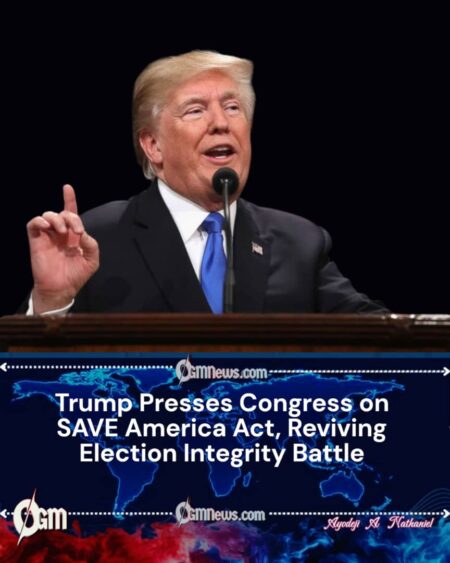
In a forceful public statement, President Donald Trump declared that America’s elections are “rigged, stolen, and a laughingstock all over the world,” urging Congress to immediately pass what he calls the SAVE America Act. Writing on Truth Social, the president framed the issue as existential, arguing that without sweeping reforms the country risks losing public confidence in democratic governance.
The remarks have intensified an already polarized national discussion about election administration, federal authority, and voting rights. While supporters view the proposal as a necessary step to restore trust, critics warn it could restrict access to the ballot and face serious constitutional challenges.
President Donald Trump Message and Call to Congress
In his post, President Donald Trump appealed directly to the House of Representatives and the Senate, calling on Republican lawmakers to “fight” for immediate passage of the SAVE America Act. He characterized the reforms as urgent and non-negotiable, portraying them as central to national survival rather than routine legislative business.
White House allies say the message reflects long-standing concerns among conservative voters about election integrity. They describe the post as a political directive meant to prioritize election legislation amid competing policy debates in Congress.
Core Provisions of the SAVE America Act
As outlined by the president, the SAVE America Act would introduce three major nationwide standards. The first would require all voters to present government-issued voter identification before casting a ballot. Proponents argue this would align voting with identification requirements already common in daily life.
The second provision would mandate proof of U.S. citizenship at the point of voter registration. Supporters say this would ensure only eligible citizens are added to voter rolls, while opponents argue existing systems already address this issue. The third proposal would significantly restrict mail-in voting, permitting it only for illness, disability, military service, or travel.
Federalism, Election Law, and Constitutional Limits
Elections in the United States are largely administered by individual states, with federal law setting baseline standards. Legal scholars note that any nationwide overhaul would need to reconcile state authority with congressional power under the Constitution.
Civil rights attorneys caution that voter ID and registration requirements have historically triggered litigation, particularly under the Voting Rights Act and equal protection clauses. President Donald Trump has maintained that the proposed standards would be applied uniformly and fairly, but experts say the final legal outcome would depend on legislative details and implementation.
Political Responses and Partisan Division
Republican lawmakers and conservative advocacy groups welcomed the call, praising President Donald Trump for keeping election integrity at the forefront of the national agenda. They argue that clearer rules would reduce disputes, litigation, and post-election controversy.
Democratic leaders rejected the president’s characterization of U.S. elections, pointing to court decisions and state certifications that have upheld recent results. They warned that the SAVE America Act, as described, could disproportionately affect minority voters, the elderly, and low-income citizens.
Claims, Evidence, and Public Trust
Claims that U.S. elections are broadly “stolen” have been examined repeatedly by courts, election officials, and independent reviews, many of which have found no evidence of widespread fraud sufficient to alter national outcomes. Nonetheless, public confidence in elections remains uneven, often tracking partisan affiliation.
Political analysts say the renewed push reflects a strategic effort by President Donald Trump to anchor his second-term agenda around election reform, framing it as both a governance and cultural issue. Supporters argue perception matters as much as proof, while critics counter that rhetoric itself can undermine trust.
Legislative Outlook and What Comes Next
As of now, no full legislative text for the SAVE America Act has been formally introduced. Congressional leaders say any such bill would undergo committee hearings, amendments, and debate before a floor vote, a process that could take months.
Whether the proposal advances will depend on party negotiations, public pressure, and legal assessments. President Donald Trump has signaled he intends to keep the issue prominent, suggesting election reform will remain a defining and contentious priority of his administration.