



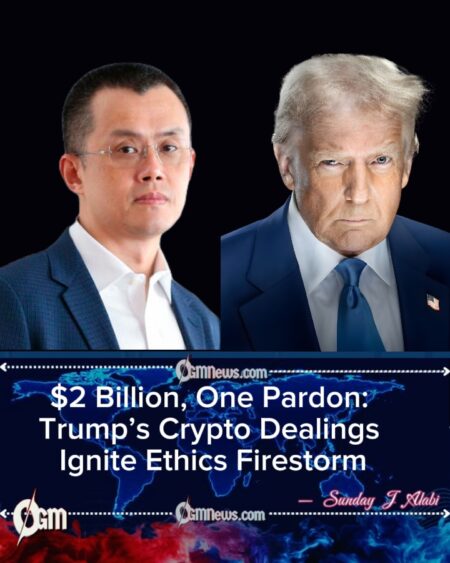
President Donald Trump, now serving his second term as the current U.S. president, is facing renewed scrutiny over his use of the pardon power after quietly granting clemency to Changpeng Zhao, one of the world’s richest crypto billionaires and founder of Binance, the globe’s largest cryptocurrency exchange.
Zhao, a Chinese-born businessman and citizen of the United Arab Emirates, had pleaded guilty in 2023 to failing to prevent money laundering on Binance, which led to a $4 billion fine for the company and a four-month prison sentence for Zhao. The U.S. Department of Justice accused him of allowing his platform to be used to move money for criminal networks and terrorist organizations, including Al-Qaeda, Hamas and ISIS.
The pardon, signed on October 21 and not formally announced by the White House, has raised concerns about whether presidential clemency is being used to reward financial benefactors and foreign partners rather than to correct injustices. Critics point to a complex web of financial ties connecting Zhao, President Trump’s family crypto venture, and a multi-billion-dollar investment from the United Arab Emirates that relied heavily on a Trump-linked digital currency.
From Criminal Case to Presidential Clemency
Zhao’s legal troubles stemmed from a landmark U.S. enforcement action that described Binance as a major gateway for illicit finance. Prosecutors said the platform failed to implement adequate controls, making it a vehicle for money laundering, sanctions evasion and the movement of funds for extremist organizations.
Despite this, Zhao’s fortunes remained vast. After pleading guilty, he served a relatively short sentence and continued to wield considerable influence in the global cryptocurrency market. For many legal experts, that profile alone would have made him an unlikely candidate for a presidential pardon.
Elizabeth Oyer, a former Justice Department official who previously oversaw pardon applications before she was replaced by a Trump loyalist, said Zhao’s petition did not resemble the typical cases that reach the president’s desk. In her view, pardons are generally reserved for individuals who show remorse, rehabilitation, and a compelling humanitarian or legal justification. Zhao, she argued, did not fit those guidelines.
Former Pardon Official: ‘This Is Corruption, Not Justice’
Oyer has been sharply critical of the administration’s pardon practices since leaving government. Speaking about Zhao’s case, she described the decision as “absolutely not justice” and went further in her assessment.
She characterized the pardon as “corruption,” alleging that money and self-interest were central to the outcome. According to Oyer, the degree to which financial influence appears to have intersected with the decision was “unprecedented,” both in terms of how money flowed around the case and the apparent benefit to the president, his family, and close associates.
In her view, the Zhao pardon reflects a broader pattern in which the formal criteria set out by the Justice Department for clemency have been sidelined in favor of political loyalty, access, and financial advantage. “The influence that money played in securing this pardon is unprecedented,” she suggested, arguing that established pardon vetting norms had been effectively bypassed.
Trump’s Crypto Embrace and the Birth of World Liberty Financial
The pardon cannot be separated from the president’s long-running courtship of the cryptocurrency industry. During the 2024 campaign, Trump offered full-throated support for digital assets, styling himself as a champion of innovation against what he called overreach by regulators and “the slow and outdated big banks.”
In that climate, Trump’s inner circle unveiled World Liberty Financial, a family-linked venture positioned as a kind of crypto-era bank: a platform to offer financial services in digital currencies. Promotional material for the company, including a so-called “gold paper,” pitched it as a bold leap into the financial future, touting its potential as an alternative to traditional banking systems.
Yet, according to Austin Campbell, a former banker and crypto executive who has briefed Congress on digital assets and now teaches at New York University, the early reality behind the glossy branding was more modest. He described World Liberty Financial at launch as relatively unknown, understaffed, and still searching for the technical infrastructure needed to operate at scale. The firm had only partially filled its initial fundraising round and had, at best, a small team of engineers.
Binance Steps In: ‘Without Zhao, the Technology Doesn’t Exist’
That picture began to change dramatically when Zhao re-entered the scene after his prison term. Sources familiar with the matter say that Binance donated crucial software to World Liberty Financial, effectively providing the technical backbone the Trump family venture needed to launch its own cryptocurrency product. One source went so far as to say that “without Zhao, the technology doesn’t exist,” highlighting the dependence of the young company on Binance’s expertise and tools.
Shortly thereafter, Zhao filed his formal application for a presidential pardon. Around the same time, he became central to a landmark transaction that would transform World Liberty Financial from a niche start-up into a global player.
In May, an Emirati investment fund placed $2 billion into Binance. The transaction, however, was structured in a highly unusual way: rather than being executed in a major global currency, the deal was conducted entirely in World Liberty’s own cryptocurrency, a token that had been publicly available for only about five weeks.
Campbell said the single transaction instantly catapulted World Liberty from a small, largely speculative project into one of the largest so-called “stablecoins” in circulation. What had been a minor venture tied to the president’s family name suddenly found itself in the “big leagues” of the global digital asset system.
A Sword Over Their Head’: Foreign Money, Ethics and Influence
The Emirati decision to move $2 billion via a newly minted Trump-linked token has been described by some observers as “nuts,” given the short track record of the asset and the concentration risk it created. According to one source, the deal left Zhao’s Binance with the $2 billion effectively on deposit at World Liberty Financial, representing the majority of the company’s holdings.
That arrangement, analysts say, created a powerful lever of influence. With so much of World Liberty’s deposits tied to Binance-related funds, Zhao effectively held “a sword over their head” — the ability to significantly damage or even destabilize the Trump-linked venture by withdrawing or shifting those assets.
Lawrence Lessig, a Harvard law professor who has spent nearly two decades studying ethics in politics and the corrosive effect of money on democratic institutions, argued that the structure of the arrangement raises troubling questions. He said the relationship is “corrupting,” not necessarily because of a provable quid pro quo, but because it creates an environment in which foreign money, private business and public power are deeply entangled.
From Lessig’s perspective, the risk is that foreign governments and wealthy business figures may now see a straightforward path to seeking favor from Washington: instead of, or in addition to, making a persuasive policy argument, they can inject large sums into entities closely linked to the president’s family and partners. Whether or not that money directly changes any single decision, he warned, the appearance of influence can be enough to compromise public trust.
Policy, Perception and the Emirates Connection
Two weeks after the $2 billion World Liberty transaction, Trump announced that the United Arab Emirates would be investing in the United States, with Washington in turn agreeing to provide Abu Dhabi with highly restricted semiconductors for artificial intelligence development — a type of export that is closely monitored and controlled.
There is no direct evidence that the chip deal was connected to the World Liberty transaction or Zhao’s activities, and officials have maintained that the policies stand on their own merits. The Emirati side has described its choice of World Liberty as resting on “business suitability,” with no suggestion of impropriety.
Nevertheless, Lessig and others say the sequence of events underscores the broader risk: when foreign funds are flowing so heavily into a private, family-linked venture that operates alongside the president’s policy agenda, it becomes increasingly difficult for citizens to know whether decisions are being shaped by national interest or by private gain. In his words, “we can’t know what’s the actual reason for the decisions that the administration is making.”
For many observers, that uncertainty alone amounts to a serious ethical problem. Even if no law has been broken, the perception that foreign money and presidential power appear intertwined threatens to erode confidence in the integrity of U.S. foreign policy and economic decision-making.
Trump Denies Conflict as White House Rejects Allegations
When news of Zhao’s full and unconditional pardon leaked two days after it was signed, Trump appeared to distance himself personally from the Binance founder. In a public exchange with reporters, he referred to Zhao simply as “the crypto person,” said he did not believe he had ever met him, and cast the case as an example of politically motivated prosecution by the previous Biden administration.
The president claimed that “a lot of good people” had urged him to grant clemency and insisted that many believed Zhao had been treated unfairly and that his actions should not have been considered criminal. When pressed with the fact that Zhao had admitted his offenses, Trump lashed out at the press as “fake news” and reiterated his longstanding support for the crypto sector.
The White House has issued a blanket denial of any conflicts of interest, stating that neither the president nor his family has engaged in improper financial entanglements. Eric Trump, a co-founder of World Liberty Financial, has insisted that his father “has nothing to do with our company,” emphasizing that the president’s businesses are held in a family-operated trust.
Critics, including Oyer and Lessig, contend that such structures are insufficient to prevent conflicts when the beneficiaries are the president’s own relatives and close partners. To them, the Zhao pardon — set against the backdrop of a $2 billion foreign investment routed through a family crypto venture — has become a test case in how modern wealth, digital finance and political power can intersect in ways that challenge traditional safeguards of democratic accountability.