








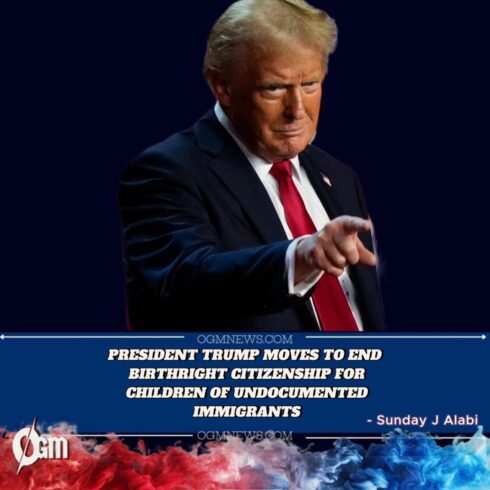
In a major legal blow to President Donald Trump’s immigration agenda, the U.S. Court of Appeals for the 9th Circuit on Wednesday ruled that his executive order limiting birthright citizenship is unconstitutional. The court stated that the order contradicts the clear language of the 14th Amendment, which grants citizenship to “all persons born in the United States and subject to the jurisdiction thereof.”
The court’s decision marks the first time a federal appellate panel has weighed in substantively on the merits of Trump’s order, issued on the first day of his second term. The order instructed federal agencies to stop issuing citizenship documents to children born in the U.S. if one or both parents are undocumented, temporary visa holders, or non-green card residents.
Constitutional Interpretation at the Core of Legal Clash
The three-judge panel’s opinion focused on the historical and textual meaning of the 14th Amendment, adopted in 1868. In rejecting the administration’s interpretation, the court wrote that the phrase “subject to the jurisdiction” plainly refers to anyone who is subject to U.S. law, not merely those with permanent legal status or allegiance.
“Perhaps the Executive Branch, recognizing that it could not change the Constitution, phrased its Executive Order in terms of a strained and novel interpretation,” the majority opinion stated. Judges Ronald Gould and Michael Daly Hawkins, appointed by Presidents Clinton and Obama respectively, agreed that the administration’s argument was based on an “unmoored” interpretation that conflicts with longstanding legal precedent.
The lone partial dissent came from Judge Patrick Bumatay, a Trump appointee, who argued that the states bringing the case lacked standing and that the court should not yet rule on the constitutional questions involved.
Legal and Political Fallout Across the Country
The executive order immediately triggered a wave of lawsuits from Democratic-led states, who argued that denying citizenship to U.S.-born children would increase administrative burdens and cause confusion in public service systems, particularly in education and health care.
In February, a federal judge in Washington state issued a temporary nationwide injunction halting implementation of the policy. That injunction was upheld by the 9th Circuit, which affirmed that the plaintiff states have the right to sue because they face “concrete financial and operational harms” under the order.
White House spokeswoman Abigail Jackson criticized the ruling in a statement, saying, “The Ninth Circuit misinterpreted the purpose and the text of the 14th Amendment. We look forward to being vindicated on appeal.”
Supreme Court Has Yet to Rule on Constitutional Merits
Although the matter has reached the Supreme Court in related contexts, the justices have not yet ruled on whether Trump’s birthright citizenship order violates the Constitution. A recent decision by the high court narrowed the scope of nationwide injunctions but did not address the fundamental legality of the executive order itself.
In that 6-3 ruling, the Supreme Court limited lower courts’ power to block federal policies nationwide unless it is necessary to provide complete relief to the plaintiffs. However, the ruling left open the door for class action lawsuits, one of which later resulted in a renewed nationwide block on the birthright citizenship order.
Observers say it is likely the high court will eventually be asked to rule directly on whether President Trump’s interpretation of the 14th Amendment is valid.
Trump Administration Defends Order Based on “Jurisdiction” Clause
The Trump administration maintains that the 14th Amendment’s citizenship clause does not apply to the children of undocumented immigrants or temporary visa holders, because those parents are not fully “subject to the jurisdiction” of the United States in a constitutional sense.
Legal experts across the political spectrum have largely rejected this interpretation. They point out that the phrase historically meant that individuals are subject to U.S. laws—something that applies to virtually all who are physically present on U.S. soil, regardless of their immigration status.
Nonetheless, administration lawyers continue to press the argument, emphasizing that birthright citizenship has never been directly ruled on by the Supreme Court in the modern context of undocumented immigration.
A Pivotal Battle in Trump’s Immigration Agenda
The birthright citizenship executive order is one of the most legally ambitious—and controversial—components of President Trump’s second-term immigration strategy. Though popular with segments of his base, it has drawn strong criticism from immigrant rights groups, legal scholars, and constitutional advocates.
While the order remains blocked, the Trump administration’s appeals and legal maneuvers signal that the fight is far from over. If the Supreme Court ultimately agrees to hear the case, it could result in a defining decision on the scope of citizenship rights under the U.S. Constitution—one with sweeping implications for immigration, civil rights, and the powers of the presidency.
For now, the 9th Circuit’s ruling stands as a clear rebuke of the executive action and a reaffirmation of one of the Constitution’s most enduring principles: that anyone born on American soil is, in the eyes of the law, an American citizen