










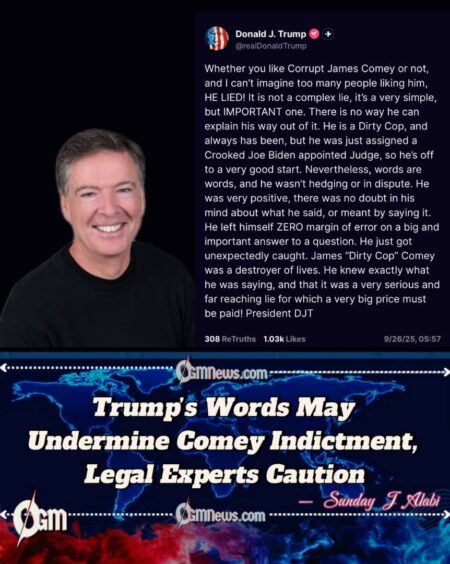
The indictment of former FBI Director James Comey on two federal counts — making false statements to Congress and obstructing a congressional proceeding — has stirred widespread debate over the independence of the Justice Department. The charges, announced Thursday, follow years of criticism from President Trump, who has long accused Comey of misconduct stemming from the FBI’s investigation into Russian interference in the 2016 election.
While President Trump has welcomed the indictment, legal analysts caution that his public hostility toward Comey could weaken the government’s case. Former federal prosecutor Gene Rossi told opitanglobamedia news that “the facts before the indictment and even comments Trump made after the indictment provide strong factual evidence” that Comey may have been targeted through selective or vindictive prosecution.
Adding to the controversy, the charges were brought only after a leadership shift in the U.S. Attorney’s Office for the Eastern District of Virginia. Lindsey Halligan, a former Trump defense lawyer with no prosecutorial experience, was installed as acting U.S. attorney days before the indictment and was the sole signatory on the charging documents.
Internal Disagreements and Legal Hurdles
Career prosecutors reportedly resisted pursuing the indictment, circulating a “declination” memo outlining why charges should not be filed. Their concerns, combined with the grand jury’s decision to reject a third proposed count, highlight the unusual circumstances surrounding the case. Rossi noted that these factors, along with Trump’s extensive record of public criticism, could support a motion to dismiss.
Comey, who has denied wrongdoing, responded in a video message declaring his innocence and calling for a fair trial. His attorney, Patrick Fitzgerald, is expected to argue that the indictment was politically motivated and unsupported by the evidence. Legal experts stress, however, that claims of selective or vindictive prosecution rarely succeed, given the high standard courts apply.
Carissa Byrne Hessick, a law professor at the University of North Carolina, explained that although judges are generally reluctant to accept such defenses, Comey’s case stands out because of its political overtones and the president’s unusually direct involvement. “The mixture of those two things … makes it too difficult to predict what a court will do here,” she said.
Trump’s Rhetoric and the Future of the Case
President Trump, now in his second term, has consistently denounced Comey, labeling him “corrupt” and “a dirty cop.” Following the indictment, he celebrated the development on social media, calling Comey “one of the worst human beings this Country has ever been exposed to.” Attorney General Pam Bondi and FBI Director Kash Patel also praised the charges, underscoring divisions within the federal law enforcement community.
For legal scholars, the political backdrop complicates an already challenging prosecution. Rossi warned that the visible animus from both the president and senior officials risks undermining public confidence in the fairness of the proceedings. “They are putting their thumb on the scale of justice instead of letting Lady Justice handle this matter blindly,” he said.
Whether the charges will withstand legal scrutiny remains uncertain. If the case is dismissed, it could mark another high-profile setback for the Justice Department at a time when its independence is under intense public examination.


