







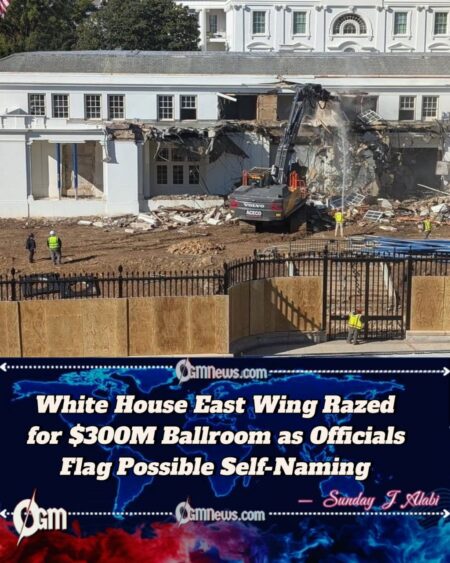
President Donald Trump’s ambitious plan to construct a grand ballroom at the White House has sparked controversy on multiple fronts, with officials revealing the structure may bear the president Trump’s own name and construction requiring the complete demolition of the historic East Wing. The $300 million privately funded project, now estimated to exceed $350 million, represents one of the most significant alterations to the White House complex in modern history, raising questions about presidential legacy, historical preservation, and the tradition of executive humility.
The Naming Controversy and Presidential Precedent
Officials have begun referring to the grandiose structure as “The President Donald J Trump Ballroom,” according to reports from ABC News, signaling the president’s intention to permanently affix his name to the addition. When questioned directly about the ballroom’s name, Trump deflected with a smile, stating “I won’t get into that now,” leaving the door open for official confirmation at a later date. The potential naming choice marks a significant departure from historical norms, as past presidents have traditionally refrained from naming White House monuments or structures after themselves, particularly while still in office.
The practice stands in stark contrast to previous administrations. President Harry S Truman, who commissioned extensive White House reconstruction including a balcony, only saw that structure named in his honor after leaving office. Trump, who built his real estate career in New York by prominently displaying his name on skyscrapers, appears poised to bring that branding approach to America’s most famous residence. White House spokesmen have emphasized that any official announcement regarding the ballroom’s name will come directly from President Trump himself, not through unnamed sources.
East Wing Demolition Reverses Initial Promises by President Trump
The project has taken a dramatic turn with the complete destruction of the 83-year-old East Wing, contradicting Trump’s original assurances that the historic structure would remain untouched. When announcing the ballroom earlier this year, the president Trump explicitly stated: “It won’t interfere with the current building. It’ll be near it but not touching it and pays total respect to the existing building, which I’m the biggest fan of.” However, photographs from Monday showing a backhoe smashing through the walls of the historic building set off alarm bells among preservationists and historians.
The White House initially remained vague about plans for the East Wing, with suggestions that portions of the structure would survive intact. Speaking from the Oval Office on Wednesday, Trump defended the demolition by displaying pictures of the ornate ballroom design and a model of the completed complex. “In order to do it properly, we had to take down the existing structure,” the president Trump explained, pushing back against criticism of the released demolition photos. Notably, First Lady Melania Trump has remained silent on the demolition despite the fact that the East Wing houses the offices of her entire staff. Public White House tours have been suspended during the construction period.
Ambitious Timeline and Escalating Costs
The White House has set an ambitious goal of completing the ballroom before President Trump leaves office in January 2029, though officials have not provided a specific timeline. Construction experts have expressed skepticism about this deadline, characterizing it as highly ambitious given the scale and complexity of the project. The estimated costs have already increased significantly, with the White House claiming to have raised $350 million for a project initially budgeted at $300 million.
According to White House officials, Trump “has received such positive and overwhelming support for the ballroom that he continues to receive donations.” The president Trump has repeatedly pledged to contribute millions of dollars of his own money to the construction. The project’s donor list reads like a who’s who of American technology, with executives from Google, Meta, Amazon, and Microsoft among the private contributors funding the massive undertaking. The influx of corporate donations and the ballroom’s potential naming have raised questions about influence and access at the highest levels of government.