










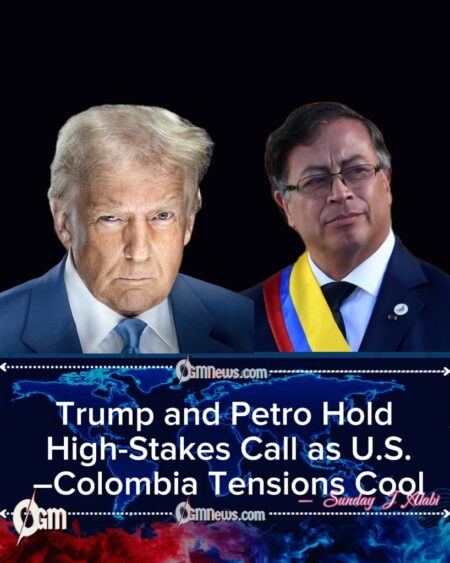
President Donald Trump, serving his second term as the current U.S. president, held a phone conversation on Wednesday with Colombian President Gustavo Petro, marking a notable diplomatic engagement after months of strained relations and sharp public rhetoric between Washington and Bogotá. The call, described by Colombian officials as “very positive,” came amid escalating tensions fueled by disagreements over drug trafficking, regional security, and U.S. military posture in Latin America.
The exchange appeared to soften a relationship that had recently deteriorated to one of its lowest points in years. While neither side suggested that longstanding differences had been resolved, both governments emphasized a renewed commitment to dialogue and future engagement, including a potential White House meeting between the two leaders.
Background to a Strained Relationship
Relations between the United States and Colombia have been tense for much of the past year, driven largely by Washington’s concerns over a reported surge in cocaine production. The Trump administration has accused the Petro government of failing to adequately curb the activities of drug cartels, framing the issue as a direct threat to U.S. national security.
President Trump has been especially vocal, previously labeling President Petro an “illegal drug leader” and publicly criticizing Colombia’s internal security policies. These accusations were reinforced by the announcement of U.S. sanctions targeting Petro and members of his family, with Treasury officials asserting that the Colombian government had allowed narcotics networks to expand unchecked.
Escalation in Rhetoric and Policy Disputes
Tensions intensified in recent months as disagreements spilled into public forums. President Petro, a former guerrilla fighter and Colombia’s first leftist leader in decades, has consistently criticized what he views as excessive U.S. militarization near Latin America. He denounced U.S. strikes on alleged drug-trafficking vessels during a speech at the United Nations and later called on American service members to disobey President Trump’s orders during a protest in New York.
The U.S. State Department responded by revoking Petro’s visa, characterizing his remarks as “reckless and incendiary.” The diplomatic fallout underscored the widening ideological divide between the two governments, even as Colombia remains a long-standing U.S. ally in the region.
The Call That Changed the Tone
Against this backdrop, Wednesday’s phone call represented a sharp shift in tone. President Trump said on his Truth Social platform that he “appreciated [Petro’s] call and tone,” noting that the Colombian leader reached out to explain disagreements related to drugs and broader bilateral issues. Trump added that discussions are underway for an in-person meeting at the White House.
Colombia’s embassy in Washington welcomed what it described as a “constructive exchange” and reaffirmed its commitment to open dialogue. A senior Colombian official familiar with the conversation characterized it as a “180-degree change” in rhetoric, signaling relief within Bogotá’s political circles.
Petro’s Perspective and Regional Vision
President Petro also offered his account of the conversation, stating on social media platform X that the two leaders discussed their differing visions for U.S.–Latin American relations. Petro emphasized his belief that the United States could become a strategic partner in regional energy development, supported by significant U.S. investment, while cautioning against viewing Latin America solely as a source of oil.
In a symbolic gesture, Petro shared an image depicting a jaguar and a bald eagle embracing, imagery he has used in the past to represent Colombia and the United States. The Colombian leader has repeatedly warned that U.S. military action in his country would “awaken the jaguar,” a metaphor underscoring Colombia’s sovereignty concerns.
Recent Flashpoints and Military Tensions
The diplomatic thaw followed a particularly volatile period triggered by the U.S. military’s overnight capture of former Venezuelan President Nicolás Maduro. Petro condemned the operation as an act of “aggression,” further inflaming regional anxieties over U.S. intervention.
Shortly afterward, President Trump intensified his criticism of Colombia, calling the country “very sick” and accusing its leadership of profiting from cocaine trafficking. When asked whether such remarks suggested possible U.S. action in Colombia, Trump replied, “It sounds good to me,” prompting strong reactions in Bogotá.
Cautious Optimism and Unresolved Challenges
While Wednesday’s call appears to have eased immediate tensions, significant policy disagreements remain unresolved. Issues surrounding narcotics control, military cooperation, sanctions, and regional strategy continue to divide the two governments. Analysts caution that sustaining the improved tone will require concrete follow-up actions rather than symbolic gestures alone.
Still, officials on both sides suggested that the conversation marked an important step toward stabilizing relations. For now, the planned White House meeting and renewed diplomatic engagement offer cautious optimism after a period defined by confrontation and mistrust.


