








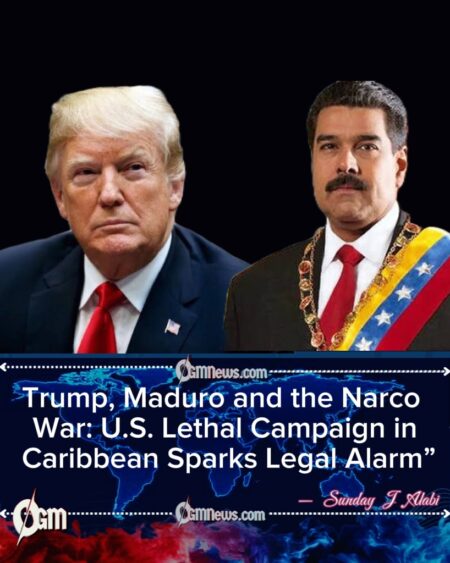
President Donald Trump, now serving his second term as U.S. president, reportedly held a secret phone conversation with Venezuelan leader Nicolás Maduro as Washington intensified a controversial campaign of lethal strikes against suspected Venezuelan drug traffickers.
According to multiple sources cited by The New York Times, the call took place last week and included discussions about a possible future meeting between the two leaders. U.S. Secretary of State Marco Rubio was also said to have joined the conversation. However, one source stressed that no concrete plans for a face-to-face meeting currently exist.
The phone call came against the backdrop of escalating military operations in the Caribbean, where U.S. forces have been authorized to launch missile strikes against vessels suspected of transporting narcotics from Venezuela. The Trump administration has framed these strikes as part of a broader crackdown on “narco-terrorists” and a sharp departure from previous U.S. policy in the region.
A New Era of Lethal Anti-Drug Operations
The campaign, which current and former Pentagon officials say has killed more than 80 people, marks a significant escalation in the use of military force in anti-drug operations. According to The Washington Post, one of the most controversial incidents occurred on 2 September, when a U.S. missile strike reportedly hit a vessel believed to be ferrying drugs from Venezuela. All 11 people on board were killed.
Sources with direct knowledge of the operation told the newspaper that the first missile set the boat ablaze. When the smoke cleared, intelligence analysts allegedly observed two survivors clinging to the wreckage. In line with what has been described as a “kill everybody” directive, a second missile was launched, killing the remaining survivors.
The September strike was reportedly executed by SEAL Team 6 and overseen by Admiral Frank “Mitch” Bradley. Two sources told The Washington Post that during a conference call, Bradley insisted that the survivors remained a threat, as they could alert other traffickers and call for help to salvage the cargo. One individual who watched the live feed described the footage as “horrifying,” highlighting the human cost of the operation.
Pentagon on the Defensive Over ‘Kill Everybody’ Directive
The Pentagon has moved quickly to deny the most explosive claim surrounding the operation: that Defense Secretary Pete Hegseth told analysts to “kill everybody” on board the targeted vessel.
On Friday, Hegseth took to X to denounce the report as “fabricated, inflammatory, and derogatory.” He nonetheless defended the underlying strategy, vowing to continue what he described as “lethal, kinetic strikes” aimed at eliminating narco-terrorists who are “poisoning the American people.”
In a pointed political contrast, Hegseth attacked the previous administration’s handling of border security and narcotics, accusing it of a “kid gloves approach” that allowed “millions of people – including dangerous cartels and unvetted Afghans – to flood our communities with drugs and violence.” He asserted that under Trump, the border has been “sealed” and that the U.S. has “gone on offense” against cartels. “Biden coddled terrorists, we kill them,” he wrote, adding in a separate post that “we have only just begun to kill narco-terrorists.”
Chief Pentagon spokesman Sean Parnell also rejected the allegations, describing the media narrative as “completely false.” In his statement to The Washington Post, Parnell insisted that ongoing operations to dismantle narcoterrorism networks and protect the U.S. homeland from deadly drugs “have been a resounding success.”
Legal and Ethical Questions Over Second Strike
While the Pentagon defends the broader campaign, the reported second missile strike on survivors has triggered a fierce debate among legal experts and lawmakers about its legality under international law.
Todd Huntley, a former military lawyer who previously advised U.S. Special Operations forces, told The Washington Post that because the United States and Venezuela are not in a formal state of armed conflict, killing the survivors could “amount to murder.” The United Nations Charter generally limits the use of force to self-defence in response to an actual or imminent armed attack.
Anthony Clark Arend, an international law specialist at Georgetown University, told Politifact that there has been no public evidence that the targeted vessel was engaged in or about to engage in an armed attack. Under that interpretation, a follow-up strike on survivors would sit on very shaky legal ground.
On Capitol Hill, Representative Seth Moulton was among those to sharply criticize the official rationale reportedly given to lawmakers — that the second strike was carried out to “remove carnage” rather than to kill survivors. Moulton dismissed that explanation as “patently absurd,” arguing that “killing survivors is blatantly illegal.” He warned that Americans involved in the operation “will be prosecuted for this, either as a war crime or outright murder,” even if accountability may take time.
Expanding Campaign Against ‘Narco-Terrorists’
Despite the mounting controversy, the Pentagon has reportedly continued to expand its operations. Internal data seen by The Washington Post suggests that, since the September incident, U.S. forces have launched missiles at at least 22 more boats suspected of carrying drugs from Venezuela.
Secretary of State Marco Rubio announced earlier this month that the U.S. government has formally designated the Cartel de los Soles as a Foreign Terrorist Organization. According to Rubio, the group consists of high-ranking figures loyal to Maduro who have infiltrated and corrupted Venezuela’s military, intelligence services, legislative institutions, and judiciary, and are engaged in both narcotics trafficking and terrorist violence.
However, experts interviewed by CNN cautioned that “Cartel de los Soles” is more a broad label for corrupt Venezuelan officials involved in illicit activities than a coherent, centralized terror group. That distinction further complicates the legal and diplomatic ramifications of treating them as terrorists and targeting suspected associates with lethal military force.
Trump: U.S.–Venezuela Relations: Dialogue and Deterrence
Trump’s reported phone call with Maduro has added a complex political layer to already strained U.S.–Venezuela relations. While the two leaders reportedly discussed the possibility of a meeting, officials familiar with the matter say such an encounter remains speculative and that no specific date or venue has been set.
Publicly, the Trump administration has remained strongly opposed to Maduro’s rule. Secretary of State Rubio has repeatedly described Maduro as an “illegitimate president,” pointing to allegations of electoral fraud, human rights abuses, and widespread corruption in Venezuela. The phone call, therefore, appears to highlight a tension between public denunciation and discreet back-channel communication.
The White House has maintained that its posture towards Caracas is driven by the need to curb drug flows, support democratic governance, and protect U.S. communities from cartel-linked violence. At the same time, critics say the lethal maritime campaign risks further destabilizing the region and undermining Washington’s moral authority on human rights and the rule of law.
Trump Signals Shift From Sea to Land Strikes
Trump: Speaking to U.S. service members on Thanksgiving, roughly a week after the reported call with Maduro, President Trump signalled that the administration’s anti-drug campaign may soon extend more aggressively onto land.
“In recent weeks, you’ve been working to deter Venezuelan drug traffickers, of which there are many. Of course, there aren’t too many coming in by sea anymore,” he said, suggesting that maritime operations had already had a significant deterrent effect. Trump added that it was “easier” to intercept suspected traffickers on land and indicated that expanded land-based strikes would begin “very soon.”
“We warn them: Stop sending poison to our country,” he declared, framing the strategy as a defensive measure to protect American lives. Human rights advocates and legal scholars, however, say any expansion of lethal operations on land — especially outside an acknowledged war zone — will intensify questions about transparency, proportionality, and compliance with both U.S. and international law.
Questions of Accountability as White House Stays Silent
As revelations about the September strike and subsequent operations circulate, pressure is mounting for clearer answers from the administration. Lawmakers are seeking more detailed briefings, while advocates are calling for independent investigations into both the conduct of the strikes and the rules of engagement guiding them.
Discrepancies between what congressional aides say they were told — that the second strike was meant to “clear carnage” — and what sources close to the operation allege — that survivors were deliberately targeted — have only deepened mistrust. The lack of publicly disclosed evidence about the nature of the suspected drug vessels, the identities of those killed, and the extent of civilian casualties continues to fuel demands for greater transparency.
Opitanglobamedia has reached out to the White House for comment on the reported phone call, the “kill everybody” allegation, and the broader legal justification for the campaign. As of press time, no official response had been received, leaving many of the most pressing questions unanswered.