





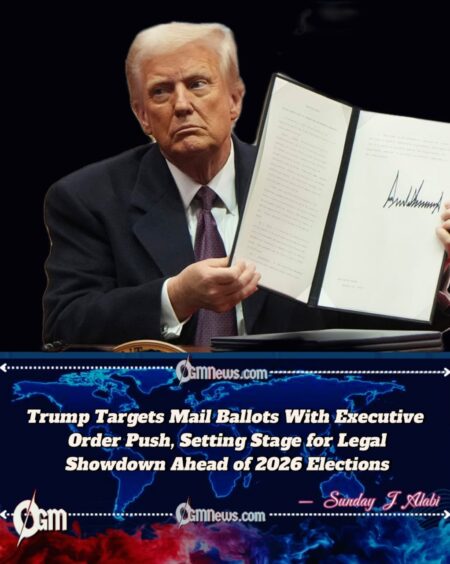
President Donald Trump on Monday vowed to ban mail-in voting before the 2026 midterm elections, saying his administration is already drafting an executive order to halt the practice. Speaking during an Oval Office meeting with Ukrainian President Volodymyr Zelenskyy, Trump declared that Republicans would “do everything possible” to end what he described as a “corrupt” system of voting.
The pledge reignited a political and legal debate that has persisted since the contested 2020 election. While Trump insists that mail-in ballots undermine election integrity, constitutional experts argue that the president lacks the authority to unilaterally dictate how states administer their elections.
Why Trump Wants to Ban Mail-In Ballots
Trump has long argued that mail-in voting is rife with opportunities for fraud. On Monday, he claimed voters in states like California sometimes receive “five, six, seven ballots” at their homes, suggesting a system easily manipulated. “Mail-in ballots are corrupt,” the president asserted, vowing Republicans would stop them through federal action.
Critics, however, have consistently disputed those claims. After the 2020 election, which saw unprecedented mail voting due to the pandemic, the Cybersecurity and Infrastructure Security Agency declared it “the most secure in American history.” Debra Cleaver, founder of VoteAmerica, noted that outgoing and return ballots are tracked with barcodes, making large-scale fraud nearly impossible.
The Looming Executive Order — Would It Be Legal?
Earlier Monday, Trump said in a social media post that his executive order would “help bring HONESTY to the 2026 Midterm Elections.” He suggested that states are merely “agents” of the federal government in elections, implying they must follow presidential directives.
But constitutional scholars immediately pushed back. Article I, Section 4 of the Constitution gives states the power to regulate the “times, places and manner” of elections, with authority to override them resting only in Congress — not the White House. Any unilateral executive action to end mail-in voting would almost certainly face immediate legal challenges.
Trump’s Global Claim on Mail-In Voting
The president also argued that the U.S. is “the only country in the world that uses mail-in voting.” He told reporters, “You will never have an honest election if you have mail-in. It’s the only way Democrats can get elected.”
That claim is demonstrably false. According to the International Institute for Democracy and Electoral Assistance, at least 30 countries — including Canada, the United Kingdom, Switzerland, Germany, and Denmark — allow voting by mail for some or all voters. Many of these nations have long-established systems designed to ensure ballot security.
The Role of Mail-In Voting in U.S. Elections
In the United States, 28 states currently allow voters to request mail ballots without giving a reason, while others restrict the practice to those with documented needs such as illness or military service. The COVID-19 pandemic dramatically expanded the use of mail voting in 2020, with 43% of ballots cast by mail, according to the Election Assistance Commission.
Though the share declined in 2024, when Trump returned to the presidency, more than 46 million Americans still voted by mail, accounting for nearly a third of all ballots. This enduring reliance shows the method remains a central part of U.S. elections, particularly for older voters, military families, and citizens with disabilities.
Putin and Trump Discuss Mail Voting
The mail voting controversy surfaced during Trump’s recent meeting with Russian President Vladimir Putin. Trump told Fox News that Putin called mail-in voting a “disaster” and claimed it allowed Democrats to steal the 2020 election. According to Trump, Putin told him, “You won that election by so much, and that’s how Biden got it.”
However, multiple audits, recounts, and investigations — including those led by Republican officials — found no evidence of widespread fraud in the 2020 election. Trump’s continued insistence that mail voting undermines democracy sets the stage for yet another clash over election rules as the 2026 midterms approach.
What Comes Next?
The White House insists that Trump’s initiative is about restoring integrity to American elections. Spokesperson Harrison Fields said Democrats had “eroded faith in our elections” through “unfettered mail-in voting” and that the president seeks to strengthen safeguards such as voter ID requirements.
Still, any executive order to restrict mail ballots is almost certain to land in federal court, setting up a constitutional battle months before the next round of elections. With both parties already gearing up for 2026, Trump’s pledge signals that voting access and election security will once again dominate the political debate.