










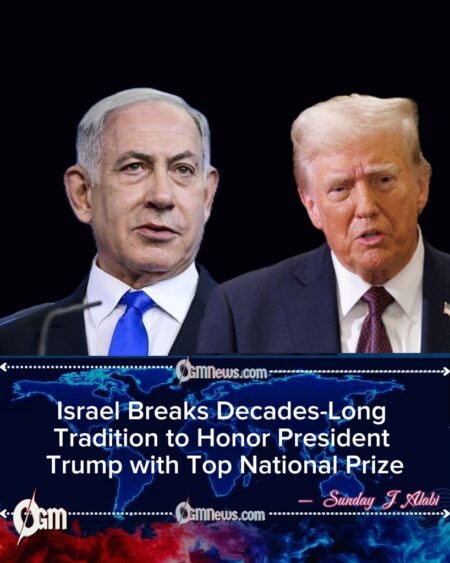
President Donald Trump, the current U.S. president serving a second term, is set to receive Israel’s highest national honor following an unusually warm and politically significant meeting with Israeli Prime Minister Benjamin Netanyahu at Mar-a-Lago. The announcement underscores the close personal and strategic relationship between the two leaders at a time of renewed uncertainty in Gaza, mounting regional tensions, and Trump’s continued pursuit of international recognition, including the Nobel Peace Prize.
The decision to award Trump the Israel Prize—traditionally reserved for Israeli citizens—comes amid stalled ceasefire efforts, unresolved humanitarian challenges in Gaza, and ongoing negotiations over the next phase of Trump’s U.N.-approved peace plan. While framed as a tribute to Trump’s support for Israel, the move also highlights the diplomatic stakes and controversies surrounding U.S.-Israeli relations in the Middle East.
A Historic Break with Tradition
Prime Minister Netanyahu announced that Trump would be awarded the Israel Prize, marking the first time in the award’s nearly 80-year history that it will go to a non-Israeli. Speaking after hours of closed-door discussions and a joint press conference at Mar-a-Lago, Netanyahu described the decision as a deliberate break with convention, reflecting what he called the “overwhelming sentiment” of Israelis across the political spectrum.
Established in 1953, the Israel Prize is the country’s highest cultural honor, typically recognizing lifetime achievements in the humanities, sciences, arts, and Jewish culture. Award recipients customarily receive a ceremonial pin and ribbon and are honored during Israel’s Independence Day celebrations, scheduled this year for April 21. Netanyahu expressed hope that Trump would accept the award in person in Israel.
The announcement was made publicly after Israel’s Education Minister, Yoav Kisch, informed Trump of the decision during a closed meeting between U.S. and Israeli delegations. Trump later described the award as “really surprising” and said it was “very much appreciated.”
Mar-a-Lago Talks and a Display of Political Affinity Between Trump And Netanyahu
The meeting between Trump and Netanyahu was marked by repeated expressions of mutual respect and personal loyalty. Both leaders highlighted their long-standing relationship, noting that while disagreements have arisen at times, they have managed them amicably. The atmosphere during press engagements was notably cordial, with both men praising each other’s leadership and resolve.
Trump repeatedly defended Netanyahu against criticism, describing him as a “wartime leader” facing extraordinary pressure. The remarks came amid Netanyahu’s ongoing corruption trial in Israel, in which he is accused of receiving gifts, including champagne and cigars, in exchange for political favors. Trump dismissed the scrutiny, framing it as an unfair burden during a period of national security crisis.
The meeting was the fifth between the two leaders this year, underscoring the frequency and depth of their engagement as the war in Gaza and broader regional concerns continue to dominate their agendas.
Gaza Ceasefire Plan Under Strain
Despite the positive tone of the meeting, substantive challenges remain unresolved. Trump’s Gaza ceasefire plan, which was approved by the United Nations, has stalled amid mutual accusations of violations by Israel and Hamas. Both sides have raised concerns over security guarantees, prisoner exchanges, and humanitarian access, threatening the fragile agreement.
The proposed second phase of the ceasefire is particularly complex. It requires Hamas to disarm and envisions the deployment of an unspecified international stabilizing force in Gaza. Humanitarian and logistical obstacles persist, including the delivery of aid and the restoration of basic services in the war-torn territory.
White House officials have privately expressed frustration with what they view as slow progress by both Israel and Hamas in advancing to this next phase, raising questions about the viability of the broader peace framework.
A Technocratic Vision for Gaza’s Future
Central to Trump’s 20-point peace plan is the creation of a technocratic, apolitical interim Palestinian government to replace Hamas’s decades-long rule in the Gaza Strip. Under the proposal, this administration would oversee daily governance while reporting directly to a newly established international body known as the Board of Peace, chaired by Trump.
The Board of Peace would be granted a renewable two-year mandate to coordinate Gaza’s reconstruction, manage international funding, and ensure security cooperation. The plan envisions rebuilding Gaza’s infrastructure and institutions under close international supervision, an approach that has drawn cautious interest as well as skepticism from regional actors.
While the framework has been endorsed by the United Nations, its implementation depends on sustained cooperation from Israel, Palestinian factions, and international partners—conditions that remain uncertain.
Iran, Regional Security, and Military Warnings
Beyond Gaza, discussions at Mar-a-Lago also focused on Iran’s nuclear and ballistic missile programs. Netanyahu reiterated Israel’s concerns about Tehran’s efforts to rebuild long-range missile capabilities, describing them as an existential threat to regional stability.
Trump responded by signaling firm support for Israeli military action if Iran continues pursuing nuclear weapons or advanced missile systems. He told reporters that the United States would back Israeli strikes under such circumstances, while also suggesting that a diplomatic deal with Iran would be a preferable outcome.
The remarks reinforced Trump’s hardline stance on Iran and highlighted the alignment between Washington and Jerusalem on containing Iranian influence in the Middle East.
Awards, Legacy, and the Nobel Ambition
Trump has repeatedly expressed frustration over not receiving the Nobel Peace Prize, often citing his role in resolving or de-escalating multiple international conflicts during his second term. The Israel Prize, while different in scope and intent, represents a significant symbolic recognition from a close ally.
For Netanyahu, the award serves both as a gesture of gratitude and a political statement, reinforcing Trump’s image as a steadfast supporter of Israel during one of its most challenging periods. For Trump, it adds to a growing list of accolades that he views as validation of his foreign policy approach.
As preparations begin for the award ceremony, the honor stands as both a personal milestone for Trump and a reflection of the deep, and sometimes controversial, U.S.-Israeli partnership shaping the region’s


