

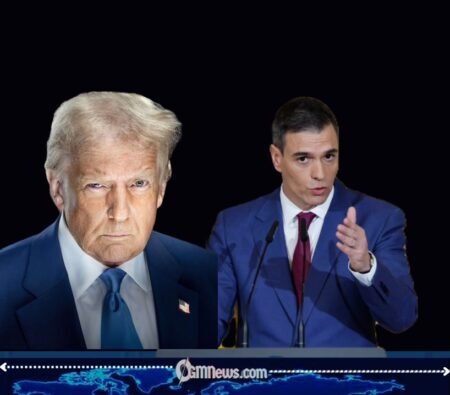
The diplomatic rift between Washington and Madrid deepened on Tuesday as U.S. President Donald Trump, currently serving his second term in office, threatened to impose a full trade embargo on Spain. The warning followed Spain’s refusal to allow U.S. forces to use military bases on its territory for missions linked to strikes on Iran.
Speaking during a meeting with German Chancellor Friedrich Merz, President Trump described Spain’s position as unacceptable and indicated he had instructed Treasury Secretary Scott Bessent to consider halting all trade relations. The remarks have raised concerns across Europe and within NATO about the potential economic and strategic consequences of an escalating transatlantic dispute.
Military Base Dispute Sparks Diplomatic Tension
At the centre of the disagreement is Spain’s decision not to permit the use of its southern military bases—Naval Base Rota and Morón Air Base—for U.S. operations connected to strikes on Iran. The facilities have long served as key logistical hubs for American and NATO forces operating in Europe, Africa, and the Middle East.
Following Madrid’s refusal, the United States relocated 15 aircraft, including refuelling tankers, from the Spanish installations. The move signalled a swift operational adjustment by Washington but also underscored the seriousness of the diplomatic breakdown between the two NATO allies.
Spain’s Socialist-led government has maintained that its decision was consistent with its foreign policy principles and international commitments. Officials in Madrid have not indicated any intention to reverse the position.
Trump Signals Trade Embargo
President Trump publicly criticised Spain’s stance, stating that the country had been “terrible” and suggesting that Washington could sever trade ties entirely. He said he had directed Treasury Secretary Scott Bessent to explore cutting off all dealings with Spain.
“We’re going to cut off all trade with Spain,” the President Trump said, adding that he believes he has broad authority to impose embargoes. His comments marked one of the strongest trade-related threats directed at a European Union member since the start of his second term.
The remarks came amid renewed debate over the limits of executive authority in trade policy. President Trump again referenced a recent Supreme Court ruling that found aspects of his broadest global tariff measures unlawful under a national emergencies statute, arguing that alternative tools remain at his disposal.
Defence Spending and NATO Friction
Beyond the immediate military dispute, the controversy reflects longer-standing tensions over defence spending within NATO. President Trump reiterated calls for all member states to allocate at least 5% of their gross domestic product to defence—well above NATO’s longstanding 2% benchmark.
Spain has consistently spent below the 2% target, drawing criticism from Washington. The president suggested that Spain contributes insufficiently to collective security while benefiting from U.S. military support, framing the base refusal as part of a broader pattern of non-compliance.
NATO officials have sought to avoid public escalation, but the dispute risks complicating alliance cohesion at a time of heightened geopolitical strain, particularly in relation to Iran and broader Middle East security dynamics.
European Union Pushes Back
German Chancellor Friedrich Merz, who met President Trump during the exchange, emphasised that Spain cannot be treated separately in trade negotiations. Spain, he noted, is a member of the European Union, and tariff agreements are negotiated collectively by Brussels.
“I said that Spain is a member of the European Union and we negotiate about tariffs with the United States only together or not at all,” Merz told reporters. “There is no way to treat Spain particularly badly.”
His remarks underscore the legal and political challenges facing any unilateral U.S. attempt to isolate Spain economically. Any embargo or targeted trade action could provoke a coordinated EU response, potentially widening the dispute beyond bilateral relations.
Economic Stakes on Both Sides
Spain’s exports to the United States include olive oil, automotive components, steel products, and chemicals—sectors that could face immediate disruption if trade restrictions are imposed. The U.S. is one of Spain’s significant non-EU trading partners, and bilateral commerce supports thousands of jobs in both countries.
For American businesses, particularly importers and manufacturers reliant on Spanish goods, a sudden embargo could increase costs and strain supply chains. Analysts caution that broad trade restrictions may have unintended economic consequences at a time when global markets remain sensitive to geopolitical instability.
U.S. Trade Representative Jamieson Greer, when asked publicly about the possibility of cutting off Spanish trade, indicated that discussions would continue with the president. “We know you can use it, and if you need to use it to assure national and economic security, we’ll do it,” he said, signalling that options remain under consideration.
Uncertain Path Forward
The coming days are expected to determine whether the dispute escalates into concrete trade measures or remains a rhetorical warning. Diplomatic channels between Washington, Madrid, and Brussels are likely to remain active as all sides assess the strategic and economic implications.
While President Trump has signalled readiness to act, the broader implications for NATO unity and EU-U.S. trade relations may encourage efforts toward compromise. For now, the standoff highlights the fragile balance between military cooperation, economic policy, and alliance politics in an increasingly complex international landscape.