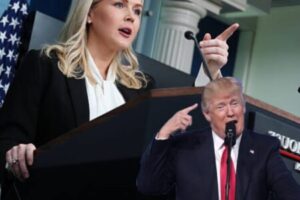


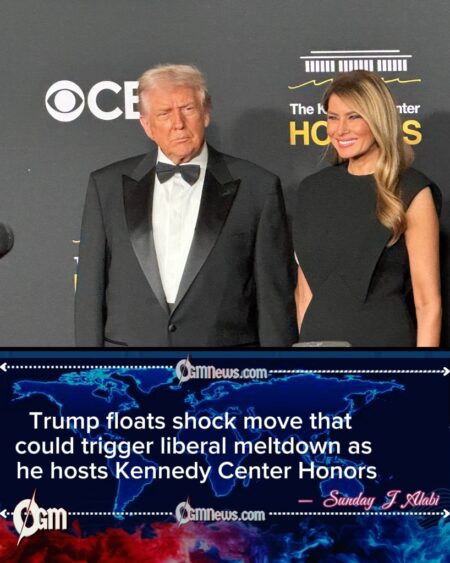
U.S. President Donald Trump, now serving his second term, made history on Sunday night as the first sitting president to host the prestigious Kennedy Center Honors. During the gala at the John F. Kennedy Center for the Performing Arts, the president jokingly floated the idea of nominating himself for future honors and even suggested renaming the building after himself—remarks that drew laughter inside the hall but stirred political debate outside it.
Arriving hand-in-hand with First Lady Melania Trump in matching black-tie attire, the president praised honorees including Sylvester Stallone, Gloria Gaynor, Michael Crawford, Kiss, and George Strait. Yet, his unscripted comments—lighthearted and provocative in equal measure—highlighted the evolving political dynamics around a traditionally bipartisan cultural institution.
A Historic Hosting and an Unexpected Turn
Trump’s appearance marked a major reversal from his first term, during which he openly criticized the Kennedy Center, declined invitations, and clashed with its leadership. Now, with a board reshaped under his administration and a new chairmanship aligned with his preferences, the ceremony symbolized a changing cultural moment in Washington.
In his opening remarks, Trump commended each honoree before quipping, “I think I’m going to nominate myself next year.” He followed with a tongue-in-cheek reference to construction projects underway at the center, joking that the facility looked like “the Trump-Kennedy Center,” drawing laughter after briefly pretending to correct himself.
Political Undertones Behind the Glamour
While the event maintained its traditional celebration of artistic achievement, Trump’s remarks and the visibly conservative shift inside the Kennedy Center signaled an ongoing redefinition of the institution. Critics argue that the president’s appointments to the board have altered decades of bipartisan cultural stewardship, with some commentators suggesting the gala is becoming more politically aligned with the administration.
Trump’s supporters, however, see the shift as long-overdue corrective action after years of what he previously labeled “woke cultural programming.” The president’s comments Sunday—sharp at moments but largely humorous—reflected his interest in reshaping national cultural conversations.
A Night of Musical Icons and Personal Tributes
The honors celebrated icons who have shaped American culture across decades. The president lauded Gaynor as a “disco icon,” praised Strait as the “undisputed champion of country,” and hailed Kiss as “one of the greatest bands in the history of rock and roll.”
Trump delivered a particularly emotional moment when acknowledging the late Kiss guitarist Ace Frehley, noting that Frehley’s daughter was in attendance and expressing sympathy for her loss. He assured Kiss fans that the band’s legacy remained central to Sunday’s celebration.
Trump vs. Late-Night Entertainment
True to his reputation, Trump did not shy away from political jabs, turning his attention to long-time critic Jimmy Kimmel. “If I can’t beat Jimmy Kimmel in terms of talent, then I don’t think I should be president,” he remarked, reinforcing a rivalry that has stretched across media platforms since before the 2024 election.
Trump also invoked late entertainment legends such as Johnny Carson and Bob Hope, placing himself within an American entertainment lineage he has long sought to engage. The contrast between that legacy and his critiques of contemporary television fueled media speculation about his future involvement in entertainment programming.
Honorees Reflect on the Moment
Stallone described the night as “being in the eye of a hurricane,” while Crawford characterized it as humbling and reflective of the arc of his career. Gaynor called the experience “a dream,” and Kiss members reflected on their four-decade journey in American music amid tributes to their late colleague.
The ceremony’s emotional resonance underscored the enduring cultural significance of the Kennedy Center Honors—whose recipients have included figures across political lines, even when tensions ran high.
A Redefined Institution, A Renewed Spotlight
Trump’s hosting of the gala—after declining to attend throughout his first term—marked a symbolic moment: the president publicly embracing an institution he once criticized, while simultaneously reshaping it under his leadership.
Trump predicted the broadcast would be the “highest-rated” in the history of the awards and vowed that Americans would witness “something special” when the program airs later this month. For supporters and detractors alike, the evening offered a vivid display of presidential personality, political symbolism, and cultural realignment.