










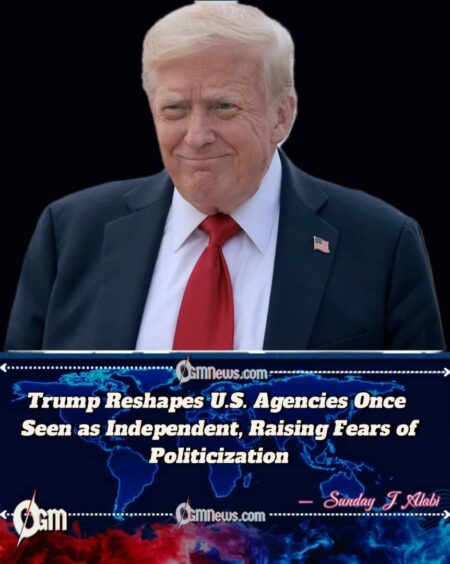
For decades, Before Trump administration Americans relied on institutions like the Centers for Disease Control and Prevention (CDC), the Bureau of Labor Statistics (BLS), and the Federal Reserve for neutral, data-driven guidance. The CDC guided public health with science-based recommendations, the BLS provided the nation’s trusted employment numbers, and the Federal Reserve guarded economic stability with independence from political whims.
Now, that tradition of institutional autonomy is under mounting strain. In recent weeks, President Trump has fired or moved to oust top officials across these agencies, raising alarms among critics who warn that politicization could erode public trust and threaten national stability.
A Wave of Firings Sparks Alarm
The most striking shake-up came when Health Secretary Robert F. Kennedy Jr., backed by the White House, dismissed CDC Director Susan Monarez after she refused to endorse directives on vaccines that her lawyers called “unscientific” and “reckless.” Days earlier, Trump fired the head of the BLS following a jobs report that portrayed the economy in less favorable terms. At the Federal Reserve, a campaign is underway to remove Governor Lisa Cook, a move seen as part of the president’s drive to secure more influence over monetary policy.
Critics argue that these actions amount to a purge of nonpartisan experts in favor of loyalists. “The biggest danger is the institution loses credibility, and people can’t count on it,” said Chris Edelson, assistant professor of government at American University.
The Push for a Unitary Executive
Supporters of the president Trump say his actions are rooted in principle. Trump has long embraced the “unitary executive” theory, which asserts that the Constitution gives the president sweeping authority over the executive branch. He recently signed an order requiring independent regulators, including the Securities and Exchange Commission and Federal Communications Commission, to submit proposed rules and budgets for White House review.
White House spokeswoman Taylor Rogers defended the moves as long overdue. “For years, Republican candidates have campaigned on reining in the power of unelected bureaucrats, but President Trump has actually delivered on this decades-long pledge to check runaway government power and spending,” she said.
Risks to U.S. Credibility and Stability
Policy experts warn that eroding institutional independence could have profound consequences. William A. Galston, a senior fellow at the Brookings Institution, said the administration’s approach substitutes expertise with ideology. “This replaces scientific and medical expertise with ideas about health and disease that have only a bare overlap with the truth,” he said, noting that credibility losses could ripple far beyond U.S. borders.
He cautioned that a compromised Federal Reserve would represent not just a domestic challenge but a global one. “If the credibility of the Fed is undermined, it could threaten the stability of the world economy,” Galston said.
Trump Administration Clashes With the Civil Service
The Trump administration’s push extends deep into the federal workforce. Trump has reinstated the controversial “Schedule F” policy, making it easier to dismiss career civil servants viewed as resistant to his agenda. More than 20 inspectors general have been fired or demoted since the start of his second term, while dozens of Federal Emergency Management Agency employees were suspended after warning Congress that disaster preparedness had been severely weakened.
Insiders describe an atmosphere of fear. “Everyone sees this, and people who want to keep their job understand they cannot speak up,” Edelson observed.
Accountability or Overreach?
To conservatives, however, the moves are about restoring accountability. Trump and his allies argue that federal agencies became too insulated, making sweeping decisions during the Covid-19 pandemic that clashed with the will of elected leaders. J. Joel Alicea, a law professor at Catholic University, said the Constitution itself envisions presidential control. “By making executive officials removable at will by the president,” he noted, “the Constitution ensures political accountability for them to the American people.”
Still, for critics, Trump’s expansive interpretation of presidential power marks a sharp break with precedent. Galston described it as “the most comprehensive effort we’ve ever seen from a president to centralize executive power… to reduce or eliminate islands of independence, and to diminish the role of competing branches of government.”


