





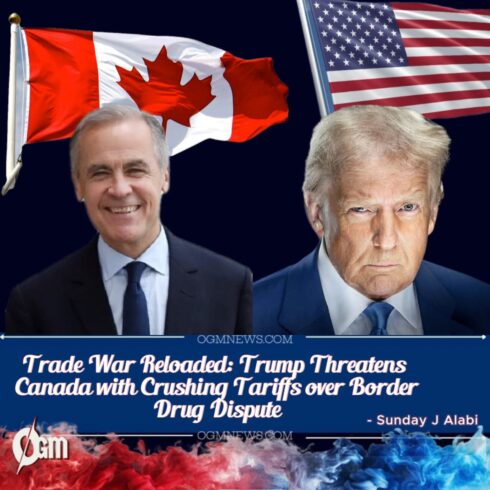
President Trump on Thursday announced plans to impose sweeping 35% tariffs on Canadian goods starting August 1, intensifying a trade battle with one of America’s closest allies and largest trading partners. In a sharply worded letter addressed to Canadian Prime Minister Mark Carney and shared on Truth Social, the president accused Canada of failing to curb the flow of drugs into the United States and of retaliating against previous U.S. tariffs with duties of its own.
The new tariffs mark a sharp escalation from the 25% duties introduced earlier in the president’s second term and come amid broader global moves to hike tariffs on dozens of countries. “Canada must act to stop the drugs pouring into our country,” Trump wrote, adding that the new tariffs could be adjusted if Canada cooperates to stem fentanyl trafficking across the border.
The move threatens to disrupt the $762 billion annual trade relationship between the two nations and has already sparked concerns in financial markets and among American business leaders.
Canada-U.S. Relations Hit New Low Over Tariff Threats
The United States and Canada have enjoyed one of the world’s most enduring trade relationships, but tensions have simmered since President Trump returned to office. The president has increasingly used tariffs as leverage in broader negotiations on immigration, drug trafficking, and economic policy.
In his letter, Trump specifically accused Canada of allowing fentanyl and other illicit substances to cross into the U.S.—a claim that Canadian officials dispute, citing minimal evidence of significant fentanyl flows through their border. Last year, only 43 pounds of fentanyl were seized at the Canadian border compared to over 21,000 pounds at the U.S.-Mexico border.
Canadian Prime Minister Mark Carney swiftly responded, rejecting the U.S. accusations and pledging to continue “defending Canadian workers and businesses.” In a social media post, Carney highlighted Canada’s efforts to combat fentanyl trafficking and reaffirmed a commitment to cooperation with U.S. authorities.
Tariffs Part of Broader Global Trade Overhaul by Trump Administration
The 35% Canadian tariff is just one piece of a sweeping recalibration of U.S. trade policy under Trump’s second-term agenda. Over the past week, the president has sent letters to leaders of more than 20 countries—including key allies in Europe and Asia—warning of impending tariff hikes.
The White House has defended these actions as necessary to protect American manufacturing, reduce trade deficits, and address perceived unfair practices by foreign governments. The president has also introduced sectoral tariffs on steel, copper, and electronics imports from various countries.
These moves follow the president’s “Liberation Day” announcement in April, where he unveiled a 10% baseline tariff on all nations, with the threat of higher rates for countries with whom the U.S. runs a trade deficit. Economists have warned that these escalating tariffs could stoke inflation, disrupt supply chains, and hinder global economic growth.
Economic Fallout: Markets React and Business Leaders Voice Concerns
The announcement of the 35% tariff on Canadian goods rattled financial markets, with stocks of major U.S. manufacturers and retailers dipping on fears of higher costs and retaliatory measures. Canada remains one of the top markets for American goods, with bilateral trade amounting to over $350 billion in U.S. exports and $412 billion in Canadian imports last year.
Major business groups, including the U.S. Chamber of Commerce, have urged the administration to reconsider the tariffs, warning of increased costs for American consumers and manufacturers alike. “Tariffs are a tax on American families and businesses,” said Neil Bradley, Executive Vice President of the Chamber, calling for dialogue over confrontation.
Federal Reserve Chair Jerome Powell has also cited tariff uncertainty as a key factor behind the central bank’s decision to hold off on interest rate cuts this year, noting that trade tensions could weigh on both investment and consumer spending.
Canadian Retaliation and Political Fallout
Prime Minister Carney has so far avoided outlining specific retaliatory measures but made clear that Canada “will stand firm” in defense of its economy. In previous trade disputes, Canada has targeted U.S. agricultural goods, steel, aluminum, and iconic American brands with counter-tariffs.
The Canadian leader, who recently secured re-election after campaigning on a platform of standing up to the Trump administration, faces mounting domestic pressure to respond decisively. Some members of Canada’s Parliament have already called for “measured but firm” economic counteractions.
The trade standoff also has political ramifications south of the border. While some of Trump’s supporters have praised the president’s aggressive stance on trade, critics warn that escalating tariffs could alienate key swing voters in manufacturing-heavy states already squeezed by rising costs.
Tariffs, Fentanyl, and Border Security: A Complex Equation
The Trump administration has increasingly tied trade measures to national security issues, particularly around immigration and drug trafficking. The president has repeatedly asserted that higher tariffs will pressure neighboring countries to strengthen border security and crack down on illicit drug flows.
However, data suggests that Canada plays a minimal role in the fentanyl crisis compared to the southern border. Critics argue that the president’s use of tariffs as leverage on drug policy could backfire by damaging vital economic ties without meaningfully addressing the public health emergency.
Nevertheless, Trump has remained steadfast. “We’re doing what’s necessary to protect American jobs, American families, and American security,” the president said in a televised interview Thursday. “And we’re winning.”
Next Steps: High-Stakes Negotiations Before August 1 Deadline
With the August 1 implementation date looming, both Washington and Ottawa face a tight window to de-escalate the trade conflict. Behind the scenes, diplomats and trade negotiators are scrambling to find common ground that could avert a full-scale tariff war.
Trump has signaled some willingness to modify the tariffs if Canada demonstrates tangible steps toward U.S. priorities, particularly on fentanyl control. Prime Minister Carney, meanwhile, has called for “good faith negotiations” while preparing contingency plans for possible economic fallout.
Whether this high-stakes standoff ends in compromise or escalation remains uncertain, but for now, North America’s two largest economies are bracing for potential disruption on both sides of the border.