









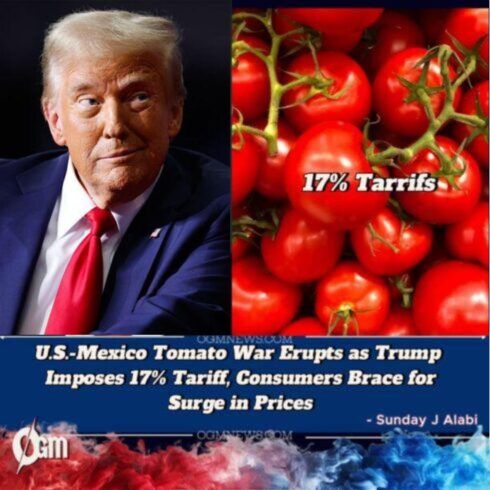
The Trump administration has imposed a 17.09% tariff on most fresh tomatoes imported from Mexico, effectively dissolving a 2019 trade pact that had long governed cross-border tomato commerce. The U.S. Department of Commerce announced the measure Monday, framing it as a win for American farmers while critics warned of food price spikes, economic fallout, and potential retaliation from Mexico.
A Long-Running Dispute Ends in a Tariff Hike
The new tariff marks the formal withdrawal of the U.S. from the 2019 Suspension Agreement that temporarily resolved a nearly 30-year dispute over tomato dumping. The agreement had allowed Mexican producers to continue exporting tomatoes to the U.S. without anti-dumping duties, provided they met minimum price thresholds.
Commerce Secretary Howard Lutnick said the move is a direct response to what the Trump administration deems unfair trade practices. “Mexico remains one of our greatest allies, but for far too long our farmers have been crushed by unfair trade practices that undercut pricing on produce like tomatoes,” Lutnick stated. “That ends today.”
Domestic Growers Cheer, Business Groups Warn
The Florida Tomato Exchange, representing one of the nation’s largest tomato-growing states, hailed the move as a long-overdue correction. Executive Vice President Robert Guenther called the tariff “an enormous victory for American tomato farmers and American agriculture.”
Several Florida lawmakers, including Sen. Rick Scott, echoed the sentiment, calling the end of the suspension agreement “a major victory for American growers and producers.” They argue that a flood of cheap Mexican tomatoes has decimated local farming communities and suppressed prices beyond sustainability.
However, the U.S. Chamber of Commerce voiced sharp opposition, warning in a letter to Lutnick that ending the agreement could “trigger retaliation from Mexico” and negatively impact sectors beyond agriculture, including logistics, retail, and food services. The Chamber estimates that the Mexican tomato trade generates $8.3 billion in economic activity for the U.S.
Consumer Impact and Rising Inflation Concerns
The timing of the tariffs has raised eyebrows among economists and consumer advocates already concerned about inflation. Although tomato prices had fallen 6.8% between May 2024 and May 2025, the new duties may reverse that trend and lead to costlier grocery bills.
“Arizona, buy your tomatoes now!!” warned Democratic Senator Ruben Gallego on X, urging consumers to stock up before prices climb. Rep. Sylvia Garcia of Texas added that the policy would lead to “pricier salsa, emptier shelves, and more expensive groceries,” placing tens of thousands of American jobs at risk, particularly in border states.
Federal Reserve Chair Jerome Powell acknowledged the possible price impact during recent congressional testimony. “We really don’t know how much of that’s going to be passed through to the consumer,” Powell said. “We have to wait and see.”
Mexico Condemns the Move as ‘Unfair and Unjustified’
In a joint statement, Mexico’s Ministries of Agriculture and Economy criticized the U.S. action as “unfair and against the interests not only of Mexican producers but also of the U.S. industry.” The Mexican government emphasized that its surge in tomato exports—now valued at $3 billion annually—reflects the quality of its produce rather than any trade violations.
The statement also stressed the importance of maintaining “mutual economic interests and stable trade frameworks,” hinting that retaliatory measures could be on the table if no resolution is found.
Despite the rhetoric, Mexican officials signaled a willingness to negotiate a new path forward, aiming to “find a constructive and equitable solution to the dispute.”
Part of a Broader Tariff Strategy by President Trump
The tomato tariffs are only one piece of a sweeping trade strategy led by President Trump, who has recently issued tariff threats to more than a dozen countries. Mexico was also notified last weekend to expect 30% tariffs on a broader range of goods starting in August unless new trade agreements are reached.
Trump has long campaigned on correcting what he calls “unfair global trade practices” that he argues have hollowed out U.S. industries. Supporters say these aggressive tariff actions are necessary to protect American jobs and level the economic playing field. Critics warn the measures could stoke inflation and slow economic growth.
“President Trump is making good on his promise to defend American farmers,” Lutnick said. “We are no longer going to allow trade deals to weaken domestic production.”
A Volatile Path Ahead for U.S.–Mexico Trade Relations
As the August tariff deadline looms, tensions between the U.S. and Mexico are set to escalate. Industry leaders, lawmakers, and economists alike are bracing for a possible trade war that could have ripple effects across the food supply chain and broader economy.
Meanwhile, American consumers, grocers, and restaurateurs are already preparing for price increases—particularly in states like California, Texas, Arizona, and Florida, where tomatoes are a staple ingredient.
With both sides standing firm, observers warn that unless a diplomatic resolution is reached quickly, the cost of everything from salads to salsa could become the latest battleground in a growing global trade confrontation.