








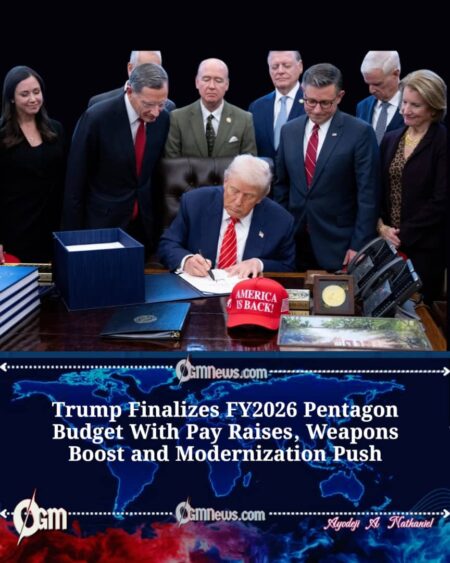
President Donald Trump has signed the FY2026 defense appropriations bill, authorizing $838.7 billion in funding for the Pentagon as part of a wider $1.2 trillion “minibus” spending package that helped end a partial U.S. government shutdown. The House approved the package 217–214 on February 3, reflecting sharp partisan divisions even as lawmakers moved to restore federal operations.
The legislation funds a broad range of priorities—from troop compensation and weapons production to readiness programs and major procurement projects—while also including domestic spending allocations covering healthcare, education, transportation and housing.
President Donald Trump Signs the Bill as Shutdown Ends
The signing by President Donald Trump, the current U.S. president serving a second term, marks a major fiscal milestone for the administration and Congress, finalizing a high-stakes funding agreement after a period of disruption caused by a partial shutdown.
The package’s narrow House passage underscores the fragile nature of the compromise. With a margin of just three votes, the 217–214 tally reflected intense negotiation, last-minute lobbying, and competing policy priorities—especially as defense spending remains one of the most politically sensitive parts of the federal budget.
For the White House, the measure provides immediate operational stability for agencies affected by the shutdown and gives the Pentagon predictable funding to continue modernization programs, contract awards, and readiness planning.
Inside the Pentagon Allocation: Pay Raises, Readiness, and Ammunition
The $838.7 billion Pentagon allocation is structured around three major objectives: strengthening the force, sustaining global readiness, and increasing production capacity—especially for munitions.
A major component is troop pay raises, a politically popular and strategically important measure aimed at retention, recruitment competitiveness, and morale across the armed forces. In parallel, the bill boosts funding for training, maintenance, and readiness, ensuring the military can meet deployment demands and sustain high operational tempo.
The legislation also prioritizes munitions production, reflecting growing concern in Washington about stockpile levels, supply chain constraints, and the pace of replenishment—particularly given ongoing global security pressures and increased demand for precision-guided weapons and air-defense interceptors.
Big-Ticket Modernization: Next-Generation Fighters and Submarines
Beyond immediate readiness needs, the bill places strong emphasis on long-term modernization, including funding for next-generation fighter aircraft and submarine programs—both central to U.S. defense strategy in an era of great-power competition.
Investment in advanced fighters typically signals a push for air dominance through improved stealth, electronic warfare capabilities, sensor fusion, and networked battlefield operations. Such programs also carry major industrial base implications, supporting high-skilled manufacturing and defense technology ecosystems across multiple states.
Submarine funding, meanwhile, remains a cornerstone of U.S. deterrence posture. Submarines provide strategic advantages through stealth, survivability, and the ability to project force across contested waters—making them a top priority for Pentagon planners seeking to maintain an edge in undersea warfare.
The Wider “Minibus” Package: Domestic Funding Included
The defense bill was not passed in isolation. It formed part of a broader $1.2 trillion minibus funding package, combining multiple appropriations measures into one consolidated legislative vehicle.
Alongside military spending, the package includes allocations across domestic priorities such as healthcare, education, transportation, and housing. These provisions are often crucial to building enough votes to pass major spending packages, as lawmakers seek to balance national security funding with investments in public services and infrastructure.
This structure also highlights how budget negotiations typically function in Washington: major national funding outcomes are achieved through bundled compromises, where different factions secure priorities in exchange for supporting the overall package.
Political Stakes: A Narrow Vote and an Expensive Budget Moment
The close House vote illustrates the difficult politics of federal spending in a polarized environment. Even with the urgency of ending a shutdown, lawmakers remained split over overall spending levels, policy riders, and competing fiscal philosophies.
Supporters argue the bill protects national security, strengthens the military, and restores stability to federal operations. Critics, however, often raise concerns about the growing federal deficit, accountability in defense contracting, and whether spending increases deliver measurable results.
For President Donald Trump, the signing reinforces an administration narrative of restoring government functionality while strengthening defense capacity. It also sets the stage for future budget fights—particularly as the U.S. faces mounting fiscal pressure from debt servicing, entitlement growth, and competing domestic demands.
What Happens Next: Implementation, Oversight, and Future Budget Battles
With the bill signed, federal agencies and the Pentagon move from negotiation to implementation—releasing funds, finalizing contracts, and accelerating programs previously delayed by uncertainty.
Congressional oversight will now focus on how funds are spent, particularly in areas like munitions procurement, readiness metrics, and high-cost modernization programs. Expect scrutiny over whether spending increases translate into real improvements in operational capability.
Meanwhile, the passage of this package may only be a temporary pause in broader budget conflict. With future funding deadlines ahead, the same political divisions that produced a 217–214 vote are likely to re-emerge, especially around defense levels, domestic priorities, and deficit concerns.