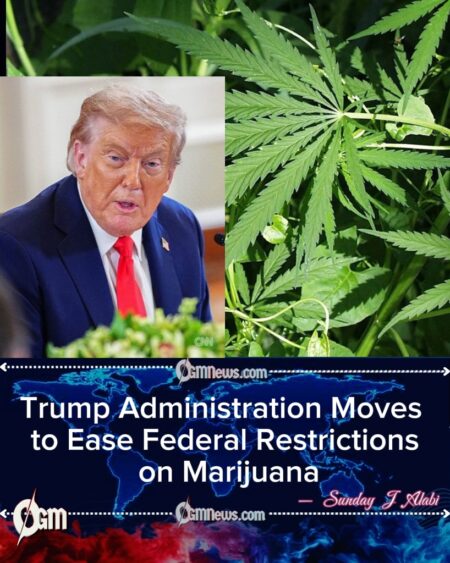
President Donald Trump, the current U.S. president serving a second term, is expected to sign an executive order that would reclassify marijuana from a Schedule I drug to a Schedule III substance, according to sources familiar with the planning. If completed, the move would represent one of the most consequential changes to federal drug policy in decades, reshaping how marijuana is regulated, researched, and taxed across the United States.
While sources indicate the order is planned for signing on Thursday, they caution that the timing could still change. Nonetheless, the proposal signals renewed momentum in a long-running debate over marijuana’s legal status, as federal policy continues to lag behind widespread state-level legalization and evolving public opinion.
A Historic Shift by Trump Administration Drug Classification
Under the current system, marijuana is classified as a Schedule I drug under the Controlled Substances Act, a category reserved for substances deemed to have no accepted medical use and a high potential for abuse. This is the same classification applied to drugs such as heroin, LSD, and ecstasy. Marijuana has remained in this category since the classification framework was established in 1970.
Reclassifying marijuana to Schedule III would place it alongside substances considered to have a moderate to low potential for physical and psychological dependence. Drugs in this category include Tylenol with codeine, testosterone, anabolic steroids, and ketamine. The shift would acknowledge a growing body of scientific research suggesting medical applications for cannabis.
Such a change would not legalize marijuana at the federal level for recreational use. However, it would represent a significant recalibration of federal policy, aligning it more closely with contemporary scientific assessments and state-level practices.
Implications for Research and Medical Use
One of the most immediate effects of rescheduling marijuana would be expanded opportunities for scientific research. Schedule I status has long imposed strict limitations on researchers, making it difficult to conduct comprehensive studies on marijuana’s medical potential and long-term effects.
President Trump has cited this issue directly, stating earlier this week that he is “considering” reclassification because “tremendous amounts of research can’t be done unless you reclassify.” By lowering the classification, researchers would face fewer regulatory hurdles, potentially accelerating studies into therapeutic uses for conditions such as chronic pain, epilepsy, and post-traumatic stress disorder.
Medical professionals and research institutions have argued for years that the current classification is outdated. A Schedule III designation would not amount to an endorsement of marijuana use but would reflect a more nuanced federal stance grounded in emerging scientific evidence.
Economic and Tax Consequences for the Cannabis Industry
The proposed reclassification could also have far-reaching economic implications, particularly for state-licensed cannabis businesses. Under current federal law, companies that sell Schedule I substances are barred from taking standard business tax deductions, resulting in significantly higher effective tax rates.
By moving marijuana to Schedule III, those restrictions would no longer apply, potentially easing the tax burden on dispensaries operating legally under state law. Industry leaders say this could improve financial stability, encourage investment, and support job growth in a sector that has expanded rapidly despite federal constraints.
Vince C. Ning, co-CEO and co-founder of the cannabis wholesale platform Nabis, said rescheduling would help “accelerate research, reduce stigma, attract new investment, and ease some of the tax burdens that have held the industry back.” He added that broader transformation would come if interstate commerce barriers between states were eventually addressed.
Political Context and Policy Background
The executive order would follow years of policy debate and administrative delays. During the previous administration, the Department of Health and Human Services recommended reclassifying marijuana to Schedule III, and the Justice Department proposed a rule to that effect. However, the process became entangled in legal and administrative challenges, leaving marijuana’s status unchanged.
President Trump expressed support for a Schedule III classification during his campaign, positioning himself as open to reform while stopping short of full federal legalization. His expected action would revive a process that stalled despite bipartisan interest.
Marijuana’s Schedule I status has increasingly stood in contrast to state-level policies. Today, most states allow marijuana for medical use, and 24 states have legalized it for recreational purposes. Although these laws technically conflict with federal statutes, the federal government has largely refrained from enforcement actions against state-licensed cannabis businesses.
Public Opinion and Bipartisan Support
Public attitudes toward marijuana have shifted significantly over the past two decades. Polling consistently shows growing support for legalizing marijuana for medical use, and increasing acceptance of recreational legalization. Lawmakers from both major parties have cited these trends in arguing for federal reform.
During the 2024 campaign, President Trump said he planned to vote in favor of a Florida ballot measure to legalize recreational marijuana. Although the proposal received nearly 56 percent of the vote, it fell short of the 60 percent threshold required to pass under state law.
In a post on Truth Social last year, the president Trump wrote that it was time to end “needless arrests and incarcerations of adults for small amounts of marijuana for personal use,” while also calling for smart regulation and access to safe, tested products. These President Trump remarks underscored a broader argument that enforcement priorities should evolve alongside public attitudes.
Ongoing Opposition and Lawmaker Concerns
Despite growing support, the proposed reclassification has drawn opposition from some lawmakers, particularly within the Republican Party. A group of 22 Republican senators recently urged President Trump to leave marijuana in the Schedule I category, citing concerns about health risks, impaired driving, and workplace productivity.
In their letter, the senators argued that expanding the marijuana industry could undermine efforts to promote healthy lifestyles and economic growth. “We cannot reindustrialize America if we encourage marijuana use,” they wrote, warning against what they see as unintended social and economic consequences.
Similar concerns have been raised in the House of Representatives. Over the summer, nine House Republicans urged Attorney General Pam Bondi not to support rescheduling, arguing that marijuana has no scientifically proven medical value and carries potential for abuse. They also expressed concern that reclassification could signal to young people that marijuana use is safe, a claim disputed by many public health experts.