








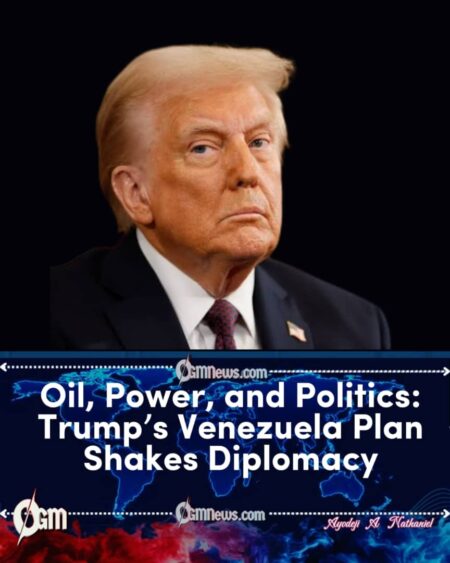
President Donald Trump, currently serving his second term as U.S. president, has sparked international debate after declaring that the United States would remain in Venezuela, oversee the country during a transition period, and take control of its oil resources. The remarks, delivered publicly, suggest a far-reaching U.S. role in Venezuela’s political and economic future and have drawn immediate attention for their implications under international law and global diplomacy.
President Trump framed the comments as part of a broader vision for stabilizing Venezuela, arguing that U.S. involvement and investment—particularly from American oil companies—would benefit both Venezuelans and Americans economically. The statement, however, has raised questions about sovereignty, legality, and whether the remarks reflect official U.S. policy.
Details of the President’s Remarks
In outlining his position, President Trump said the United States would “stay” and “run Venezuela” until what he described as a “proper transition” takes place. He also suggested that American oil companies would move in to rebuild the country’s energy sector and benefit from Venezuela’s vast oil reserves.
President Donald Trump further stated that the United States was prepared to escalate its actions if necessary, though he expressed hope that such measures would not be required. No formal policy documents, executive orders, or congressional notifications accompanied the remarks at the time they were made.
Sovereignty and International Law Concerns
Foreign policy experts note that statements implying control over another sovereign nation raise serious legal questions. Under international law, states are generally prohibited from exercising authority over another country’s territory or natural resources without consent or a recognized legal framework.
Diplomatic analysts caution that even rhetorical suggestions of external rule can provoke strong reactions from the international community. Such comments may invite scrutiny at global institutions and complicate diplomatic relations, particularly in regions sensitive to foreign intervention.
Reaction in Venezuela and Latin America
Political observers in Venezuela and across Latin America reacted with concern, emphasizing that oil sovereignty is a deeply rooted national issue. Venezuela’s oil reserves have long been central to its national identity and economic policy.
Regional analysts warn that statements suggesting foreign control could harden domestic opposition within Venezuela and undermine efforts toward a negotiated political transition. Neighboring countries and regional blocs are also expected to closely monitor developments given the broader implications for regional stability.
Economic Claims and Energy Implications
President Trump highlighted Venezuela’s oil wealth as a central justification for U.S. involvement, pointing to the potential for economic gains through American investment. Venezuela holds some of the largest proven oil reserves in the world, but production has declined sharply due to infrastructure decay, sanctions, and years of economic mismanagement.
Energy economists note that while foreign investment could increase output, any such effort would require internationally recognized agreements, legal certainty, and political legitimacy. Without these conditions, large-scale energy projects would face significant operational and legal obstacles.
Policy Clarity and Official Position
As of publication, the White House and the U.S. State Department have not issued detailed clarification on whether the president’s remarks represent a formal shift in U.S. policy toward Venezuela. Analysts stress that presidential statements alone do not establish binding policy without coordination across federal agencies and Congress.
Until official guidance is released, experts suggest the comments should be viewed cautiously. Nonetheless, they acknowledge that statements from President Donald Trump carries substantial diplomatic weight, regardless of whether they translate into concrete action.
Broader Implications for U.S. Foreign Policy
The episode underscores how rhetoric can quickly shape global perceptions of U.S. foreign policy. Observers say the remarks fit within a broader pattern of assertive language on international affairs during President Trump’s second term.
Whether the comments signal a new strategic approach or remain rhetorical will become clearer in the coming weeks. For now, they have intensified debate over U.S. intervention, resource control, and the limits of presidential authority in international relations.