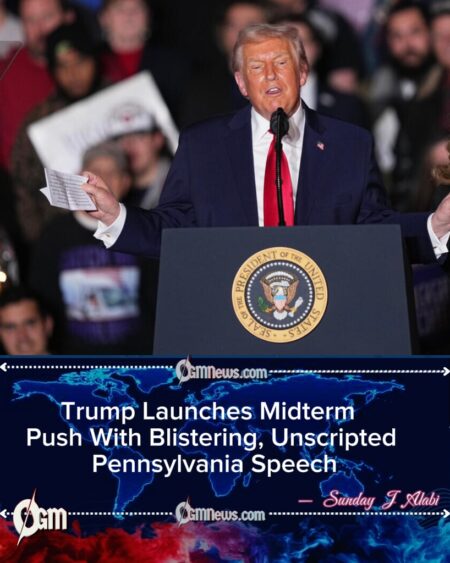
The current U.S. president, Donald Trump, returned to the campaign trail with a charged, profanity-laced appearance in Mount Pocono, Pennsylvania, delivering remarks that blended economic talking points with sharp attacks on Democratic opponents. Although the event was billed as an economic address, the atmosphere closely resembled a full campaign rally, with the president defending his second-term record before an enthusiastic crowd.
Trump speech marked his most animated public appearance in recent months and signaled the White House’s intention to re-engage heavily in political messaging ahead of next year’s pivotal midterm elections. Trump’s remarks were peppered with unscripted detours, personal jabs, and colorful language that drew loud reactions from supporters.
A Rally Structured as an Economic Address by Trump
The event was initially framed as a discussion on economic policy, set against growing national debate over affordability and Americans’ concerns about rising costs. However, the president quickly shifted into a campaign-style tone, opening with a boastful reference to the last election and launching into criticisms of his political opponents.
Trump defended his handling of the nation’s economic challenges and rejected criticisms that voters remain uneasy about the economy. He pointed to recent comments he made in interviews, where he assigned himself a grade of “A-plus-plus-plus-plus-plus,” arguing that the administration’s approach has been strong and misunderstood by political adversaries.
Republicans, meanwhile, are concerned about the possibility of a “blue wave” in the midterms—an outcome that could significantly reduce their House majority and reshape the Senate landscape. Trump’s appearance was seen by many strategists as a deliberate move to energize conservative voters.
Sharp Attacks on Biden, Omar, and Democratic Figures
Throughout his 96-minute speech, Trump frequently invoked the names of Democratic rivals, reserving some of his most provocative remarks for former President Joe Biden and Representative Ilhan Omar. He referred to Biden using coarse language and mocked his Scranton roots, prompting mixed reactions even among some longtime political observers.
His repeated references to Omar drew further attention as he revived claims—long disputed and lacking substantive evidence—that she married her brother to obtain immigration benefits. He also criticized her appearance and heritage, comments that echoed earlier controversies surrounding his rhetoric about immigrants and people of color.
Though the president insisted Omar was connected to a major fraud scandal in Minnesota, no direct evidence currently links her to the case. Omar has consistently denied the allegations regarding her family history, calling them discriminatory and unfounded.
Immigration Messaging and “Third World Migration” Pause
The president Trump also used the stage to reiterate his hardline stance on immigration, announcing what he described as a “permanent pause” on migration from countries he labeled “hell holes.” The crowd responded with both cheers and crude interjections, which Trump acknowledged with humor, distancing himself from the explicit language while maintaining the underlying sentiment.
He contrasted countries such as Afghanistan, Haiti, and Somalia with Nordic nations, questioning why the United States does not receive more immigrants from places like Norway, Sweden, and Denmark. The comments mirrored earlier controversies surrounding his immigration rhetoric and signaled that the issue remains central to his campaign messaging.
The remarks also served as a pivot point, allowing Trump to argue that communities—including Black Americans—recognize what he called “scams” within the political system. His language underscored a strategy aimed at broadening appeal among disaffected voters.
A Freewheeling Performance, Far from Scripted
About an hour into his speech, Trump acknowledged that the event had departed significantly from its prepared script. He admitted he had rarely looked at the teleprompter, joking that his speechwriters often receive awards despite his tendency to ignore their work entirely.
The president Trump credited Chief of Staff Susie Wiles—whom he jokingly referred to as “Susie Trump”—with pushing him back into public appearances. His remarks about the title “chief of staff,” which touched on Native American identity, drew mixed reactions but underscored his characteristic, unscripted speaking style.
As he surveyed the cheering audience, Trump remarked on the intensity of the moment, telling supporters that winning had previously allowed him to “rest,” but that the stakes of the upcoming midterms required renewed public engagement.
Foreign Policy Defenses and Clashes With Former Allies
Trump also responded to criticisms from within his own party, including comments from outgoing Representative Marjorie Taylor Greene, who questioned his recent international travel. He defended his trips to Saudi Arabia, Qatar, and the United Arab Emirates, asserting that they yielded substantial economic benefits.
He dismissed critics as “stupid people,” arguing that active global engagement is necessary for national prosperity. The exchange spotlighted growing ideological and strategic divides within the Republican caucus as the midterm cycle approaches.
A Midterm Opening Salvo Marked by Controversy
The Pennsylvania speech ultimately served as Trump’s de facto re-entry into the midterm political arena—a re-entry marked by controversy, humor, anger, and improvisation. Supporters embraced the unscripted intensity, while critics noted the president’s reliance on divisive rhetoric and unverified claims.
As midterm season accelerates, the Mount Pocono appearance is likely to shape upcoming campaign messaging on both sides, offering a preview of the confrontational style the president appears ready to deploy in the months ahead.