










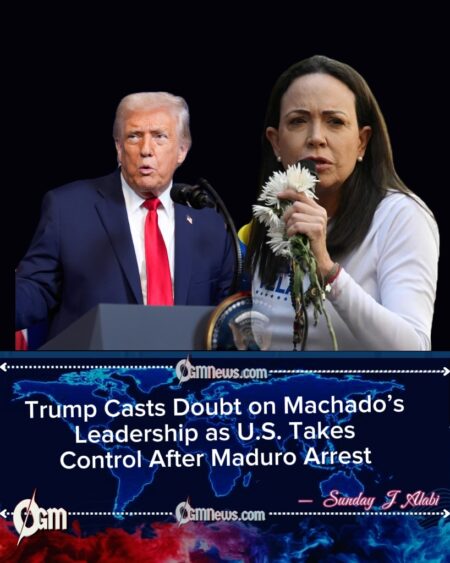
The arrest of Venezuelan leader Nicolás Maduro by United States forces has opened a new and highly contested chapter in Venezuela’s political future, with President Donald Trump casting doubt on the suitability of opposition leader María Corina Machado to assume national leadership. Despite Machado’s international profile and domestic popularity, Trump said she lacks sufficient support and respect within Venezuela to lead the country during a transition.
Speaking to reporters a day after Maduro’s capture, President Trump, now serving a second term, dismissed suggestions that his administration would work with Machado, even though she has publicly endorsed recent U.S. actions against Maduro’s government. His comments have triggered sharp reactions from Venezuelan opposition figures, analysts, and business leaders, underscoring the uncertainty surrounding Venezuela’s governance in the wake of the dramatic U.S. intervention.
Trump Questions Machado’s Political Backing
President Trump stated plainly that María Corina Machado does not command the level of domestic support he believes is necessary to govern Venezuela effectively. He told reporters that he has not been in contact with the opposition leader and suggested that her international recognition does not translate into sufficient legitimacy at home.
“She doesn’t have the support within or the respect within the country,” Trump said, distancing his administration from Machado despite her long-standing role as one of Maduro’s most prominent critics. His remarks came as many observers expected the U.S. to align with the opposition figure most widely viewed as capable of leading a post-Maduro transition.
Trump’s assessment contrasts sharply with the views of many Venezuelan voters and opposition supporters, who see Machado as the most credible alternative to years of authoritarian rule. Her exclusion from immediate U.S. plans has raised questions about Washington’s strategy for political reconstruction in Venezuela.
Machado’s Response and Support for U.S. Action
Machado has publicly welcomed the U.S. operation that led to Maduro’s arrest, framing it as a turning point for Venezuela. In a post on X shortly after the capture, she described the moment as “the hour of freedom” for Venezuelans, reflecting widespread relief among her supporters.
The opposition leader has also voiced support for U.S. efforts to combat alleged drug trafficking networks linked to the Maduro government. Following her recent Nobel Peace Prize win, which placed her on the global stage, Machado dedicated the honor to President Trump and the Venezuelan people, a gesture that highlighted her openness to cooperation with Washington.
Despite Trump’s dismissal, Machado remains highly popular within Venezuela’s opposition base. Her supporters argue that her consistent stance against corruption and authoritarianism has earned her broad respect across social and political lines.
Backlash From Venezuelan Opposition Figures
Trump’s remarks sparked swift pushback from prominent Venezuelan figures, including businessman Pedro Burelli, a former board member of the state oil company PDVSA. Burelli rejected the notion that Machado lacks legitimacy, calling her “the most respected politician in the country.”
In a pointed response on social media, Burelli argued that while Venezuela is economically devastated, it is “not about to surrender to absurd whims.” His comments reflect growing concern among opposition leaders that U.S. decisions may overlook local political realities.
The backlash highlights a widening gap between Washington’s immediate plans and the expectations of Venezuelans who have rallied around Machado as a symbol of democratic change.
Maduro’s Capture and Transfer to U.S. Custody
The crisis escalated dramatically when U.S. forces captured Nicolás Maduro and his wife, Cilia Flores, in Caracas during the early hours of Saturday. The operation, carried out by elite Delta Force units, ended with the couple being transported out of Venezuela to face drug trafficking charges in the United States.
After initial transfer through Puerto Rico, where local officials confirmed Maduro’s presence, the detainees were flown aboard a white FBI Boeing 757 to Stewart Air National Guard Base in upstate New York. Footage later showed Maduro and Flores disembarking under heavy security.
They are expected to be held at Brooklyn’s Metropolitan Detention Center, a facility known for its harsh conditions and for housing high-profile detainees. The arrest marked an unprecedented direct intervention by the United States in Venezuelan leadership.
Dispute Over Venezuela’s Interim Leadership
In the immediate aftermath of Maduro’s capture, President Trump announced that Vice President Delcy Rodríguez had been sworn in as Venezuela’s new leader and was prepared to cooperate with U.S. plans to “make Venezuela great again.” However, Rodríguez publicly rejected the claim, insisting that Maduro remained the country’s only legitimate president.
Trump responded by declaring that the United States would govern Venezuela indefinitely until a “safe, proper and judicious transition” could be achieved. The announcement intensified debate over sovereignty and the legality of U.S. administration over a nation of roughly 30 million people.
The lack of clarity surrounding interim governance has further complicated Venezuela’s already fragile political landscape, with no consensus on who should lead the country forward.
U.S. Justification and Plans for Venezuela’s Future
President Trump defended the operation by accusing Maduro of leading the Cartel de los Soles, an alleged drug trafficking network responsible for flooding the United States with narcotics and gang members. He said the urgency of the mission required secrecy, claiming he did not brief Congress for fear the plan would leak.
While offering few logistical details, Trump suggested that Venezuela’s vast oil reserves would be central to funding the country’s recovery under U.S. oversight. He indicated that American administration would remain in place until stability and democratic governance could be assured.
As international reaction continues to unfold, questions remain over how long U.S. control will last and whether Venezuelan political forces, including Machado’s movement, will be integrated into any future transition.


