


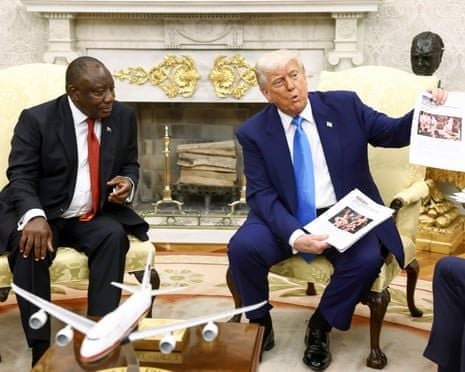
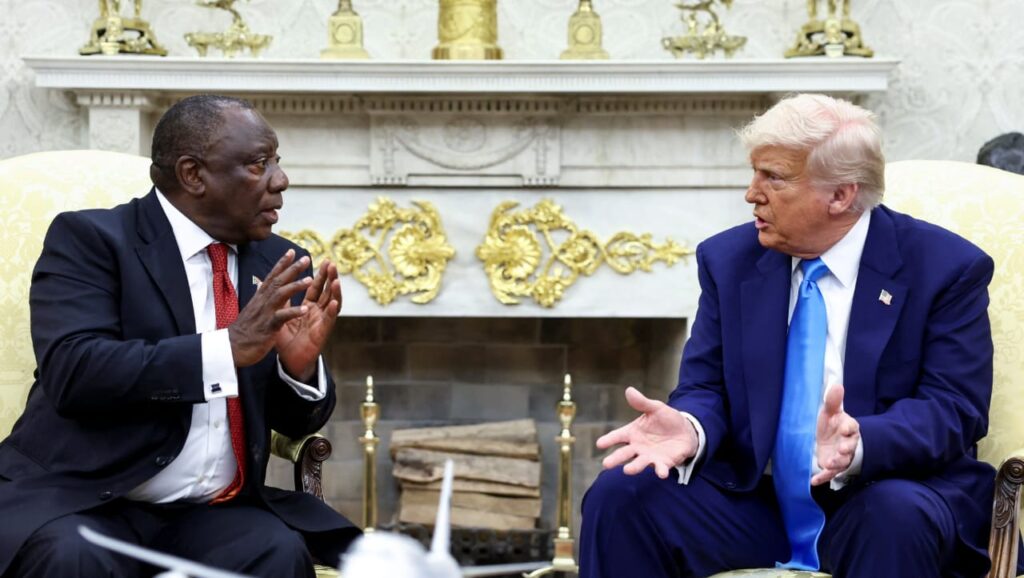
A high-stakes meeting between U.S. President Donald Trump and South African President Cyril Ramaphosa turned tense on Wednesday, as the two leaders clashed publicly in the Oval Office over allegations of “White genocide” in South Africa. The meeting, initially described by both camps as a diplomatic effort to reset relations, quickly devolved into a pointed exchange over farm murders and race-related violence in South Africa.
At the center of the dispute was the Trump administration’s recent decision to grant refugee status to 59 White Afrikaners—a move that Ramaphosa and his delegation viewed as a politicized response to isolated acts of violence rather than a reflection of systematic persecution. Mr. Trump, referencing “thousands of stories” and “documentaries,” insisted that the violence faced by White South African farmers constituted genocide, and directed staff to dim the lights and play a video showcasing alleged anti-White rhetoric and farm attacks.
The video, previously shared on social media by South African-born billionaire Elon Musk, who was present in the room but remained silent throughout, showed a procession of white crosses and anti-White chants. Ramaphosa pushed back strongly, insisting the footage did not reflect government policy and asserting that most victims of crime in South Africa are Black. “There is criminality in our country,” he said. “People who do get killed, unfortunately through criminal activity, are not only White people. The majority of them are Black people.”
South African Delegation Denies Targeted Persecution
Ramaphosa brought a high-profile delegation to the meeting, including golfers Ernie Els and Retief Goosen and billionaire Johann Rupert, aiming to project unity and clarity on the contentious issue. In a striking moment, Ramaphosa responded to a reporter’s question—meant for Trump—by challenging the very premise of the genocide narrative.
“It will take President Trump listening to the voices of South Africans, some of whom are his good friends, like those who are here,” Ramaphosa said. “When we have talks between us at a quiet table, it will take President Trump to listen to them. I will not be repeating what I’ve been saying.” His comments underscored a growing frustration among South African officials that anecdotal reports were being used to distort the country’s complex crime statistics for political ends.
Other members of the South African delegation also contested the genocide label, stating that violence in rural areas affects all ethnicities. “It is not a racially motivated purge,” one official asserted privately after the meeting. “We have immense challenges with crime, yes—but to classify this as genocide is not just incorrect, it’s dangerous.”
Trump Administration’s Refugee Policy Under Fire
Trump’s decision to admit 59 White Afrikaners as refugees has ignited backlash, both domestically and abroad, with critics accusing the administration of racial bias. When asked by reporters why the Afrikaners were prioritized over other persecuted groups such as Uyghurs, Rohingyas, or Afghan allies, Trump diverted the conversation to his general dissatisfaction with conditions across Africa.
“We’ve had tremendous complaints about Africa… they said there’s a lot of very bad things going on,” Trump said. “We have many people that feel they’re being persecuted.” His remarks were vague and appeared to conflate local criminality with systematic persecution.
Democratic Senator Tim Kaine raised the issue during a Senate hearing, questioning Secretary of State Marco Rubio on whether Afrikaners face more danger than other persecuted groups globally. Rubio acknowledged that the Afrikaners were a “small subset” and claimed the president “identified it as a problem and wanted to use it as an example.” But Kaine pushed back sharply, noting that Afrikaner politicians are now part of South Africa’s unity government, with Jan Steenhuisen—former leader of the Democratic Alliance, an Afrikaner-leaning party—serving as Agriculture Minister.
Elon Musk’s Influence and Silent Presence
While the Oval Office exchange unfolded, Elon Musk—whose social media posts on the issue helped fuel the White genocide narrative—watched silently. Trump notably invoked Musk’s support during the meeting, claiming that “Elon wanted” the Afrikaners to be admitted to the U.S. as refugees.
Musk has repeatedly posted about alleged attacks on White South Africans, including the controversial video shown during the meeting. The footage, featuring a protest in Normandien, South Africa, had been widely misinterpreted online. Participants of the 2020 demonstration said it was intended to protest all farm murders, not only those affecting Whites.
Musk’s silence during the exchange left many observers puzzled, given his outsized influence and his South African heritage. Critics argue that Musk’s amplification of the genocide narrative has contributed to misinformation and geopolitical tension.
A Fractured Diplomatic Reset
Despite the confrontation, both leaders initially attempted to frame the meeting as a diplomatic thaw. Trump opened the session by calling it “a great honor” to host Ramaphosa, though he quickly added that the South African leader is “respected in some circles, a little less in others.” Ramaphosa struck a more conciliatory tone in his opening remarks, stating, “We are essentially here to reset the relationship between the United States and South Africa.”
Yet, the meeting only highlighted how far apart the two administrations are on key issues—from immigration to race relations to the framing of criminal violence. By allowing reporters to witness the heated exchange, Trump once again broke with tradition, using the Oval Office as a stage for confrontation rather than quiet diplomacy.
With the U.S. refugee program under legal scrutiny and questions swirling about racial preferences in admissions, the fallout from the Trump-Ramaphosa meeting is likely to reverberate in both capitals. For now, the diplomatic reset appears far from complete.