










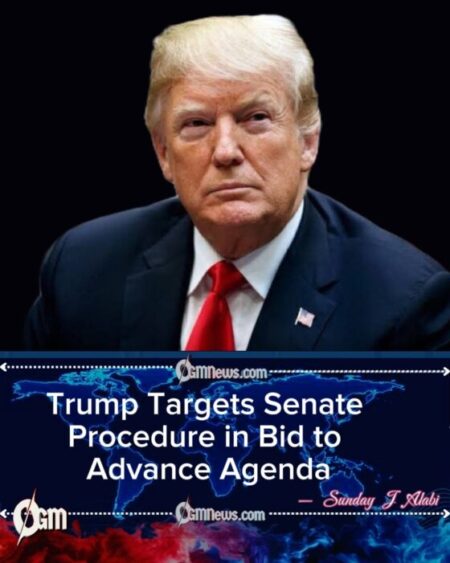
President Donald Trump has renewed calls for Republicans in the United States Senate to abandon the filibuster rule, arguing that the long-standing procedural tool has become a barrier to effective governance and a threat to his party’s ability to deliver on key promises before the 2026 midterm elections. Speaking in a recent interview with Politico, the president said eliminating the rule would prevent future government shutdowns and allow Republicans to pass legislation more efficiently with their narrow Senate majority.
The intervention places Trump at the center of a debate that has divided lawmakers of both parties for decades. While the filibuster is often defended as a safeguard for minority rights in the Senate, Trump has framed it as an outdated obstacle that no longer serves the interests of voters or the governing party.
Understanding the Filibuster and Its Role in the Senate
The filibuster is a Senate procedure that allows a minority of senators to delay or block legislation by extending debate, effectively requiring most major bills to secure 60 votes to advance. In practice, this means that even when one party controls a simple majority, it often needs bipartisan support to move legislation forward.
Supporters of the filibuster argue that it encourages compromise and protects against abrupt policy swings when political power changes hands. Critics, however, say it enables obstruction and gridlock, preventing elected governments from implementing their platforms.
Over time, both Democrats and Republicans have supported or opposed ending the filibuster depending on their position in the Senate. This shifting stance has made reform politically sensitive, particularly among centrist lawmakers.
Trump’s Case: Governance, Gridlock, and Shutdowns
President Trump described the filibuster as “hurting the Republican Party,” urging Senate Republicans to eliminate it “without question.” He argued that doing so would streamline the legislative process and reduce the likelihood of prolonged standoffs that can lead to government shutdowns.
According to Trump, removing the rule would allow Congress to pass critical measures, including healthcare reforms, with a simple majority. He presented the proposal as a practical solution rather than an ideological shift, emphasizing efficiency and stability.
The president has repeatedly linked the filibuster to past shutdowns, asserting that its removal would eliminate one of the key tools used by the minority party to block funding bills.
Republican Calculations and Internal Resistance
Despite Trump’s strong rhetoric, many Republican senators remain cautious. The party currently holds 53 seats to the Democrats’ 47, leaving little margin for defections if legislation is to pass along party lines.
Several GOP lawmakers are wary of ending the filibuster because they anticipate future shifts in power. If Republicans lose their majority, the same rule could protect them from sweeping Democratic legislation.
This concern has historically led senators of both parties to back away from permanent changes to Senate rules, even under pressure from party leadership or presidents.
Lessons From Past Standoffs
Trump previously called on Republicans to end the filibuster during a government funding crisis in October, hoping to reopen the government without Democratic votes. Senate Republicans declined, leading to a prolonged standoff over healthcare costs.
That impasse resulted in a 43-day government shutdown, disrupting federal services and highlighting the political risks of legislative deadlock. The episode remains a reference point in current discussions, underscoring both the power and the pitfalls of Senate procedure.
With time pressures mounting ahead of the midterms, some analysts suggest the memory of that shutdown could influence future calculations within the Republican caucus.
Midterm Strategy and the Politics of the Economy
Beyond Senate rules, Trump used the interview to outline his expectations for the 2026 midterm elections. He said the campaign would focus on “pricing,” a term he prefers over Democrats’ emphasis on “affordability,” which he dismissed as misleading.
The president expressed confidence that voters would respond positively to his argument that his administration is correcting economic problems inherited from former president Joe Biden. He cited recent data showing cooling inflation and stronger-than-expected economic growth.
However, public opinion polls indicate that many Americans remain pessimistic about their personal financial situation, suggesting that economic messaging will be a central and contested issue in the coming campaign.
A Debate With High Stakes for Senate Governance
Trump’s renewed push to scrap the filibuster has brought a long-running institutional debate back into sharp focus. While the proposal aligns with his desire to move quickly on policy priorities, it challenges deeply held views about the Senate’s role as a deliberative body.
Whether Republicans ultimately act on the president’s call remains uncertain. Any move to eliminate the filibuster would require near-unanimous support within the party and could have lasting consequences beyond the current Congress.
As the midterms approach, the issue highlights the tension between short-term legislative goals and long-term institutional traditions in American politics.


