






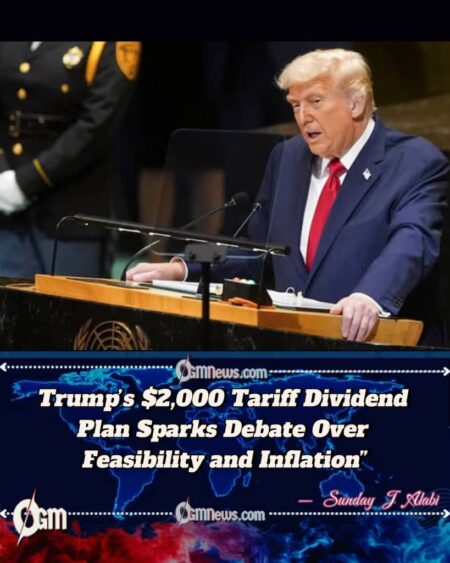
President Donald Trump on Sunday announced a proposal to issue a $2,000 dividend to most American adults, funded by revenue collected from tariffs — a cornerstone of his administration’s economic policy. The president Trump, now serving his second term, unveiled the plan in a Truth Social post, touting the initiative as a way to “return America’s tariff success to the people.”
“A dividend of at least $2,000 a person (not including high income people!) will be paid to everyone,” President Trump wrote. He framed the idea as a way to reward citizens for what he called the nation’s “record investment in manufacturing and domestic growth,” attributing it to his aggressive tariff measures on imports from major trading partners.
However, the announcement offered no concrete details on how the payments would be distributed or under what timeline. The White House declined to comment on implementation logistics when contacted by opitanglomedia News. The plan also emerges as the Supreme Court weighs the legality of certain tariffs imposed under the 1977 International Emergency Economic Powers Act (IEEPA), a case that could significantly affect the administration’s ability to sustain current revenue levels.
Questions Surround Funding of Trump Administration Tax Rebate and Legal Viability
Economists and tax experts were quick to question whether the U.S. government has accumulated enough tariff revenue to fund a $2,000 payment for each eligible adult. Erica York, vice president of federal tax policy at the Tax Foundation, estimated that delivering such dividends to roughly 150 million Americans earning $100,000 or less would require about $300 billion in funding.
“Only problem, new tariffs have raised $120 billion so far,” York noted in a post on X, highlighting a significant shortfall between expected costs and available funds. Data from the U.S. Department of the Treasury showed that the federal government collected $195 billion in customs duties for the fiscal year ending in September, though only about $89 billion stemmed directly from tariffs enacted under the IEEPA.
If the Supreme Court ultimately deems those tariffs unlawful, businesses could be entitled to refunds, further depleting the revenue source for Trump’s proposed rebate. Even if the checks were issued, analysts warn they could add to the national debt, as the revenue generated by tariffs often reduces other forms of tax income. Treasury Secretary Scott Bessent, speaking on Fox News, said the dividend “could come in lots of forms,” potentially including tax reductions or deductions rather than direct cash payments.
Experts Warn of Inflation Risks
While many Americans might welcome another direct payment, economists are expressing concern about potential inflationary consequences. During the pandemic, stimulus checks issued under both the Trump and Biden administrations were credited with fueling demand and contributing to record inflation, which peaked at a 40-year high in 2022.
“Tariff dividends would be another factor pushing inflation up rather than bringing it down,” York explained, suggesting that new payments could increase demand for goods without corresponding growth in supply. Some economists estimate that prior stimulus programs raised inflation by as much as three percentage points.
Trump Administration officials, however, dismissed such warnings as “premature speculation,” emphasizing that no final structure for the plan has been determined. A White House spokesperson noted that President Trump’s intent is to “reward hardworking Americans and use any remaining funds to reduce the national debt,” underscoring the administration’s argument that tariffs have strengthened the nation’s fiscal position.